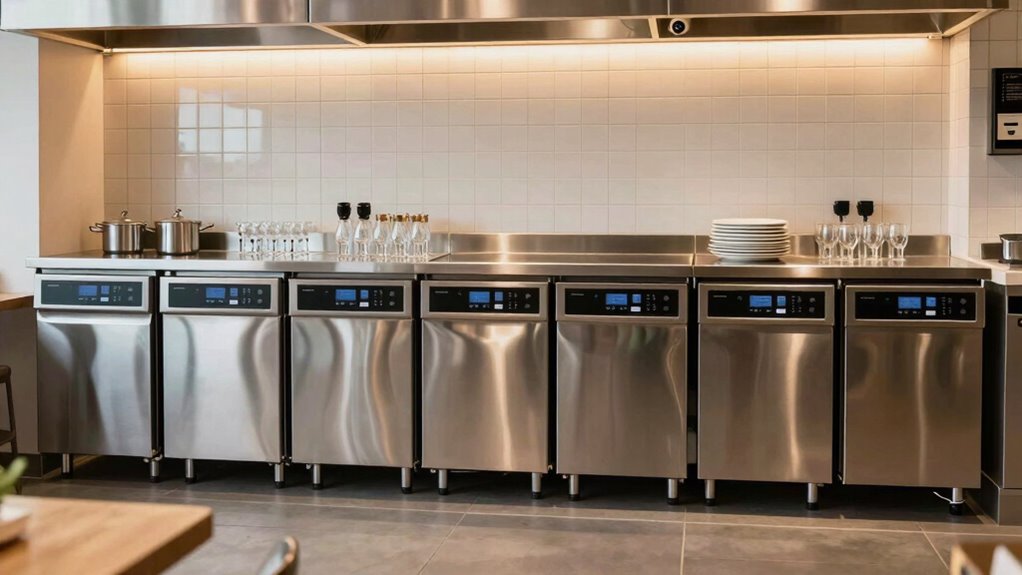

For a small cafe that needs a general-purpose machine with documented capacity, I’d start with the Commercial High-Temperature Door-Type Dishwasher, rated at 60 racks per hour. The HYBOKITCH 40-rack-per-hour undercounter model stands out for a cafe weighing throughput against a smaller footprint, while the Eurodib Lamber DSP3 is a more specialized choice for glassware. The main tradeoff is between rack capacity, counter space, and the type of dishes you wash most often. Installation needs, electrical service, and ventilation can narrow the field just as much as machine size. Read on for how the seven options compare and which cafe setups each one suits.

Get cleaning gear delivered free with Prime
- Fast, free delivery on millions of items
- Prime Video, Amazon Music and more included
- Member-only deals all year
Complete the kit



Key Takeaways
- The 60-rack-per-hour door-type model is the clearest throughput pick, but its larger format makes it a poor fit for cafes without the space and utility connections for a door-type machine.
- The HYBOKITCH 40-rack-per-hour undercounter model offers a stated capacity figure in a compact format; that makes it easier to compare with the door-type pick, though rack rate alone cannot predict a cafe’s actual dish flow.
- The Eurodib Lamber DSP3 and VIKEER are glassware-focused options, so they make more sense for bar-heavy operations than as automatic replacements for an all-purpose dish machine.
- RIOXC, H50-S1, and the other HYBOKITCH undercounter model need closer specification checks because their names alone do not provide enough information to compare output or utility demands.
- Installation compatibility may decide the purchase before capacity does: confirm the machine’s electrical, water, drainage, detergent, and space requirements with the seller and a qualified installer.
| Commercial High-Temperature Door-Type Dishwasher, 60 Racks per Hour |  | Best for Peak-Service Volume | Capacity: Up to 60 racks per hour | Wash cycles: 60, 90, or 120 seconds | Final rinse temperature: Up to 194°F | VIEW ON AMAZON | See Our Full Breakdown |
| Eurodib Lamber DSP3 Undercounter Commercial Glass Washer |  | Best for Glass-Focused Cafes | Installation type: Undercounter | Rack size: 16 × 16 inches | Wash cycle: 2 minutes | VIEW ON AMAZON | See Our Full Breakdown |
| RIOXC High-Temperature Undercounter Commercial Dishwasher |  | Best Overall for Busy Small Cafes | Installation type: Undercounter | Rack throughput: Up to 40 racks per hour | Wash cycles: 85, 115, and 175 seconds | VIEW ON AMAZON | See Our Full Breakdown |
| H50-S1 High-Temperature Undercounter Commercial Dishwasher |  | Best for Straightforward Installation | Certification: NSF | Capacity: Up to 30 racks per hour | Wash cycles: 120, 150, and 180 seconds | VIEW ON AMAZON | See Our Full Breakdown |
| HYBOKITCH High-Temperature Undercounter Commercial Dishwasher, 40 Racks per Hour |  | Best for Built-In Pump Convenience | Installation type: Undercounter | Capacity: Up to 40 racks per hour | Wash cycles: 90, 120, and 180 seconds | VIEW ON AMAZON | See Our Full Breakdown |
| HYBOKITCH High-Temperature Undercounter Commercial Dishwasher |  | Best for Short Wash Cycles | Installation: Freestanding undercounter | Cycle options: 60, 120, and 180 seconds | Stated throughput: 20–45 cycles per hour | VIEW ON AMAZON | See Our Full Breakdown |
| VIKEER Commercial Undercounter Glassware Dishwasher |  | Best for Glassware-Focused Cafes | Installation: Undercounter | Throughput: Up to 30 racks per hour | Wash cycles: Four | VIEW ON AMAZON | See Our Full Breakdown |
| commercial dishwasher for small cafe | Wash cycles | Dimensions | Electrical |
|---|---|---|---|
| Commercial High-Temperature Do | 60, 90, or 120 seconds | — | — |
| Eurodib Lamber DSP3 Undercount | — | 20 × 18 × 31 inches (D × W × H) | 208–240 volts, 15 amps; NEMA 6-20 plug |
| RIOXC High-Temperature Underco | 85, 115, and 175 seconds | 24.8 × 23.62 × 31.1 inches (D × W × H) | 208–240V; single-phase or three-phase |
| H50-S1 High-Temperature Underc | 120, 150, and 180 seconds | 24 × 25 × 32 inches (L × D × H) | 208–240V; single-phase or three-phase |
| HYBOKITCH High-Temperature Und | 90, 120, and 180 seconds | — | 208–240V, single-phase; 6-20P plug |
| HYBOKITCH High-Temperature Und | — | 22.56 × 23.9 × 32.09 inches (D × W × H) | 208–240V, single phase; maximum power 3 kW |
| VIKEER Commercial Undercounter | Four | 25 × 23.6 × 31.5 inches (D × W × H) | — |
More Details on Our Top Picks
Commercial High-Temperature Door-Type Dishwasher, 60 Racks per Hour
For a small cafe with concentrated dish rushes and room for a hood machine, this door-type model offers the highest listed throughput in this group: up to 60 racks per hour. Its 60-, 90-, and 120-second cycles let staff match wash time to the load, while a final rinse up to 194°F supports high-temperature sanitizing. Compared with the undercounter RIOXC H50-ST, it can process more racks per hour, but it takes substantially more installation space and is less suited to fitting beneath a counter. The three-year component warranty is a useful advantage for a cafe relying on equipment through daily service. Its 28.54-inch width, deep body, and 76.16-inch open height call for careful site planning, so I’d skip it if the dish area is tight or lacks hood clearance.
Pros:- Up to 60 racks per hour suits concentrated dish rushes
- Three cycle lengths let staff choose a faster wash or longer cycle
- Final rinse reaches up to 194°F
- Three-year warranty covers all components
Cons:- Large footprint needs more room than the undercounter RIOXC H50-ST
- Requires 76.16 inches of clearance with the hood open
Best for: Small cafes with busy meal periods, a dedicated dish area, and enough overhead clearance for a hood-style machine
Not ideal for: Compact cafes that need an undercounter unit or cannot accommodate the open-hood height and installation footprint
- Capacity:Up to 60 racks per hour
- Wash cycles:60, 90, or 120 seconds
- Final rinse temperature:Up to 194°F
- Dimensions, hood closed:28.54 × 32.28 × 59.06 inches (W × D × H)
- Height, hood open:76.16 inches
- Certifications:ETL Listed and CSA Certified
- Warranty:3 years on all components
Our verdict“Choose this hood-type model when peak throughput matters more than saving floor and overhead space.”
Eurodib Lamber DSP3 Undercounter Commercial Glass Washer
The Eurodib Lamber DSP3 is the lineup’s clearest fit for a cafe whose dish station handles many glasses, saucers, and cutlery but has limited undercounter room. At 20 × 18 × 31 inches, it is narrower than the RIOXC H50-ST, and its included baskets and inserts are tailored to barware rather than general-purpose rack flexibility. The two-minute cycle and 30-rack-per-hour throughput are more modest than the HYBOKITCH’s listed 40 racks per hour, so I’d favor the HYBOKITCH for broader dish volume. Digital controls and temperature thermometers offer useful operating visibility, while the stated 45 dB noise level suits a customer-facing space. The main planning issue is gravity drainage: the drain must sit below the washer. Water-use figures also need clarification, so I wouldn’t choose it on an assumed low-consumption claim.
Pros:- Compact 20-inch depth and 18-inch width fit tighter spaces than the RIOXC H50-ST
- Includes glass baskets, a saucer insert, and cutlery containers
- Digital controls and temperature thermometers aid routine operation
- 45 dB listed noise level is suited to customer-facing cafe layouts
Cons:- 30 racks per hour is below the listed throughput of the RIOXC and HYBOKITCH
- Gravity drainage requires a drain below the unit
- Water-consumption information is inconsistent in the supplied product data
Best for: Coffee bars and small cafes that wash a steady mix of glassware, saucers, and cutlery in a narrow undercounter space
Not ideal for: Cafes with heavy plate volume, no drain below the machine, or a need for a clearly specified low water use per cycle
- Installation type:Undercounter
- Rack size:16 × 16 inches
- Wash cycle:2 minutes
- Throughput:30 racks per hour
- Dimensions:20 × 18 × 31 inches (D × W × H)
- Electrical:208–240 volts, 15 amps; NEMA 6-20 plug
- Drainage:Gravity drain; drain must be below the unit
- Certifications:UL and UL Sanitation
Our verdict“Pick the DSP3 for a compact, glass-focused washing station, not for a cafe needing maximum general dish throughput.”
RIOXC High-Temperature Undercounter Commercial Dishwasher
The RIOXC H50-ST balances fast service, undercounter placement, and a clearly stated high-temperature rinse, making it my strongest all-round fit for a small cafe with regular dish surges. Its up to 40 racks per hour is a step above the H50-S1’s 30, while three cycles from 85 to 175 seconds give staff options for different loads. The 12-inch chamber height sets a real limit: tall pitchers or oversized items may not fit, even if rack throughput looks generous. Compared with the HYBOKITCH, RIOXC specifies CSA and ETL certifications and lists water use at 0.22 gpm, but it is heavier at 158 pounds and still needs 208–240V service. I’d choose it over the door-type 60-rack model when counter placement and a smaller installation footprint matter more than peak capacity.
Pros:- Up to 40 racks per hour in an undercounter format
- Three cycle options span 85 to 175 seconds
- High-temperature rinse and Zoppas booster heating element
- CSA certified and ETL listed, with a three-year parts warranty
Cons:- Requires 208–240V electrical service
- 158-pound weight makes installation and repositioning difficult
- 12-inch chamber height limits the size of items it can accommodate
Best for: Small cafes serving steady breakfast or lunch rushes that need up to 40 racks per hour in an undercounter format
Not ideal for: Cafes without 208–240V service, operators who regularly wash tall cookware, or kitchens that need a lightweight movable unit
- Installation type:Undercounter
- Rack throughput:Up to 40 racks per hour
- Wash cycles:85, 115, and 175 seconds
- Usable chamber height:12 inches
- Electrical:208–240V; single-phase or three-phase
- Dimensions:24.8 × 23.62 × 31.1 inches (D × W × H)
- Water consumption:0.22 gpm
- Certifications and warranty:CSA certified and ETL listed; 3 years on all parts
Our verdict“Choose the RIOXC when your cafe needs fast undercounter washing, high-temperature sanitizing, and a specified three-year parts warranty.”
H50-S1 High-Temperature Undercounter Commercial Dishwasher
The H50-S1 suits a cafe that wants a certified undercounter machine with core installation components included, rather than the fastest cycle times in this group. Its up to 30 racks per hour trails the RIOXC and HYBOKITCH, but may be enough for a smaller service with manageable dish peaks. The supplied chemical dispensers, hoses, cavity drain, and pumped rinse system reduce the number of separate components a buyer must source. It also supports single-phase or three-phase 208–240V power, though it does not remove the need for suitable high-voltage service. Compared with the Eurodib DSP3, it is aimed at general dishwashing rather than a glass-focused setup; compared with the RIOXC, its cycles are longer at 120–180 seconds. A one-year parts and labor warranty is shorter than the RIOXC’s parts coverage.
Pros:- NSF certification for commercial foodservice use
- Includes chemical dispensers, hoses, cavity drain, and pumped rinse system
- Works with single-phase or three-phase 208–240V power
- Three cycles and digital temperature gauges support different wash needs
Cons:- Up to 30 racks per hour is lower than the RIOXC and HYBOKITCH
- Requires 208–240V electrical service
- One-year parts and labor warranty is shorter than the RIOXC’s parts warranty
Best for: Small cafes seeking an NSF-certified undercounter dishwasher with included hoses and chemical-dosing components
Not ideal for: High-volume cafes that need 40 racks per hour or a longer warranty than one year on parts and labor
- Certification:NSF
- Capacity:Up to 30 racks per hour
- Wash cycles:120, 150, and 180 seconds
- Usable chamber height:12 inches
- Rinse volume:0.66 gallons per cycle
- Electrical:208–240V; single-phase or three-phase
- Dimensions:24 × 25 × 32 inches (L × D × H)
- Warranty:1 year parts and 1 year labor
Our verdict“Choose the H50-S1 for a certified, component-ready undercounter setup when 30 racks per hour is sufficient.”
HYBOKITCH High-Temperature Undercounter Commercial Dishwasher, 40 Racks per Hour
HYBOKITCH stands out for cafes that want an undercounter washer with its core pumps already built in: detergent, rinse aid, and drain pumps are included, along with inlet and drain hoses. That package can simplify setup compared with the Eurodib DSP3, which relies on gravity drainage and needs a drain below the machine. At up to 40 racks per hour, it matches the RIOXC’s stated throughput, though the listed wash cycles start at 90 seconds and extend to 180. Its 304 stainless steel body and 0.67 gallons-per-rack figure give buyers useful construction and water-use details. The tradeoffs are a 208–240V requirement and a 149-pound weight that still calls for planned delivery and installation. The supplied data lists single-phase power, so it may not suit a site set up only for three-phase equipment.
Pros:- Up to 40 racks per hour, matching the RIOXC’s listed capacity
- Built-in detergent, rinse aid, and drain pumps simplify equipment setup
- 304 stainless steel body resists rust and corrosion
- Water consumption is specified at 0.67 gallons per rack
Cons:- Requires 208–240V single-phase power
- 149-pound weight makes delivery and placement a planned job
- Product data does not list a certification
Best for: Small cafe operators who want a 40-rack-per-hour undercounter machine with detergent, rinse aid, and drain pumps included
Not ideal for: Cafes without 208–240V single-phase service or buyers seeking a lighter machine or a stated certification
- Installation type:Undercounter
- Capacity:Up to 40 racks per hour
- Wash cycles:90, 120, and 180 seconds
- Rinse temperature:Up to 180°F
- Water consumption:0.67 gallons per rack
- Electrical:208–240V, single-phase; 6-20P plug
- Dimensions and weight:22.6 × 23.9 × 32 inches; 149 pounds
- Material:304 stainless steel
Our verdict“Choose HYBOKITCH when included pumps and a stated per-rack water figure matter more than a lighter unit or documented certification.”
HYBOKITCH High-Temperature Undercounter Commercial Dishwasher
For a small cafe facing quick dish turnover, this HYBOKITCH stands out for its 60-, 120-, and 180-second cycles and stated throughput of up to 45 cycles per hour. That cycle flexibility can help clear racks between rushes, while the 185°F maximum wash temperature suits kitchens seeking a high-temperature wash. Compared with the VIKEER, which offers four cycles and reports up to 30 racks per hour, this model emphasizes faster cycle options rather than a stated rack-per-hour figure.
Its undercounter footprint and included detergent and rinse aid pumps reduce the need to source those components separately. The tradeoffs are substantial for a compact cafe: it needs 208–240V single-phase power, and its listing gives capacity in conflicting ways, so I would confirm the intended measure and installation requirements before purchase. The 19.7-inch racks may also limit what fits compared with VIKEER’s 20-inch baskets.
Pros:- Three cycle options, including a 60-second cycle
- Stated throughput of up to 45 cycles per hour
- Includes detergent and rinse aid pumps, hoses, and two racks
- Compact undercounter format with stated water use of 0.67 gallons per set of tableware
Cons:- Requires a 208–240V single-phase connection
- Capacity information uses differing measures that should be verified
- 19.7 × 19.7-inch racks are smaller than the VIKEER’s included 20 × 20-inch baskets
Best for: Small cafes with frequent rack turnover, suitable 208–240V power, and a need for short selectable wash cycles.
Not ideal for: Cafes without a 208–240V single-phase connection or buyers who need clear, verified capacity figures before planning service volume.
- Installation:Freestanding undercounter
- Cycle options:60, 120, and 180 seconds
- Stated throughput:20–45 cycles per hour
- Water consumption:0.67 gallons per set of tableware; 0.67 gpm listed
- Wash temperature:Up to 185°F (85°C)
- Electrical:208–240V, single phase; maximum power 3 kW
- Dimensions:22.56 × 23.9 × 32.09 inches (D × W × H)
- Rack size and included items:19.7 × 19.7-inch racks; two racks, detergent and rinse aid pumps, and hoses
Our verdict“Choose this HYBOKITCH if fast cycle choices matter more than a clearly stated rack capacity and your cafe already has the required electrical supply.”
VIKEER Commercial Undercounter Glassware Dishwasher
The VIKEER is the more clearly glassware-oriented pick here: its compact undercounter design, four wash cycles, and rotating spray arms give a cafe options for handling different loads without relying on one short-cycle format. It processes up to 30 racks per hour, less than the HYBOKITCH’s stated maximum of 45 cycles per hour, but the figures describe different measures and should not be treated as a direct capacity comparison. VIKEER’s included 20-inch baskets make its rack format explicit.
304 stainless steel components and a digital thermometer add useful material and temperature information for a busy beverage station. The high-temperature rinse reaches 180–194°F, while the listed wash temperature is 131–140°F. Compared with the HYBOKITCH, VIKEER provides four one-touch cycles and a stated rack rate, but does not list included detergent or rinse aid pumps. Its 208–240V requirement and 145-pound weight also call for advance electrical and installation planning.
Pros:- Up to 30 racks per hour with four wash cycles
- Includes two 20 × 20-inch wash baskets
- 304 stainless steel components and rotating spray arms
- Digital thermometer and high-temperature rinse listed
Cons:- Requires a 208–240V electrical connection
- 145-pound weight makes placement and installation less convenient
- Does not list detergent or rinse aid pumps among the included items
Best for: Cafes and small bars that wash glassware throughout service and want several selectable cycles with two standard 20-inch baskets.
Not ideal for: Very small operations without 208–240V power, or buyers who need a lightweight unit or documented detergent and rinse aid pumps included.
- Installation:Undercounter
- Throughput:Up to 30 racks per hour
- Wash cycles:Four
- Temperatures:Wash: 131–140°F; rinse: 180–194°F
- Electrical and energy:208–240V; 2.95 kW
- Dimensions:25 × 23.6 × 31.5 inches (D × W × H)
- Material:304 stainless steel components
- Included baskets:Two 20 × 20-inch wash baskets
Our verdict“Pick the VIKEER for a glassware-heavy cafe that values four cycle choices and defined basket dimensions over the HYBOKITCH’s shorter cycle options.”

How We Picked
I ranked these machines for the realities of a small cafe: limited floor space, mixed loads, rush-period dish flow, and the need to keep washing from interrupting service. I gave more weight to clearly stated intended use and capacity than to broad product labels. That puts the 60-rack-per-hour door-type machine first for cafes that can accommodate its format, while the HYBOKITCH 40-rack-per-hour undercounter model is the more space-conscious option with a stated output figure.
I also separated glassware-focused machines from general-purpose undercounter dishwashers instead of treating them as interchangeable. The Eurodib Lamber DSP3 and VIKEER have a specific role for cafes that wash many glasses, but that specialization can leave mixed dish loads less well served. Where the supplied product information does not state capacity, dimensions, or utility details, I treat that as a comparison limitation—not proof of poor performance—and recommend verifying specifications before ranking either model for a particular installation.
Factors to Consider When Choosing Commercial Dishwasher For Small Cafes
Before choosing by machine name or rack rate, I’d map the wash station to the cafe’s menu, service pattern, and building utilities. These checks help prevent a machine that looks suitable on paper from becoming a poor operational fit.
Match Machine Format to Your Wash Station
Undercounter machines can keep dishes close to the point of use, which helps when staff have little room to carry racks across the kitchen. A door-type machine can suit heavier rack flow, but it needs space for the unit, open-door clearance, and a workable loading and unloading area. Measure the whole work zone rather than the machine footprint alone, including nearby counters, walkways, and access for maintenance. A cramped washer can slow staff even if its cycle capacity looks appealing. Check that racks can move from scraping to washing and then to storage without crossing food-prep traffic. For a small cafe, workflow fit may matter more than choosing the biggest machine that can physically fit.
Treat Rack-Per-Hour Figures as a Starting Point
A published rack-per-hour figure helps compare rated output, but it does not tell you how many cups, plates, or cutlery baskets your team can process during a rush. Cycle length, loading habits, soil level, rack type, and time spent scraping all affect real throughput. Estimate demand by tracking how many racks accumulate during your busiest service window, not by using a daily average. Leave room for staff to unload clean racks and reload promptly; a machine cannot clear a queue if the landing area is blocked. If a product listing omits its capacity, request a specification sheet rather than assuming it matches another undercounter model. This is particularly useful when comparing the two HYBOKITCH options, one of which has a stated 40-rack-per-hour figure.
Check Utilities and Installation Before Ordering
Commercial machines can have specific electrical, water, drainage, and detergent requirements, and those needs vary by model. Ask for the exact connection specifications and have a qualified installer compare them with the cafe’s existing service. A mismatch can add electrical or plumbing work, delay opening, or rule out a machine entirely. Confirm water temperature and pressure requirements, drain placement, and whether the site needs any additional ventilation or accessories. Do not infer utility compatibility from the phrase “high-temperature”; it describes a wash approach, not a guarantee that the machine suits your premises. Include installation access in the check, since doorways and tight turns can prevent a unit from reaching its intended location.
Decide Whether Glassware Deserves Its Own Machine
A glass washer can be a sensible match for a cafe where espresso cups, water glasses, or bar glassware dominate the wash queue. Its specialized design may fit that work better than asking one general-purpose machine to handle every load. The tradeoff is that a glass-focused unit may not cover plates, trays, or varied kitchenware as conveniently. Consider whether you need one versatile washer or a dedicated glass station, and check that the rack format matches the actual glasses you use. Also account for where clean glassware will drain and dry without adding congestion behind the counter. The Eurodib Lamber DSP3 and VIKEER are the lineup’s glassware-oriented choices, not automatic substitutes for a broader dishwashing setup.
Compare Cleaning Method, Staff Routine, and Maintenance
High-temperature models can affect how a cafe handles sanitation procedures, chemical use, and staff training, so review the manufacturer’s operating instructions rather than relying on the label alone. Ask what detergent and rinse products are required and whether staff can check that the machine is operating within its specified conditions. Daily cleaning tasks, filter access, and service support also shape how much work the machine adds between shifts. A unit that is awkward to clean can become a weak link even when its rated capacity fits demand. Check the warranty, parts availability, and local service options before committing. For a small team, straightforward routine care can be more valuable than a feature that rarely affects service.
Choose Capacity With Growth and Flexibility in Mind
Buying only for current volume can leave a cafe short during seasonal peaks or after adding menu items that generate more dishes. At the same time, a machine with more capacity than the site can use may take up valuable floor space and require utilities the cafe does not need. Estimate likely changes over the next few years, such as longer hours, more seating, or a larger beverage program. If volume is uncertain, favor a configuration that fits today’s wash station and has clear, verifiable operating specifications. Avoid treating an unstated feature as included; confirm racks, installation components, and required accessories with the seller. A measured capacity decision is more useful than buying the largest machine available.
Frequently Asked Questions
Is a door-type dishwasher too large for a small cafe?
Not always, but the decision depends on both wash volume and the layout. The 60-rack-per-hour door-type model is the lineup’s clearest high-throughput option, yet its operating space and installation needs may be out of reach for a compact kitchen. Measure loading and unloading clearance as well as the unit’s footprint. If staff would have to block a walkway or cross food-prep traffic to use it, a smaller undercounter machine may work better despite a lower potential output. Confirm the exact dimensions and utility requirements before treating it as a fit.
Should I choose a glass washer or an all-purpose undercounter dishwasher?
Choose around the loads that most often delay service. A glassware-focused machine such as the Eurodib Lamber DSP3 or VIKEER may suit a cafe with a busy bar or beverage counter, while an all-purpose undercounter washer is more flexible for mixed plates, cups, and kitchen items. A specialized glass washer may not handle every dish type as conveniently, so check its rack format and intended use. If glassware and food-service dishes both pile up at peak times, estimate whether one versatile machine can keep pace or whether separate stations are justified. Your answer should come from the wash queue, not the machine label alone.
Can I compare the machines by racks per hour alone?
No. Rack rate is useful, but actual service depends on cycle time, how racks are loaded, the mix of dishes, and whether staff can scrape and unload quickly. The door-type model states 60 racks per hour, and one HYBOKITCH undercounter model states 40; those figures offer a starting comparison, not a guarantee of cafe output. For models without a stated rate, ask the seller for documented capacity and cycle details. Then compare those details with the number and type of racks your cafe produces during its busiest period. Make sure you have enough clean-rack and dirty-rack space to keep that flow moving.
What should I verify before buying a high-temperature model?
Request the exact electrical, water, drainage, and detergent requirements for the specific model. Confirm that the site can meet those specifications and ask a qualified installer to check the connections and placement. Review the manufacturer’s sanitation and operating instructions, including any conditions staff must monitor during use. Also check maintenance access, required cleaning tasks, and local service availability. The term high-temperature does not confirm that a machine will work with your building or satisfy every operational requirement, so verify both fit and procedure before ordering.
What if a product listing does not state capacity or utility requirements?
Ask the seller for a current specification sheet before making a decision. Request dimensions, rack or cycle capacity, electrical details, water and drain requirements, and any included racks or installation components. This information is especially useful when comparing the RIOXC, H50-S1, and HYBOKITCH undercounter model without a stated rack rate against the models with clearer capacity information. If the seller cannot confirm compatibility, treat that uncertainty as a purchasing risk rather than filling in the gaps from another model’s specifications. A qualified installer can check whether the confirmed requirements match your site.
Conclusion
For the best overall choice when throughput leads, I’d start with the Commercial High-Temperature Door-Type Dishwasher at 60 racks per hour, provided the cafe has the space and utilities. The best value in a compact format is the HYBOKITCH undercounter model rated at 40 racks per hour, since it pairs an undercounter layout with a stated capacity figure; compare its full specifications before buying. For a premium-oriented, glassware-specific choice, the Eurodib Lamber DSP3 is the clearest specialist in this group, while the VIKEER is another option to investigate for glassware-heavy service. The best choice for beginners is whichever undercounter model has the clearest confirmed installation and operating information for your site—not simply the easiest-sounding product name. If you need a more general undercounter machine, compare the RIOXC, H50-S1, and second HYBOKITCH option only after obtaining their capacity and utility details. My final advice: pick by wash-station fit and verified specifications first, then use rated output to settle the close calls.
Halloween Picks
halloween
As an affiliate, we earn on qualifying purchases.