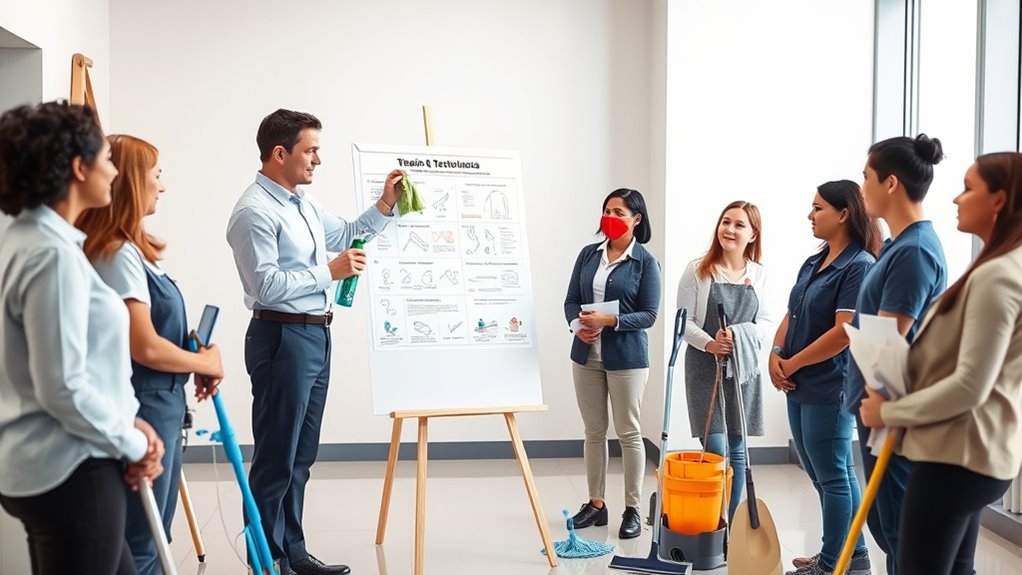

To develop an effective training plan for your new cleaning staff, focus on teaching proper techniques, safety procedures, and hands-on practice. Emphasize the use of cleaning tools, safe chemical handling, and hazard prevention. Use demonstrations, supervised practice, and ongoing reinforcement to build confidence and skills. Prioritize safety to minimize risks. Follow a structured approach, and you’ll guarantee your team maintains high standards. Keep exploring to discover how to implement these steps smoothly.
Key Takeaways
- Provide comprehensive instruction on proper cleaning techniques, tools, and surface handling to ensure consistent, high-quality results.
- Emphasize safety procedures, chemical handling, PPE use, and hazard identification to protect staff and the environment.
- Incorporate supervised hands-on practice with immediate feedback to reinforce skills and build confidence.
- Schedule regular refresher courses, utilize visual aids, and encourage ongoing questions to promote continuous learning.
- Highlight the benefits of thorough training, including improved efficiency, safety, and maintaining high cleanliness standards.
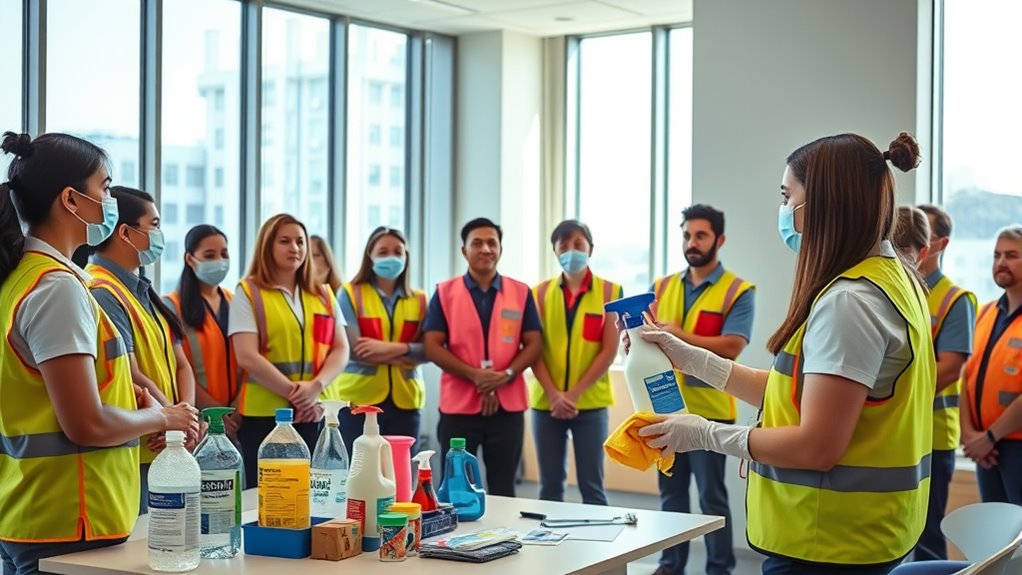
Starting your new cleaning staff on the right foot requires a clear and all-encompassing training plan. You want your team to be confident, efficient, and safe from the moment they begin. To achieve this, focus on teaching essential cleaning techniques that guarantee every surface is spotless and sanitized efficiently. Show your staff how to properly use cleaning tools, such as mops, vacuums, and microfiber cloths, emphasizing the importance of technique to maximize results and minimize waste. Demonstrate how to reach tricky spots, clean different types of surfaces, and handle delicate materials carefully. Reinforce the value of consistency in cleaning methods to maintain high standards across all areas. Incorporate standardized procedures to ensure uniformity and quality in your cleaning practices.
Effective training ensures your cleaning team is confident, efficient, and consistent in delivering spotless, sanitized results.
Equally important are safety procedures. You can’t afford to overlook this aspect, as the health and well-being of your staff and the integrity of the environment depend on it. Make sure your team understands how to handle cleaning chemicals properly, including reading labels, measuring accurately, and storing products safely. Teach them the importance of wearing personal protective equipment like gloves, masks, and eye protection when necessary. Show them how to avoid common hazards, such as slips, trips, and falls, by keeping walkways clear and promptly cleaning up spills. Incorporate procedures for emergency situations, like chemical spills or injuries, so your staff knows whom to contact and how to respond swiftly and correctly.
A thorough training plan also involves hands-on practice and demonstrations. Instead of just explaining, let your staff practice cleaning techniques under supervision. Provide immediate feedback to reinforce good habits and correct errors. This active involvement helps solidify their skills and builds confidence. Incorporate safety drills, like proper lifting techniques or responding to a chemical spill, so safety procedures become second nature. Keep training sessions interactive and engaging to ensure your team retains critical information.
Additionally, emphasize the importance of ongoing learning. Encourage your staff to ask questions, share their experiences, and suggest improvements. Regular refresher courses help keep safety procedures and cleaning techniques fresh in everyone’s mind. Use checklists, visual guides, and written protocols to reinforce key points. By establishing a detailed, practical training plan that covers cleaning techniques and safety procedures, you foster a professional, responsible, and capable cleaning team that can deliver consistent results while prioritizing safety at every step.
Frequently Asked Questions
How Long Is the Overall Training Program?
The overall training program lasts about two weeks, providing a thorough curriculum overview. During this time, you’ll learn essential cleaning techniques, safety protocols, and equipment use. The training duration balances theory and hands-on practice to guarantee you’re confident in your skills. Daily sessions help reinforce learning, and assessments track your progress. By the end, you’ll be well-prepared to perform cleaning tasks efficiently and safely, ready to excel in your role.
Are There Any Certification Requirements?
Yes, there are certification requirements. You need to meet certification standards that include completing skill assessments to make certain you understand proper cleaning techniques and safety protocols. These standards help verify your competence and readiness for the job. You’ll undergo evaluations throughout the training, and passing these skill assessments is essential to obtain your certification. This process guarantees that you’re prepared to perform your duties effectively and safely.
What Equipment Is Provided During Training?
During training, you are provided with essential cleaning tools like mops, brushes, and cloths, so you can practice proper techniques. Safety gear such as gloves, masks, and goggles is also supplied to guarantee your protection while learning. These items help you get comfortable with the equipment and safety procedures, making sure you’re prepared to perform your duties efficiently and safely once training is complete.
How Is Performance Evaluated Throughout Training?
Imagine your progress as a garden blooming; performance metrics are your sunlight, guiding growth. You’re evaluated through regular feedback sessions, like watering your skills and pruning weaknesses. These sessions help you understand where you excel and where to improve. Your supervisor observes your work, providing constructive insights. This continuous cycle guarantees your skills flourish, turning you into a confident, effective cleaner, ready to nurture a spotless environment with every task.
Is Ongoing Support Available After Initial Training?
Yes, ongoing support is available after initial training through mentorship programs and refresher courses. You’ll have access to experienced colleagues who can guide you as you develop your skills further. Additionally, regular refresher courses help reinforce your knowledge and introduce new cleaning techniques. This continuous support guarantees you stay confident, competent, and up-to-date, making your work more effective and satisfying over time.
Conclusion
By following this training plan, you’ll transform fresh recruits into shining stars of your cleaning team. Think of it as planting seeds, nurturing their skills until they flourish into confident professionals. With each lesson, you’ll see them blossom, ready to sweep away dirt and doubts alike. Keep guiding them with patience and purpose, and watch your team grow into a well-oiled machine, sparkling with efficiency and pride—brightening every space they touch.