
For a heat-only system, I’d start with the ecobee Smart Thermostat Essential as my best overall pick because it offers smart scheduling and app control without requiring a thermostat designed for complex heating and cooling setups. The Amazon Smart Thermostat makes sense for Alexa households, while the Sensi Lite is a straightforward choice for buyers who want simpler controls. The biggest tradeoffs are compatibility with your wiring and heating equipment, the need for a C-wire or power adapter, and how much smart-home integration you’ll actually use. A thermostat that supports heat-only wiring may still require a particular system voltage or relay configuration. Read on for the full comparison and a guide to checking fit before you buy.

Get cleaning gear delivered free with Prime
- Fast, free delivery on millions of items
- Prime Video, Amazon Music and more included
- Member-only deals all year
Complete the kit


Key Takeaways
- Heat-only compatibility comes before smart features: Check the thermostat’s supported wiring and system type against your equipment; a Wi-Fi connection alone does not make a model suitable.
- Ecobee Essential is the balanced pick: It combines app-based scheduling with a simpler proposition than the more feature-rich ecobee Enhanced.
- Amazon’s model is a focused Alexa choice: It suits homes already using Alexa, while buyers who want broader controls may prefer a Sensi or ecobee option.
- Sensi Lite and Sensi ST55 serve different priorities: The Lite emphasizes a simpler feature set, while the ST55 is the better fit for buyers seeking more connected thermostat functions.
- Honeywell’s color-screen models prioritize the thermostat itself: The RTH9585WF and RTH9600WF appeal to buyers who value on-device display and control, while compact or minimalist preferences point elsewhere.
| Honeywell Home RTH9585WF Wi-Fi Smart Color Programmable Thermostat |  | Best for Custom Scheduling | Model: RTH9585WF | Connectivity: Wi-Fi | Display: Customizable color touchscreen | VIEW ON AMAZON | See Our Full Breakdown |
| Honeywell Home X2S Smart Wi-Fi Thermostat |  | Best for Matter Smart Homes | Connectivity: Wi-Fi, 2.4 or 5 GHz | Power: 24 VAC; C-wire required | Conventional system support: Up to 2 heat/2 cool | VIEW ON AMAZON | See Our Full Breakdown |
| Amazon Smart Thermostat with Alexa and Ring Compatibility |  | Best for Alexa Households | Smart-home compatibility: Alexa and select Ring devices | Installation: DIY installation guided by the Alexa app | Wiring requirement: C-wire required | VIEW ON AMAZON | See Our Full Breakdown |
| ecobee Smart Thermostat Essential Wi-Fi Thermostat |  | Best for Multi-Platform Basics | Connectivity: Wi-Fi | Display: Color touchscreen | HVAC compatibility: Most 24 VAC systems, including gas, oil, electric, dual fuel, forced air, heat pumps, and boilers | VIEW ON AMAZON | See Our Full Breakdown |
| ecobee Smart Thermostat Enhanced |  | Best Premium Automation | Connectivity: Wi-Fi | HVAC compatibility: Compatible with 90% of HVAC systems; verify the specific system | Smart-home compatibility: Amazon Alexa, Google Assistant, Apple HomeKit, and SmartThings | VIEW ON AMAZON | See Our Full Breakdown |
| Honeywell Home RTH9600WF Smart Color Wi-Fi Thermostat |  | Best for At-a-Glance Home Information | Model: RTH9600WF | Display: Customizable color touchscreen | Connectivity: Wi-Fi | VIEW ON AMAZON | See Our Full Breakdown |
| Sensi Lite Smart Wi-Fi Thermostat, Alexa Compatible, ENERGY STAR Certified, ST25 | 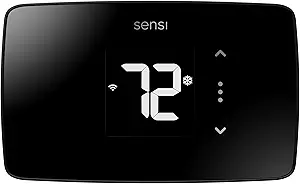 | Best for DIY Installation | Model: ST25 | Connectivity: 2.4 GHz Wi-Fi | Power: Battery or C-wire | VIEW ON AMAZON | See Our Full Breakdown |
| Vine Wi-Fi Smart Thermostat with Alexa and Google Assistant Compatibility |  | Best for Detailed Weekly Scheduling | Connectivity: Wi-Fi | Compatible systems: Many 24V AC systems, including heating-only | Voice assistants: Amazon Alexa and Google Assistant | VIEW ON AMAZON | See Our Full Breakdown |
| Sensi Smart Wi-Fi Thermostat, Alexa Compatible, ENERGY STAR Certified (ST55) |  | Best for a Familiar Thermostat Footprint | Model: ST55 | Connectivity: Wi-Fi | Voice assistant: Amazon Alexa | VIEW ON AMAZON | See Our Full Breakdown |
| Google Nest Thermostat, Wi-Fi Smart Thermostat, Snow |  | Best for Google Home Automation | Color: Snow | Connectivity: Wi-Fi | Certification: ENERGY STAR | VIEW ON AMAZON | See Our Full Breakdown |
| smart thermostats for heatonly system | Connectivity | Display | Certification |
|---|---|---|---|
| Honeywell Home RTH9585WF Wi-Fi | Wi-Fi | Customizable color touchscreen | ENERGY STAR |
| Honeywell Home X2S Smart Wi-Fi | Wi-Fi, 2.4 or 5 GHz | — | — |
| Amazon Smart Thermostat with A | — | — | — |
| ecobee Smart Thermostat Essent | Wi-Fi | Color touchscreen | — |
| ecobee Smart Thermostat Enhanc | Wi-Fi | — | — |
| Honeywell Home RTH9600WF Smart | Wi-Fi | Customizable color touchscreen | ENERGY STAR |
| Sensi Lite Smart Wi-Fi Thermos | 2.4 GHz Wi-Fi | LCD | ENERGY STAR |
| Vine Wi-Fi Smart Thermostat wi | Wi-Fi | LCD | — |
| Sensi Smart Wi-Fi Thermostat | Wi-Fi | — | ENERGY STAR |
| Google Nest Thermostat | Wi-Fi | — | ENERGY STAR |
More Details on Our Top Picks
Honeywell Home RTH9585WF Wi-Fi Smart Color Programmable Thermostat
The RTH9585WF suits heat-only homes where a clear schedule and an easy-to-read control matter more than newer smart-home standards. Its customizable color touchscreen and seven-day programming make it straightforward to set different temperatures through the week, while app and voice control let you adjust from elsewhere. It supports hot-water and steam systems as well as forced air, so it can fit many conventional heating setups. Compared with the Amazon Smart Thermostat, it offers a more prominent on-device display and broader stated system support, while the Amazon model centers control on Alexa. The tradeoff is wiring: this Honeywell requires a C-wire, and it cannot control electric baseboard heat. Check the system voltage and wiring before choosing it.
Pros:- Seven-day scheduling supports different weekday and weekend routines
- Customizable color touchscreen makes local adjustments easy to read
- App, Alexa, and Google Home support provide remote control options
- Energy reports and equipment reminders add useful system oversight
Cons:- Requires a C-wire for power
- Not compatible with 120–240V electric baseboard heating
Best for: Homeowners with a compatible 24V boiler or forced-air heat-only system who want weekly schedules and an at-a-glance touchscreen.
Not ideal for: Households with 120–240V electric baseboard heating or no C-wire who do not want to address the wiring requirement.
- Model:RTH9585WF
- Connectivity:Wi-Fi
- Display:Customizable color touchscreen
- Programming:7-day flexible scheduling
- Smart home compatibility:Amazon Alexa and Google Home
- Supported systems:Forced air, hot water, steam, and heat pumps with electric backup
- Power requirement:C-wire required
- Certification:ENERGY STAR
- Not compatible with:120–240V electric baseboard heat
Our verdict“Choose the RTH9585WF for a compatible heat-only system if you value detailed weekly schedules and a large color control over newer platform features.”
Honeywell Home X2S Smart Wi-Fi Thermostat
For a heat-only home already built around Apple HomeKit, Alexa, or Google Assistant, the Honeywell Home X2S has a useful advantage: Matter certification gives it a route into several major smart-home platforms. Its flexible scheduling and auto-away can reduce unnecessary heating when the household is out, and filter reminders and optional humidity display add practical information. Compared with the RTH9585WF, the X2S is the more connected choice, though the RTH9585WF’s color touchscreen and energy reports may appeal more to buyers who want more feedback at the thermostat. The X2S supports conventional systems up to two heat stages, which is ample for many homes but may exceed what a simple heat-only setup needs. It still requires a C-wire and does not support electric baseboard heat.
Pros:- Matter certification supports integration with several major smart-home platforms
- Auto-away can reduce heating when the home is empty
- Flexible scheduling accommodates changing weekly routines
- Optional humidity display and interchangeable accent pieces add customization
Cons:- Requires a C-wire
- Does not support 120–240V electric baseboard systems
Best for: Owners of compatible 24V heat-only systems who want Matter access across Apple, Google, or Alexa smart-home setups.
Not ideal for: People with electric baseboard heat, no C-wire, or a preference for a larger, highly customizable color display.
- Connectivity:Wi-Fi, 2.4 or 5 GHz
- Power:24 VAC; C-wire required
- Conventional system support:Up to 2 heat/2 cool
- Heat pump support:Up to 2 heat/1 cool with electric backup
- Features:Flexible scheduling, auto-away, filter reminders, optional humidity display
- Smart-home certification:Matter
- Energy certification:ENERGY STAR
- Warranty:2 years
- Not compatible with:120–240V electric baseboard heat
Our verdict“Pick the X2S if broad smart-home integration matters more to you than the RTH9585WF’s richer on-thermostat display.”
Amazon Smart Thermostat with Alexa and Ring Compatibility
The Amazon Smart Thermostat makes the most sense for a heat-only household that already uses Alexa and wants scheduled or presence-based temperature changes without adding another smart-home ecosystem. Its app-guided DIY setup and remote control keep daily adjustments simple, while compatible Alexa devices can support automatic control. Against the Honeywell Home X2S, this model is more tightly centered on Alexa and Ring, while the X2S offers Matter compatibility across a wider range of platforms. That narrower approach can be a plus for an Alexa household, but it limits flexibility if your devices are split between ecosystems. The thermostat requires a C-wire, and some features depend on compatible Alexa devices. Confirm that your specific heat-only wiring is supported before installation.
Pros:- Alexa app provides remote temperature control
- Schedules and automatic adjustments support routine changes
- App-guided DIY installation helps with setup
- Compatible Ring devices can extend presence-based control
Cons:- Requires a C-wire
- Some features rely on compatible Alexa devices
- Smart-home support is narrower than the Matter-certified Honeywell Home X2S
Best for: Alexa users with a compatible 24V heat-only system who want app-guided setup and scheduled or presence-based control.
Not ideal for: Households that rely on Apple HomeKit or Google Assistant, or that lack a C-wire or compatible Alexa devices for certain features.
- Smart-home compatibility:Alexa and select Ring devices
- Installation:DIY installation guided by the Alexa app
- Wiring requirement:C-wire required
- Control options:Schedules, automatic control, and Alexa app
- Thermostat technology:Honeywell Home Thermostat Technology
- Energy certification:ENERGY STAR
Our verdict“Choose this model for a compatible heat-only setup if Alexa is already your main smart-home platform.”
ecobee Smart Thermostat Essential Wi-Fi Thermostat
The ecobee Smart Thermostat Essential is a flexible pick for heat-only homes with compatible 24V boilers or other listed HVAC systems, especially when the household mixes Apple, Google, and Alexa devices. Its touchscreen and app handle everyday adjustments, while the schedule assistant and humidity detection can help tune comfort around household routines. Compared with the Amazon Smart Thermostat, it supports more smart-home platforms and gives you local touchscreen control; the Amazon option is a more natural fit when Alexa is the priority. Ecobee’s broad system list does not guarantee compatibility with every heat-only installation, so check the wiring and system type first. Homes without a C-wire may need the separately sold Power Extender Kit, adding an extra purchase and installation step.
Pros:- Works with Apple HomeKit, Google Assistant, and Alexa
- Color touchscreen and app offer two convenient control methods
- Schedule assistant and humidity detection support comfort adjustments
- Compatible with many listed 24 VAC systems, including boilers
Cons:- Homes without a C-wire need a separately sold Power Extender Kit
- Compatibility depends on the specific HVAC system and wiring
- SmartSensor and trim kit are sold separately
Best for: Households with a compatible 24V heat-only system that want touchscreen control and flexibility across Apple, Google, and Alexa.
Not ideal for: Buyers seeking a complete no-C-wire package or room-by-room sensing included in the box.
- Connectivity:Wi-Fi
- Display:Color touchscreen
- HVAC compatibility:Most 24 VAC systems, including gas, oil, electric, dual fuel, forced air, heat pumps, and boilers
- Smart-home compatibility:Apple HomeKit, Google Assistant, and Amazon Alexa
- Energy certification:ENERGY STAR
- Power for homes without C-wire:Power Extender Kit required; sold separately
- Additional features:Indoor humidity detection, schedule assistant, and time-of-use energy features
- Energy savings claim:Up to 23% annually on heating and cooling costs
Our verdict“Pick the Essential if you want broad platform support and straightforward scheduling for a compatible 24V heat-only system.”
ecobee Smart Thermostat Enhanced
Among these five picks, the ecobee Smart Thermostat Enhanced offers the richest automatic adjustments for households that want heating to follow occupancy, sleep schedules, temperature preferences, and humidity. That can reduce routine manual changes, particularly in a busy home. It also supports Alexa, Google Assistant, Apple HomeKit, and SmartThings, making it broader in platform coverage than the Amazon Smart Thermostat. The included Power Extender Kit helps homes without a C-wire, and the trim kit gives more flexibility around the wall plate. The tradeoff is that its occupancy-led features may be more than a simple heat-only household needs, and room-by-room comfort requires separately sold SmartSensors. Confirm compatibility with your particular system before choosing it, even though ecobee states broad HVAC coverage.
Pros:- Adjusts settings around occupancy, sleep schedules, temperature preferences, and humidity
- Supports Alexa, Google Assistant, Apple HomeKit, and SmartThings
- Includes a Power Extender Kit for homes without a C-wire
- Remote control works through the ecobee app on phones, tablets, and Apple Watch
Cons:- SmartSensors for room-by-room comfort are sold separately
- Specific HVAC compatibility should be confirmed before purchase
Best for: Busy households with a compatible heat-only system that want occupancy and sleep-based automation plus broad smart-home integration.
Not ideal for: Buyers who want only basic scheduling or expect room-by-room sensing to be included.
- Connectivity:Wi-Fi
- HVAC compatibility:Compatible with 90% of HVAC systems; verify the specific system
- Smart-home compatibility:Amazon Alexa, Google Assistant, Apple HomeKit, and SmartThings
- Remote control:ecobee app for smartphone, tablet, and Apple Watch
- Included accessories:Power Extender Kit and trim kit
- Warranty:3 years
- Energy savings claim:Up to 26% per year on heating and cooling costs
- Additional sensors:ecobee SmartSensors sold separately
Our verdict“Choose the Enhanced if you want automatic comfort adjustments and have a compatible heat-only system to benefit from them.”
Honeywell Home RTH9600WF Smart Color Wi-Fi Thermostat
The RTH9600WF’s color touchscreen gives this Honeywell a more informative wall display than the simpler LCD on the Sensi Lite ST25. Temperature, humidity, and weather details are useful if you want to check conditions without opening an app, while flexible scheduling and remote control cover everyday adjustments. It supports hot water and steam systems, which suits many heat-only homes, but compatibility depends on the wiring and system type. The key tradeoff is power: a C-wire is required, and this model is not for 120–240V electric baseboard heat. Buyers with a heating-only oil furnace should confirm the specific wiring requirements before choosing it. Its richer display earns it a distinct role, though Sensi models may be easier fits where avoiding a C-wire matters.
Pros:- Color touchscreen shows temperature, humidity, and weather information
- Supports hot water and steam systems
- Remote app control and compatible voice assistants
- Flexible scheduling and ENERGY STAR certification
Cons:- Requires a C-wire or compatible power adapter
- Does not support 120–240V electric baseboard heat
- Heating-only oil furnace compatibility depends on having a C-wire
Best for: Homeowners with compatible 24V hot water, steam, or forced-air heat who want weather and humidity information on the thermostat itself.
Not ideal for: People with electric baseboard heat, no available C-wire, or an oil furnace setup whose wiring has not been confirmed compatible.
- Model:RTH9600WF
- Display:Customizable color touchscreen
- Connectivity:Wi-Fi
- Compatible systems:Forced-air gas, oil, or electric; hot water and steam; heat pumps with electric backup
- Power requirement:C-wire required
- Voice assistants:Amazon Alexa, Google Assistant, Microsoft Cortana
- Certification:ENERGY STAR
Our verdict“Choose the RTH9600WF if your heat-only system is compatible and you want a detailed color display with weather and humidity at a glance.”
Sensi Lite Smart Wi-Fi Thermostat, Alexa Compatible, ENERGY STAR Certified, ST25
For a heat-only setup that is compatible with its wiring, the Sensi Lite ST25 makes a practical pick for homeowners who want app control without a complicated installation process. Its built-in level and step-by-step instructions are more explicitly DIY-focused than the feature-rich touchscreen approach of the Honeywell Home RTH9600WF. Scheduling, geofencing, and usage reports add ways to manage heating when routines change. The power requirements need a close check: the thermostat can run on batteries or a C-wire, but heat pumps and heat/cool-only systems require a C-wire. Wi-Fi is limited to 2.4 GHz, which may rule it out for some network setups. Compared with the Vine thermostat, Sensi brings stated privacy practices and a more guided installation, while offering fewer listed schedule periods and reminders.
Pros:- Built-in level and step-by-step installation instructions
- App control, scheduling, and geofencing
- Works with Alexa and Google Assistant
- Battery or C-wire power options for compatible setups
Cons:- Heat pumps and heat/cool-only systems require a C-wire
- Wi-Fi supports 2.4 GHz only
Best for: DIY-minded homeowners with a compatible boiler or furnace who want guided setup, app scheduling, and geofencing.
Not ideal for: Buyers with a heat pump or heat/cool system but no C-wire, or households that rely on a Wi-Fi network without 2.4 GHz.
- Model:ST25
- Connectivity:2.4 GHz Wi-Fi
- Power:Battery or C-wire
- Voltage:24 volts
- Display:LCD
- Control methods:App, touch, and voice
- Voice assistants:Amazon Alexa and Google Assistant
- Compatible systems:Air conditioner, boiler, furnace, and heat pump
- Certification:ENERGY STAR
Our verdict“Pick the Sensi Lite if your heat-only wiring is compatible and you value a guided DIY setup with app-based routines.”
Vine Wi-Fi Smart Thermostat with Alexa and Google Assistant Compatibility
The Vine thermostat stands out for homeowners who want to shape a heat-only routine around eight schedule periods per day. That level of control can suit households with several temperature changes across workdays and weekends, while auto-away, geofencing, and vacation mode offer ways to reduce heating when the home is empty. It supports many 24V heating-only systems and works with Alexa and Google Assistant. Compared with the Sensi Lite ST25, Vine lists more schedule periods and extras such as filter reminders and child lock, but it has a firmer wiring requirement: a C-wire is required. Compatibility should be checked before buying, especially for less typical heating setups. This makes Vine a fit for schedule-focused buyers with confirmed wiring, rather than someone prioritizing the easiest power setup.
Pros:- Supports 7-day schedules with eight periods per day
- Auto-away, geofencing, and vacation mode
- Remote control through Vine Thermostat or Smart Life apps
- Alexa and Google Assistant compatibility
Cons:- Requires a C-wire
- System compatibility should be confirmed before purchase
Best for: Households with compatible 24V heat-only systems that need several daily temperature changes and vacation or away controls.
Not ideal for: Owners without a C-wire or anyone uncertain whether their heating system is among the supported 24V configurations.
- Connectivity:Wi-Fi
- Compatible systems:Many 24V AC systems, including heating-only
- Voice assistants:Amazon Alexa and Google Assistant
- Schedule:7 days, 8 periods per day
- Power:Corded electric
- Required wiring:C-wire
- Display:LCD
- Additional features:Auto-away, geofencing, vacation mode, temperature alerts, filter reminders, and child lock
Our verdict“Choose Vine if detailed daily scheduling matters and you have verified both 24V system compatibility and C-wire availability.”
Sensi Smart Wi-Fi Thermostat, Alexa Compatible, ENERGY STAR Certified (ST55)
The Sensi ST55 is a sensible option for homeowners who want smart control while keeping the look and footprint of a traditional thermostat. Its built-in level and app instructions support DIY installation, and a common wire is not needed in most applications—a useful advantage over the C-wire-dependent Vine Wi-Fi Smart Thermostat. Remote access, schedules, energy reports, equipment alerts, and maintenance reminders cover the main day-to-day needs without relying on a large information display like the Honeywell Home RTH9600WF. The tradeoff is that its common-wire needs vary with the HVAC setup, so heat-only buyers should check their exact equipment and wiring before installation. The supplied details specify Alexa support, but do not list the broader assistant compatibility offered by some alternatives.
Pros:- Fits the space of a traditional thermostat
- Built-in level and app-guided DIY installation
- Remote access and flexible scheduling
- Energy reports, equipment alerts, and maintenance reminders
Cons:- Common-wire requirements vary by HVAC setup
- The listed voice assistant compatibility is limited to Alexa
Best for: Homeowners replacing a conventional wall thermostat who want DIY guidance, remote schedules, and reports on a compatible heat-only system.
Not ideal for: Buyers who need confirmed compatibility across a specific heat-only wiring configuration or want voice assistants beyond Alexa.
- Model:ST55
- Connectivity:Wi-Fi
- Voice assistant:Amazon Alexa
- Certification:ENERGY STAR
- Installation:DIY, with built-in level and app instructions
- Common wire:Not required in most applications; requirements vary by setup
- Features:Scheduling, remote access, usage reports, equipment alerts, and maintenance reminders
- Privacy:Does not sell personal information to third parties
Our verdict“The ST55 suits heat-only homeowners seeking a familiar wall-thermostat fit and useful smart features, provided their wiring checks out.”
Google Nest Thermostat, Wi-Fi Smart Thermostat, Snow
For heat-only households already using Google Home, the Nest Thermostat links remote scheduling with automatic adjustments when the home is empty. Its HVAC monitoring and energy-saving suggestions add guidance beyond the core app control offered by the Sensi ST55, while support for Google Assistant, Alexa, and Matter-certified voice assistants gives it broad smart-home reach. Nest works without a C-wire in most homes, which can make it more flexible than the Vine thermostat, though some systems still need a C-wire or compatible power accessory. The product information does not spell out its supported heat-only equipment types, so buyers should verify system compatibility before purchase rather than infer it from the broad smart-home feature set. It makes most sense where Google Home is already part of the household routine.
Pros:- Can adjust settings automatically when occupants leave
- Google Home app supports remote control and schedules
- HVAC monitoring and maintenance alerts
- Works with Google Assistant, Alexa, and Matter-certified voice assistants
Cons:- Some systems require a C-wire or compatible power accessory
- Voice control requires a compatible smart device
- Specific supported heat-only equipment types are not detailed in the supplied product information
Best for: Google Home households with a compatible heat-only system that want automatic away adjustments, remote schedules, and HVAC alerts.
Not ideal for: Buyers who need clearly listed heat-only system compatibility or whose wiring requires a C-wire they cannot provide.
- Color:Snow
- Connectivity:Wi-Fi
- Certification:ENERGY STAR
- C-wire requirement:Not required in most homes; required for some systems
- Smart home compatibility:Google Assistant, Alexa, and Matter-certified voice assistants
- Control:Google Home app, schedules, and automatic adjustments when you leave
- Additional features:HVAC monitoring, maintenance alerts, and energy-saving suggestions
Our verdict“Choose Nest if you use Google Home and want automatic away adjustments, after confirming the thermostat supports your heat-only system.”

How We Picked
I ranked these thermostats around the needs that matter most in a heat-only home: documented support for the home’s heating configuration, practical wiring requirements, clear scheduling and app controls, and how much extra smart-home complexity each model adds. A thermostat can look capable on paper but still be a poor fit if the system needs a different voltage, a specific terminal setup, or a C-wire solution the buyer does not have.
The order reflects the balance between useful control and setup burden, then the value of each model’s distinctive strengths. I placed versatile options with approachable controls ahead of products whose appeal depends on a specific ecosystem or a larger feature set. Display quality, voice-assistant support, and simplicity helped separate close contenders, but compatibility and ease of ownership carried more weight than a long feature list.
| smart thermostats for heatonly system | Display |
|---|---|
| Honeywell Home RTH9585WF Wi-Fi | Customizable color touchscreen |
| Honeywell Home X2S Smart Wi-Fi | — |
| Amazon Smart Thermostat with A | — |
| ecobee Smart Thermostat Essent | Color touchscreen |
| ecobee Smart Thermostat Enhanc | — |
| Honeywell Home RTH9600WF Smart | Customizable color touchscreen |
| Sensi Lite Smart Wi-Fi Thermos | LCD |
| Vine Wi-Fi Smart Thermostat wi | LCD |
| Sensi Smart Wi-Fi Thermostat | — |
| Google Nest Thermostat | — |
Factors to Consider When Choosing Smart Thermostats For Heatonly Systems
Choosing a smart thermostat for heat-only equipment starts with the system behind the wall, not the app. I’d verify the equipment, wiring, and power needs first, then decide which connected features will make day-to-day temperature control easier.
Identify the heating equipment and control voltage
“Heat-only” describes what the thermostat controls, but it does not identify how the heating equipment is powered or switched. A conventional low-voltage furnace or boiler often uses different controls from line-voltage electric baseboard heat, and thermostat compatibility can vary sharply between them. Check the equipment manual or ask a qualified heating technician to identify the control type before ordering. A wire count by itself is not enough to confirm fit because terminals and system designs differ. Do not connect a thermostat based only on wire color. This first check can rule out an otherwise appealing model before installation becomes a problem.
Check wiring and power before choosing features
Smart thermostats need steady power for their Wi-Fi radios and displays, so some installations require a C-wire or an approved adapter. A thermostat that works with your heating terminals may still need a power solution your existing wiring does not provide. Photograph the current wiring and note each terminal label before removing the old control. Then compare those labels with the manufacturer’s compatibility guide, rather than assuming that a similar-looking wire connection is equivalent. If your setup has only two wires, check the exact model’s instructions and whether an adapter is supported. A small amount of pre-purchase checking can prevent resets, unreliable connections, or a second installation visit.
Decide how much scheduling control you need
Smart scheduling is most useful when your routine changes enough that manual temperature adjustments become a chore. If you keep consistent hours, a basic weekly schedule may do the job without learning features, occupancy detection, or multiple app automations. Buyers with irregular schedules may value remote changes more than automatic routines because they can adjust heat when plans shift. Think about how often you want the thermostat to make decisions without your input. More automation can save effort, but it also means more setup and more settings to review. Pick the control style you will actually maintain.
Match the thermostat to your smart-home setup
Voice control is convenient when it works within the platform you already use, but adding a new ecosystem just for a thermostat can complicate daily use. Check which assistants and connected devices a model supports, and whether its key functions remain available from the thermostat and its own app. A household centered on Alexa may find the Amazon model an uncomplicated fit, while another home may prefer a thermostat with different assistant support. Shared access matters too: consider whether other household members need their own app accounts or straightforward manual controls. Platform compatibility can change over time, so check current manufacturer documentation for the features you need. Treat voice support as a useful extra, not a substitute for verifying heating compatibility.
Choose a display and controls that suit the household
A large, readable screen can matter more than advanced app features when someone regularly adjusts the thermostat in person. Color displays make schedules and settings easier to scan, while simpler interfaces may be faster for a household that mainly changes the set temperature. Consider where the thermostat will be mounted and whether the display is easy to read from that spot. Also think about who will use it: a highly connected interface can be less convenient for someone who expects a simple dial or a few clear buttons. Remote access is helpful, but it should not make everyday manual control awkward. Prioritize the interface that fits the people in the home.
Weigh installation help against feature value
Installation difficulty depends on the existing wiring and heating controls, so a model described as easy to install is not automatically easy in every home. If the wiring is unclear, the system uses an unusual relay, or the thermostat controls high-voltage equipment, plan for professional advice before starting. Paying for a more capable model makes sense when its scheduling, display, or smart-home tools solve a real need for your household. If you only want app access and a weekly schedule, a simpler thermostat may be easier to set up and live with. Check whether required adapters or accessories are included or sold separately. Compare the complete setup, not just the thermostat’s feature list.
Frequently Asked Questions
How can I tell whether a smart thermostat will work with my heat-only system?
Start by identifying whether the system uses low-voltage controls or line-voltage power, then compare the thermostat’s supported system types with the equipment manual. Look at the terminal labels on the existing thermostat and check them against the exact model’s compatibility guide. A heat-only label does not guarantee compatibility with every boiler, furnace, or electric heater. If the wiring or equipment type is unclear, ask a heating professional to identify it before connecting a new thermostat. That check is especially useful when the system uses only two wires or a relay.
Do I need a C-wire for a smart thermostat on a heat-only setup?
Some smart thermostats need a C-wire for continuous power, while others may support an approved adapter or another power method. Heat-only systems can have fewer wires at the thermostat, so confirm the exact requirements for both the model and your equipment. Do not treat an unused wire as a C-wire unless it is correctly connected at both ends. If the thermostat repeatedly loses power or Wi-Fi, an unsuitable power setup may be the cause. Check the manufacturer’s wiring instructions or get help from a qualified installer.
Can a heat-only thermostat control electric baseboard heaters?
Only if the thermostat is specifically rated for the voltage and load used by the baseboard system. Many popular smart thermostats are designed for low-voltage heating controls and should not be connected directly to line-voltage heaters. Verify the heater’s voltage and the thermostat’s specifications before purchase. If the system is line-voltage, look for a model intended for that use rather than relying on a general heat-only compatibility claim. An electrician can confirm the setup when the wiring is uncertain.
Is it worth choosing a thermostat with learning or occupancy features for a heat-only home?
Those features are most useful when the household schedule varies and you want temperature changes to happen with less manual input. For a predictable routine, a programmable schedule or remote app control may cover the same practical need with less setup. Consider whether occupancy sensing could cause unwanted temperature changes in rooms where people spend time irregularly. Also check what data, app permissions, and connected services the feature requires. I’d choose automation only when its behavior matches how the home is used.
Should I choose a thermostat based on Alexa or Google Assistant support?
Assistant support is a good tie-breaker if your household already uses that platform and wants voice changes to fit existing routines. It should come after confirming the thermostat works with the heating equipment and wiring. Check whether the voice assistant supports the specific commands you expect, since basic temperature changes may be available while other settings are not. If people in the home prefer the wall control or the manufacturer’s app, assistant integration may add little. Choose the ecosystem that reduces friction for the household, not the one with the longest feature list.
Conclusion
For most buyers with compatible low-voltage heat-only equipment, I’d begin with the ecobee Smart Thermostat Essential for the best balance of connected control and everyday usability. The Sensi Lite is my value-minded choice for buyers who want a simpler thermostat, while the ecobee Enhanced is the premium pick for households that will use its broader feature set. Beginners who want a familiar, guided setup may prefer the Amazon Smart Thermostat if Alexa is already part of their home. Choose the Honeywell RTH9585WF or RTH9600WF when an on-device color display matters most, and look at Sensi ST55 for a more connected Sensi option. Before choosing any of them, confirm the voltage, wiring, and power requirements against your exact heating system.
Fall Picks
fall essentials
As an affiliate, we earn on qualifying purchases.