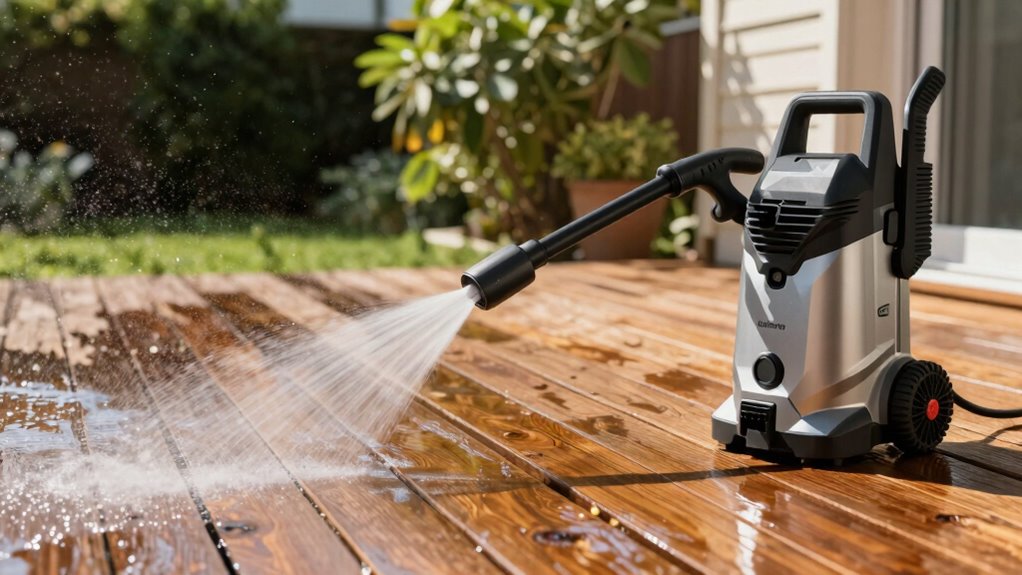
If you’re looking for a pressure washer for deck cleaning, I rate the Westinghouse ePX3050 as the best overall balance of flow, useful attachments, and versatility. The Greenworks 2100 PSI is a straightforward value pick, while the Kärcher K1700 is a more approachable choice for smaller jobs and newer users. The main tradeoff is cleaning pace versus control: higher output can speed up stubborn grime removal, but an overly forceful stream can damage wood or finish. I also weigh portability and nozzle options, since deck size and access to power and water change what works best. Read on for the full breakdown and practical guidance on choosing a model that suits your deck.

Get cleaning gear delivered free with Prime
- Fast, free delivery on millions of items
- Prime Video, Amazon Music and more included
- Member-only deals all year
Complete the kit


Key Takeaways
- The Westinghouse ePX3050 earns the overall lead by pairing a 2100 max PSI rating and 1.76 max GPM with a foam cannon; its turbo nozzle is not the right choice for wood decking.
- Greenworks’ 2100 PSI, 1.2 GPM setup is a simpler value-oriented pick, while the Westinghouse ePX3050 offers higher stated flow and more included cleaning tools.
- The Westinghouse ePX3500 has the highest stated pressure among the electric picks here, but more output calls for extra care with nozzle choice and distance on deck boards.
- The Kärcher K1700 and compact K 1 prioritize manageable scale over speed; they suit smaller areas better than a large, grime-heavy deck.
- The KEEPEAK cordless washer and the light-green portable washer favor access and portability, but their format is a compromise for cleaning a full deck efficiently.
| Greenworks 2100 PSI (1.2 GPM) Electric Pressure Washer |  | Best Overall | Pressure: 2100 PSI | Flow rate: 1.2 GPM | Power cord: 35 ft with GFCI plug | VIEW ON AMAZON | See Our Full Breakdown |
| Sun Joe SPX3000 Electric Pressure Washer, 2500 Max PSI |  | Best for Nozzle Variety | Maximum pressure: 2500 PSI | Working pressure: 2030 PSI | Water flow: 1.2 GPM | VIEW ON AMAZON | See Our Full Breakdown |
| Westinghouse ePX3050 Electric Pressure Washer, 2100 Max PSI 1.76 Max GPM with Foam Cannon and Turbo Nozzle |  | Best for Easy Maneuvering | Maximum pressure: 2100 PSI | Maximum flow: 1.76 GPM | Power cord: 35 ft GFCI | VIEW ON AMAZON | See Our Full Breakdown |
| Kärcher K 1 Compact Pressure Washer |  | Best Compact Pick | Maximum pressure: 1700 PSI | Maximum flow rate: 1.45 GPM | Weight: 9.8 lbs | VIEW ON AMAZON | See Our Full Breakdown |
| Westinghouse ePX3500 Electric Pressure Washer, 2500 PSI, 1.76 GPM |  | Best for Stability and Reach | Maximum pressure: 2500 PSI | Maximum flow rate: 1.76 GPM | Hose length: 25 ft nylon braided | VIEW ON AMAZON | See Our Full Breakdown |
| Westinghouse ePX3100v Electric Pressure Washer |  | Best Compact Corded Pick | Maximum pressure: 2,100 PSI | Maximum flow: 1.76 GPM | Weight: 17.6 lb | VIEW ON AMAZON | See Our Full Breakdown |
| Portable Pressure Washer with 4 Quick-Connect Nozzles – Light Green |  | Best for Broad Rinsing | Water flow: 2.5 GPM | Power source: Electric | Nozzles: 4 metal quick-connect tips: 0°, 15°, 25°, and 40° | VIEW ON AMAZON | See Our Full Breakdown |
| KEEPEAK Cordless Portable Handheld Pressure Washer |  | Best for Cordless Spot Cleaning | Maximum pressure: 1,450 PSI | Water flow: 3.0 GPM | Motor: Brushless | VIEW ON AMAZON | See Our Full Breakdown |
| Kärcher K1700 Pressure Washer |  | Best for Straightforward Deck Care | Pressure: 1,700 PSI | Flow rate: 1.2 GPM | Certification: CETA certified | VIEW ON AMAZON | See Our Full Breakdown |
| pressure washer for deck cleaning | Maximum pressure | Hose length |
|---|---|---|
| Greenworks 2100 PSI | — | 20 ft |
| Sun Joe SPX3000 Electric Press | 2500 PSI | — |
| Westinghouse ePX3050 Electric | 2100 PSI | 20 ft |
| Kärcher K 1 Compact Pressure W | 1700 PSI | 10 ft |
| Westinghouse ePX3500 Electric | 2500 PSI | 25 ft nylon braided |
| Westinghouse ePX3100v Electric | 2,100 PSI | — |
| Portable Pressure Washer with | — | — |
| KEEPEAK Cordless Portable Hand | 1,450 PSI | 16.4 ft |
| Kärcher K1700 Pressure Washer | — | — |
More Details on Our Top Picks
Greenworks 2100 PSI (1.2 GPM) Electric Pressure Washer
The Greenworks is my most balanced pick for routine deck cleaning: its 2100 PSI and 1.2 GPM suit seasonal grime without leaning on the higher peak pressure of the Westinghouse ePX3500. The 25° tip offers a practical starting point for boards, while the 40° tip gives a gentler option; I’d still test a hidden spot and keep the wand moving, especially on softer wood. A 35-foot GFCI cord gives more reach between outlets than the Kärcher K 1’s compact setup, and the push-button start keeps operation simple. The tradeoff is a 20-foot hose and a corded design, which can mean more repositioning around a broad deck. It’s versatile rather than specialized, with no surface cleaner included.
Pros:- 25° and 40° tips provide useful choices for deck boards and lighter rinsing.
- 35-foot GFCI power cord offers flexibility around an outdoor work area.
- Push-button electric start avoids gas, oil, and spark-plug upkeep.
- Three-year limited warranty and included soap applicator add practical everyday value.
Cons:- Corded operation can restrict movement around large decks.
- The 20-foot hose may require frequent repositioning.
- No dedicated surface cleaner is included for faster coverage of broad, flat areas.
Best for: Homeowners with a medium-sized wood or composite deck who want several spray choices and straightforward electric operation.
Not ideal for: People cleaning a large deck far from an outlet or wanting a surface-cleaner attachment included; the cord and 20-foot hose limit reach.
- Pressure:2100 PSI
- Flow rate:1.2 GPM
- Power cord:35 ft with GFCI plug
- Hose length:20 ft
- Included nozzles:25°, 40°, turbo, and soap applicator
- Start:Push-button
- Warranty:3-year limited
Our verdict“I’d choose the Greenworks for a medium deck when I want capable everyday cleaning, useful nozzle options, and low-maintenance electric operation.”
Sun Joe SPX3000 Electric Pressure Washer, 2500 Max PSI
The Sun Joe makes the most sense when I want to adjust the spray carefully across different deck surfaces. Its five quick-connect tips include 25° and 40° options for broader, gentler passes, plus a 0° tip that calls for extra caution on wood. That range gives it more nozzle flexibility than the Greenworks, which has fewer spray choices, though both deliver 1.2 GPM for steady household cleaning rather than fast, high-volume rinsing. Two onboard detergent tanks let me keep separate cleaning solutions ready, a useful touch for moving between a deck and nearby outdoor furniture. The 20-foot hose is still a reach constraint, and the product data gives no warranty details. I’d skip the narrowest tip on deck boards unless the surface and technique call for it.
Pros:- Five spray tips give more pattern choices than the Greenworks’ included selection.
- Two onboard 0.9-liter detergent tanks allow separate cleaning solutions to stay ready.
- 34-inch stainless steel lance with brass fittings provides a sturdy wand setup.
- 1.2 GPM flow is suited to regular household cleaning tasks.
Cons:- The 0° tip can concentrate force too sharply for many deck boards.
- The 20-foot hose may limit movement around a larger deck.
- Warranty information is not supplied in the product data.
Best for: Homeowners who clean a deck along with vehicles or outdoor furniture and want a wider selection of spray patterns and detergent options.
Not ideal for: Anyone who prefers a simple, deck-focused setup or needs long hose reach; the five-tip set takes some nozzle judgment and the hose is 20 feet.
- Maximum pressure:2500 PSI
- Working pressure:2030 PSI
- Water flow:1.2 GPM
- Spray tips:0°, 15°, 25°, 40°, and soap
- Spray lance:34-inch stainless steel with brass fittings
- High-pressure hose:20 ft
- Detergent tanks:Two onboard 0.9 L tanks
Our verdict“I’d pick the Sun Joe if nozzle choice and dual detergent tanks matter more to me than a longer hose or a simpler deck-only setup.”
Westinghouse ePX3050 Electric Pressure Washer, 2100 Max PSI 1.76 Max GPM with Foam Cannon and Turbo Nozzle
For a deck with awkward corners or nearby steps, the ePX3050’s 35-foot GFCI cord and compact wheeled body make it easier to move around than the Kärcher K 1, whose hose is only 10 feet. It has 1800 rated PSI and 1.2 rated GPM, with higher maximum figures listed for different conditions; those rated numbers are the more grounded guide for routine work. The included 25° nozzle is a sensible starting choice for many deck-cleaning passes, while the turbo nozzle is better reserved for surfaces that can handle a concentrated spray. A foam cannon adds flexibility, though it is less directly useful for rinsing deck boards than the soap applicator on the Greenworks. Its 20-foot hose remains a limitation, and the listing gives no warranty details.
Pros:- 35-foot GFCI cord gives more outlet reach than the Kärcher K 1’s short-hose compact setup.
- Compact wheeled design helps with moving around tight deck layouts.
- 25° nozzle provides a more deck-appropriate starting pattern than the turbo tip.
- Foam cannon is included for detergent application on compatible cleaning tasks.
Cons:- 20-foot hose can require repositioning on a large deck.
- Turbo nozzle concentrates spray and needs care on wood surfaces.
- Warranty details are not provided in the product data.
Best for: People with a modest deck, steps, or tight outdoor spaces who value a compact wheeled washer and long power-cord reach.
Not ideal for: Owners of expansive decks who want long hose reach or a dedicated surface cleaner; the supplied hose is 20 feet and no surface cleaner is listed.
- Maximum pressure:2100 PSI
- Maximum flow:1.76 GPM
- Power cord:35 ft GFCI
- Hose length:20 ft
- Included nozzles:15°, 25°, and turbo
- Included accessory:Foam cannon
Our verdict“I’d choose the ePX3050 for a smaller, awkwardly laid-out deck where compact wheeled portability and cord reach take priority.”
Kärcher K 1 Compact Pressure Washer
The Kärcher K 1 is the easiest choice here to carry and store, weighing 9.8 pounds and offering an adjustable Vario Power lance rather than a bundle of separate nozzles. For a small deck with light dirt, that simplicity can be more appealing than the Sun Joe SPX3000’s five-tip selection. Its 1700 PSI and 1.45 GPM are also modest next to the Greenworks 2100 PSI washer, so I’d treat it as a light-duty cleaner, not a way to speed through stubborn buildup or a large deck. The integrated detergent siphon helps apply cleaning solution, but the 10-foot hose is the big compromise: expect to move the unit often. I’d pass if reach and broad-area productivity matter more than compact storage.
Pros:- At 9.8 pounds, it is lighter to carry than the other listed electric washers.
- Adjustable Vario Power lance changes spray settings without swapping among several tips.
- Built-in detergent siphon simplifies applying cleaning solution.
- Compact format suits limited storage space.
Cons:- 10-foot hose means frequent repositioning around a deck.
- Lower pressure and flow than the Greenworks 2100 PSI model limit tough or large-area cleaning.
- Not suited to heavy buildup or fast coverage of a spacious deck.
Best for: Apartment, townhouse, or small-home owners with a compact deck who need a lightweight washer that is easy to carry and store.
Not ideal for: People cleaning a broad deck or tackling stubborn buildup; its lower output and 10-foot hose make larger jobs slower and less convenient.
- Maximum pressure:1700 PSI
- Maximum flow rate:1.45 GPM
- Weight:9.8 lbs
- Hose length:10 ft
- Spray lance:Adjustable Vario Power
- Detergent application:Built-in detergent siphon
- Model number:1.600-027.0
Our verdict“I’d buy the Kärcher K 1 for a small, lightly soiled deck when easy storage and low carry weight matter more than reach or cleaning pace.”
Westinghouse ePX3500 Electric Pressure Washer, 2500 PSI, 1.76 GPM
The ePX3500 is the strongest fit in this group for buyers who want a stable cart and a little more working reach around a deck. Its four-wheel, 360-degree steering and anti-tipping design set it apart from the Greenworks, which relies on a telescoping handle for transport. The 25-foot hose is also longer than the 20-foot hoses on the Greenworks and Sun Joe, so it may mean fewer moves around a medium-sized deck. Its 2500 PSI maximum sounds substantial, but the listed rated flow is 1.2 GPM, so I wouldn’t choose it on peak numbers alone or assume it will clean faster than every alternative. Five nozzles and an onboard soap tank add versatility; the 19-pound body and corded power still limit portability.
Pros:- 25-foot hose provides more reach than the 20-foot hoses on the Greenworks and Sun Joe.
- Four-wheel steering and anti-tipping design support controlled movement.
- Five quick-connect nozzles offer several spray choices for different tasks.
- Onboard 20-ounce soap tank keeps detergent close at hand.
Cons:- At 19 pounds, it is heavier to lift than the Kärcher K 1.
- Rated flow is 1.2 GPM, below its stated 1.76 GPM maximum.
- Corded operation still limits how far it can travel from an outlet.
Best for: Homeowners with a medium or larger deck who want a stable wheeled unit, more hose reach, and an onboard soap tank.
Not ideal for: People who need a very light washer to carry up stairs or who expect high water volume from the 1.76 GPM maximum-flow figure.
- Maximum pressure:2500 PSI
- Maximum flow rate:1.76 GPM
- Hose length:25 ft nylon braided
- Soap tank capacity:20 oz
- Weight:19 lbs
- Wand length:17.5 in extendable steel
- Wheels:Four quick-lock wheels with 360° steering
- Warranty:3-year limited service, labor, and parts
Our verdict“I’d choose the ePX3500 for a medium-to-large deck when a stable wheeled base and a longer hose matter more than minimum weight.”
Westinghouse ePX3100v Electric Pressure Washer
The Westinghouse ePX3100v suits deck owners who want a corded washer that is easy to carry and store. Its 1,800 rated PSI and 1.2 rated GPM put it in a modest-flow class for this lineup: enough for routine dirt and mildew, though larger decks may take patience. Compared with the Westinghouse ePX3050, it shares the same listed maximum pressure and flow, while this model emphasizes its lightweight, handheld form. The three-nozzle set gives you spray options, but the product data does not specify their angles, so take care to select a fan spray and test an inconspicuous board before cleaning wood. The foam cannon can help apply detergent, but it does not replace rinsing. Its tradeoff is portability over faster coverage.
Pros:- Lightweight 17.6-pound body with a built-in carry handle
- Rated output of 1,800 PSI and 1.2 GPM for routine outdoor cleaning
- Detachable foam cannon supports detergent application
- Automatic pump stop cuts operation when the trigger is released
Cons:- Rated flow may make broad deck rinsing slow
- Nozzle angles are not given, making wood-safe spray selection less clear
- The listed hose length conflicts: the description says 20 feet while measurements list 25 feet
Best for: Deck owners with a small or medium surface who prioritize easy carrying, compact storage, and corded operation.
Not ideal for: People cleaning a large deck quickly or seeking precise spray-angle guidance; its rated flow is modest and the nozzle angles are not specified.
- Maximum pressure:2,100 PSI
- Maximum flow:1.76 GPM
- Weight:17.6 lb
- Nozzles:3 quick-connect spray tips
- Detergent accessory:Detachable foam cannon
- Power source:AC electric
- Warranty:3-year limited service, labor, and parts coverage
Our verdict“Choose the ePX3100v for manageable, corded deck-cleaning jobs where portability matters more than covering ground quickly.”
Portable Pressure Washer with 4 Quick-Connect Nozzles – Light Green
This LWQ washer is the flow-focused choice here: its stated 2.5 GPM can help rinse a deck more briskly than the 1.2-GPM Kärcher K1700, especially after detergent loosens surface grime. Four metal quick-connect tips include a 40-degree fan that is a more sensible starting point for wood than the narrow 0-degree tip; keep the spray moving and test a hidden area first. The product listing does not give a PSI figure, so I cannot judge its cleaning force against the Westinghouse ePX3100v or recommend it for stubborn, embedded buildup. Dual rollers and an anti-tipping base make repositioning easier, while the detergent bottle is separate from the pump system. That arrangement has a tradeoff: soap application is available, but detergent is not drawn through an integrated tank.
Pros:- Stated 2.5-GPM flow supports brisk rinsing across larger areas
- Four metal tips include a 40-degree spray option
- Dual rollers and an anti-tipping base aid movement and stability
- Built-in cord and nozzle holders simplify storage
Cons:- No PSI rating is provided, limiting comparison of cleaning force
- Detergent uses a separate removable bottle rather than an integrated pump-fed system
- The narrow 0-degree tip can damage deck boards if used carelessly
Best for: Homeowners with a broad deck who value water flow, easy repositioning, and a wide-fan nozzle for routine rinsing.
Not ideal for: Buyers who need a stated pressure rating to compare cleaning force or want detergent routed through an onboard system.
- Water flow:2.5 GPM
- Power source:Electric
- Nozzles:4 metal quick-connect tips: 0°, 15°, 25°, and 40°
- Detergent accessory:Removable detergent bottle
- Rollers:2
- Anti-tipping base:Yes
- Color:Light green
Our verdict“Pick this LWQ model for high-flow rinsing and convenient movement, but skip it if a documented pressure rating is a must.”
KEEPEAK Cordless Portable Handheld Pressure Washer
The KEEPEAK cordless washer is better suited to deck steps, railings, and isolated dirty patches than to washing a whole deck. Its battery power and 2.18-pound weight make it easy to carry where a corded model such as the Westinghouse ePX3100v is less convenient, and the stated 16.4-foot hose supports several water sources. At 1,450 PSI, it has less listed pressure than the Kärcher K1700, but that does not make every nozzle setting appropriate for wood: the 0-degree setting should be avoided on deck boards. The 6-in-1 nozzle offers flexibility, while two 4.0-Ah batteries provide up to about 30 minutes of runtime. The main compromise is endurance; battery limits and handheld operation make large, continuous cleaning jobs less practical.
Pros:- Cordless design allows use away from a power outlet
- Very light 2.18-pound body and waterproof hard case ease carrying and storage
- Six-in-one nozzle supports several spray patterns
- Compatible with faucets, buckets, pools, rivers, and garden hoses
Cons:- Runtime is limited to about 30 minutes per charge
- Lower stated pressure than the Kärcher K1700
- The 0-degree setting can damage wood if directed at deck boards
Best for: People who need to clean a few deck boards, stairs, or railings away from an outlet and want to draw water from a bucket or other listed source.
Not ideal for: Owners tackling an entire large deck in one session; its stated runtime is limited to about 30 minutes and its handheld format favors smaller jobs.
- Maximum pressure:1,450 PSI
- Water flow:3.0 GPM
- Motor:Brushless
- Battery capacity:2 × 4.0 Ah
- Runtime:Up to 30 minutes per charge
- Hose length:16.4 ft
- Weight:2.18 lb
- Nozzle:6-in-1: 0°, 15°, 25°, 40°, wide spray, and 45° angled
- Water-source compatibility:Faucet, bucket, pool, river, or garden hose
Our verdict“Choose KEEPEAK for cordless spot cleaning and skip it as your primary tool for washing a large deck.”
Kärcher K1700 Pressure Washer
The Kärcher K1700 is a straightforward corded option for routine deck washing, with 1,700 PSI and 1.2 GPM. Its 65-degree nozzle offers a broad, gentler pattern for detergent application, while the 15-degree and turbo tips call for extra caution on wood. I would start with the widest spray and test a hidden board before moving closer. Compared with the higher-flow LWQ washer, the K1700 is less geared to fast rinsing; compared with the cordless KEEPEAK, it trades freedom of movement for continuous corded operation. A 0.5-gallon detergent tank keeps soap on the machine, and the foot switch lets you turn it off without reaching for the washer. Its modest flow and small tank make it a less compelling choice for large, heavily soiled decks.
Pros:- CETA-certified performance with stated 1,700 PSI and 1.2 GPM
- 65-degree nozzle provides a broad option for applying detergent
- On/off foot switch reduces the need to reach for the unit
- Never-flat wheels support repositioning around a deck
Cons:- Lower flow than the LWQ washer can slow broad-area rinsing
- The 0.5-gallon detergent tank may need refilling during longer jobs
- 15-degree and turbo tips can be too aggressive for deck boards if used close up
Best for: Deck owners who want a conventional corded washer with an onboard detergent tank, broad spray option, and simple foot control.
Not ideal for: People cleaning a large deck quickly or relying on a generous detergent supply; its flow is 1.2 GPM and the tank holds 0.5 gallon.
- Pressure:1,700 PSI
- Flow rate:1.2 GPM
- Certification:CETA certified
- Nozzles:15°, turbo, and 65°
- Detergent tank:0.5 gallon
- Wheels:Never-flat
- Control:On/off foot switch
Our verdict“Choose the K1700 for controlled, routine deck care with corded operation and onboard detergent, not for fast cleaning of a large surface.”

How We Picked
I ranked these nine models for the specific demands of deck cleaning, not for general-purpose washing alone. My criteria were usable control on wood, stated pressure and flow, the usefulness of included nozzles or soap accessories, portability, and how well each format fits a small or large deck. I treated maximum PSI as a capability figure, not a recommended setting for wood; a broad fan pattern and careful technique matter more than chasing the largest number.
The Westinghouse ePX3050 leads for its blend of stated flow and deck-useful versatility, while the ePX3500 ranks as a higher-output option rather than an automatic upgrade for every deck. I placed simpler or lower-output models where their easier handling can outweigh slower cleaning, and portable cordless picks lower for full-deck work because convenience may come with less sustained cleaning capacity. Since wood species, finish, and condition vary, I favor models that let buyers control the spray and advise testing in an inconspicuous spot.
Factors to Consider When Choosing Pressure Washer For Deck Cleaning
Choosing a washer for a deck is less about finding the biggest pressure figure and more about matching output and control to the boards in front of you. I’d start with the deck’s size and condition, then check how the machine can be used safely and conveniently.
Match Spray Force to the Deck Surface
Wood can scar when a concentrated stream is held too close, and older or soft boards may be especially vulnerable. A machine’s maximum PSI does not tell you how forceful every nozzle setting will feel at the surface. Use a wide fan nozzle for an initial pass, keep the wand moving, and test an out-of-sight board before cleaning a visible area. Avoid using a turbo nozzle on wood unless the manufacturer specifically approves it for that surface. If your deck has a fragile coating or splintered boards, a garden hose and deck cleaner may be a safer starting point.
Read Flow Rate Alongside PSI
Pressure helps loosen stuck-on dirt, while water flow affects how quickly debris and cleaning solution can be rinsed away. A washer with a higher maximum PSI but modest flow may not clean a broad deck as quickly as its headline number suggests. Compare the stated GPM figures, but remember that maximum ratings may not describe output during every setup. For a small landing, portability and easy control may matter more than faster coverage. On a large deck, steady flow and a comfortable working pace can save more time than extra pressure alone.
Choose Accessories for Safe Coverage
Nozzle choice changes both the shape and intensity of the spray, so check what comes in the box and whether replacements are available. A wide-angle nozzle spreads the stream over more board area and is generally a more sensible starting point than a narrow jet. Soap tanks and foam cannons can help apply cleaner, but they do not replace rinsing or a product suited to your deck material. A surface-cleaner attachment can be useful on compatible flat areas, yet buyers should confirm that its instructions allow use on their specific decking. Don’t assume every included accessory is suitable for wood just because it ships with the washer.
Account for Deck Size and Working Access
A compact or cordless unit can be easier to carry through a narrow gate, around stairs, or to a small balcony deck. That convenience may come with slower coverage or a shorter working session, so it can be a poor fit for a large surface. Before choosing, check the distance from the outlet and water source, the length of the power cord and hose, and where the washer can sit while you work. If you need to move the machine often, a built-in carry handle or stable compact frame can matter more than extra attachments. For a broad deck, a corded model with a practical reach may be less tiring than repeatedly repositioning a small portable washer.
Factor in Deck Condition and Cleaning Method
Pressure washing is not always the right first step, especially for loose boards, peeling stain, or weathered wood. A suitable deck cleaner, a soft brush, and a controlled rinse can remove routine grime with less risk than relying on force alone. Check the cleaner label for compatibility with your decking and nearby plants, and follow the washer maker’s guidance for detergent use. Let the deck dry before judging whether it needs another pass or a new finish. Buyers often make the mistake of treating a darker stain as proof that more pressure is needed, when the issue may call for cleaning solution or refinishing instead.
Frequently Asked Questions
What pressure washer is the safest choice for a wood deck?
I’d favor a model with controllable spray options and start with a wide fan nozzle rather than choosing by maximum PSI alone. The Kärcher K1700 is a more approachable pick in this group for buyers who want a modest-scale machine, while the Westinghouse ePX3050 adds more stated flow and accessories for broader jobs. Neither makes careless technique safe: test a hidden area, keep the wand moving, and follow the deck and washer manufacturers’ guidance. For fragile, splintered, or coated boards, hand cleaning may be the better route.
Is a 2500 PSI washer too powerful for deck boards?
A 2500 PSI rating does not mean every pass applies that force to the deck, but it does call for careful nozzle selection and distance. The Westinghouse ePX3500 and Sun Joe SPX3000 have high stated maximum ratings in this lineup, so I would not treat their strongest settings as a wood-cleaning default. Start with a broad spray, test a small hidden patch, and increase force only if the surface tolerates it. If you are unsure about your boards or finish, choose a gentler cleaning method rather than trying to solve the problem with a narrow stream.
Should I choose higher GPM or higher PSI for a large deck?
Both affect cleaning, but neither figure alone predicts how quickly you can finish. Pressure helps loosen soil; flow helps move water and rinse loosened debris across the boards. For a large deck, I’d compare stated flow as well as pressure and think about hose reach, comfort, and the time you can work without moving the washer. The Westinghouse ePX3050 and ePX3100v list 1.76 max GPM, while the Greenworks 2100 PSI lists 1.2 GPM, though maximum figures may not reflect every operating setup. Choose a controllable spray and use a cleaner made for the deck before turning up the force.
Can a cordless handheld pressure washer clean an entire deck?
It can handle small areas or spot rinsing, but I would not make a handheld cordless unit the first choice for a large deck. The KEEPEAK’s portability and included batteries suit buyers who need access away from a standard washer setup, while a corded model is generally a more practical format for sustained, broad coverage. Battery runtime, water supply, and the pace of rinsing all affect how much area you can finish in one session. For a full deck, check those limits against your surface area before buying. A cordless washer makes more sense as a convenience tool than as a substitute for every larger cleaning job.
Do I need a foam cannon or soap tank to clean deck boards?
No; a detergent accessory is helpful only when you plan to use a cleaner approved for your deck material. Foam cannons and onboard tanks can make application easier, but the cleaner’s instructions determine dilution, dwell time, and rinsing. The Westinghouse ePX3050 and ePX3100v include foam-related accessories, while a simpler washer can still be paired with a separate deck-cleaning method. Avoid using household products or pressure-washer detergent without checking compatibility with the wood, finish, and surrounding plants. If the deck only needs loose dust rinsed away, soap may not be needed.
Conclusion
For most buyers, I’d choose the Westinghouse ePX3050 as the best overall because its stated flow and included accessories make it a versatile match for deck cleaning, provided you leave the turbo nozzle off the boards. The Greenworks 2100 PSI is my value pick for straightforward electric washing, while the Westinghouse ePX3500 is the higher-output choice for buyers who also want a broader-capability washer and can manage its stronger settings carefully. New users with a smaller deck may prefer the Kärcher K1700 for a more approachable scale; the Kärcher K 1 suits buyers putting compact storage first. For carrying convenience, look at the Westinghouse ePX3100v; for portable spot cleaning, choose the KEEPEAK cordless or the light-green portable model, not as a first pick for a large deck. Whichever fits your needs, begin gently, test a hidden board, and let the deck’s condition guide your cleaning method.
Halloween Picks
halloween
As an affiliate, we earn on qualifying purchases.