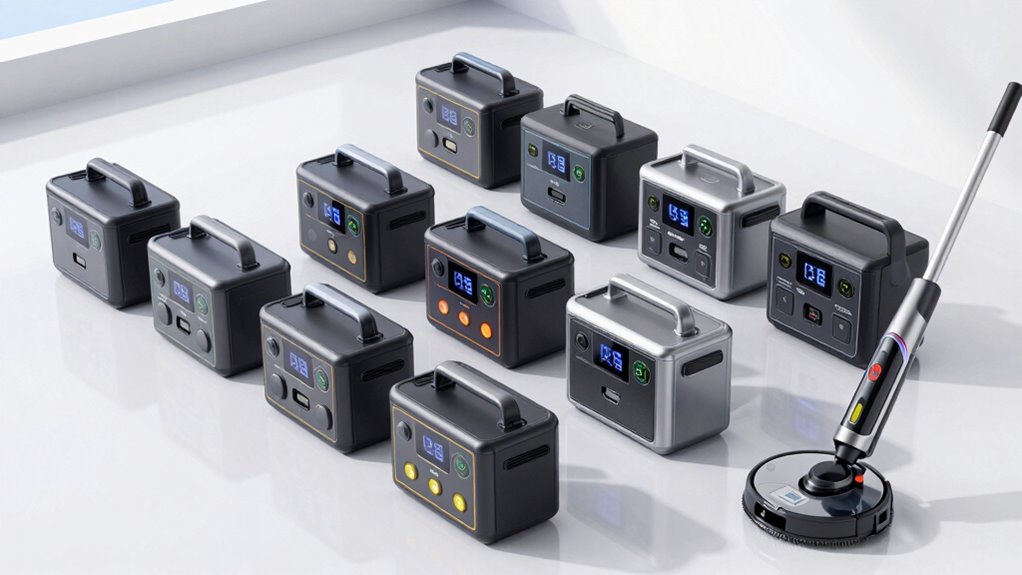

A portable power station for mobile cleaning needs enough output for your equipment and enough capacity to last through the job. I’d put the DARAN 288Wh, 600W model first for its balance of capacity and output, while the 299Wh, 600W model stands out for its 140W USB-C port and the EnginStar 300W for a straightforward mid-capacity option. The main tradeoff is portability versus runtime: compact units are easier to carry but can run out quickly, while larger units add weight and still may not support high-draw vacuums or pressure washers. Check both your tool’s running wattage and its startup surge before choosing. Read on for the full breakdown and picks by job type.

Get cleaning gear delivered free — and shop member deals
- Fast, free delivery on millions of items
- Access to Prime Big Deal Days deals on October 6–7
- Prime Video, Amazon Music and more included
Complete the kit


Key Takeaways
- The DARAN 288Wh, 600W model leads this lineup on the stated combination of battery capacity and AC output, which gives it more headroom for mobile cleaning tools than the sub-200Wh options.
- Capacity and wattage are separate limits. The 299Wh, 600W model and EnginStar’s 296Wh battery offer more stored energy than compact picks, but their AC output still sets which equipment they can run.
- Several models cluster below 150Wh. The DaranEner R100, JIYHF P100, and MARBERO 88.8Wh are better matched to short, light-duty tasks than extended cleaning sessions.
- The 299Wh, 600W unit lists 140W USB-C output, a useful distinction for charging compatible devices, though that port does not replace checking the AC requirements of cleaning equipment.
- Product labels alone do not settle runtime or compatibility. The listed specifications do not provide a complete runtime estimate for a particular cleaner, so buyers need to compare tool wattage, surge demand, and usable battery energy.
| DaranEner R100(2025 New) Portable Power Station |  | Best for Airport Carry-On Cleaning Kits | Battery capacity: 89.6Wh | AC output: 100W continuous; 200W peak | USB-C ports: 2 (45W and 15W) | VIEW ON AMAZON | See Our Full Breakdown |
| MARBERO 200W Portable Power Station 148Wh |  | Best for Multi-Device Charging | Battery capacity: 146Wh | AC output: 200W continuous; 270W maximum | AC sockets: 2 | VIEW ON AMAZON | See Our Full Breakdown |
| DARAN 288Wh Portable Power Station, 600W |  | Best for Higher-Draw Cleaning Accessories | Battery capacity: 288Wh | Battery chemistry: LiFePO4 | AC output: 600W pure sine wave | VIEW ON AMAZON | See Our Full Breakdown |
| MARBERO 150Wh Portable Power Station |  | Best for Car-Based Accessory Charging | Battery capacity: 150Wh | AC output: 100W continuous; 150W peak | USB ports: 3 USB ports (5V/2.1A max) and 1 QC3.0 port | VIEW ON AMAZON | See Our Full Breakdown |
| MARBERO Portable Power Station with AC Outlet 100W Solar Generator 88.8Wh |  | Best Compact Pick for Short Jobs | Battery capacity: 88.8Wh | AC output: 100W continuous; 150W surge | USB-C: 1 USB-C PD port, up to 60W | VIEW ON AMAZON | See Our Full Breakdown |
| JIYHF P100 Portable Power Bank with AC Outlet, 99.9Wh |  | Best Compact Pick | Battery capacity: 99.9Wh | Maximum AC output: 100W, 110V | USB-C: 65W input and output | VIEW ON AMAZON | See Our Full Breakdown |
| EnginStar 300W Portable Power Station with 296Wh Lithium Battery |  | Best for Longer Cleaning Sessions | Battery capacity: 296Wh | Power output: 300W | AC outlets: 2 × 110V pure sine wave | VIEW ON AMAZON | See Our Full Breakdown |
| 600W Portable Power Station, 299Wh, 6.8 lbs, 140W USB-C |  | Best for Higher-Power Tools | Capacity: 299Wh | Continuous output: 600W | Peak output: 1200W | VIEW ON AMAZON | See Our Full Breakdown |
| Westinghouse iGen400s 400 Watt, 183Wh Portable Power Station and Solar Generator |  | Best for Multi-Device Charging | Battery capacity: 183Wh | Running output: 200W | Peak output: 400W | VIEW ON AMAZON | See Our Full Breakdown |
| DaranEner 192Wh Portable Power Station, 300W (600W Surge) |  | Best Long-Life Compact Station | Battery capacity: 192Wh | Battery type: LiFePO4 | AC output: 300W total, 600W surge | VIEW ON AMAZON | See Our Full Breakdown |
| HOWEASY Portable Power Station, 260W (500W Peak) |  | Best Compact Pick for Mobile Cleaning | AC output: 260W (500W peak) | Ports: 2 AC outlets, 1 USB-C, 3 USB-A, 3 DC | USB-C output: 65W | VIEW ON AMAZON | See Our Full Breakdown |
| portable power station for mobile cleaning | Battery capacity | Weight | AC output | Dimensions |
|---|---|---|---|---|
| DaranEner R100(2025 New) Porta | 89.6Wh | 2.5 lb | 100W continuous; 200W peak | 4 x 6.5 x 3.3 in |
| MARBERO 200W Portable Power St | 146Wh | 3.3 lb | 200W continuous; 270W maximum | 7.5 x 5.3 x 3.6 in |
| DARAN 288Wh Portable Power Sta | 288Wh | 8.86 lb | 600W pure sine wave | 10.0 x 6.6 x 8.2 in |
| MARBERO 150Wh Portable Power S | 150Wh | — | 100W continuous; 150W peak | — |
| MARBERO Portable Power Station | 88.8Wh | 2.27 lb | 100W continuous; 150W surge | 7.5 x 4.78 x 3.31 in |
| JIYHF P100 Portable Power Bank | 99.9Wh | 1.9 lb | — | 8.66 × 3.86 × 1.65 in |
| EnginStar 300W Portable Power | 296Wh | — | — | 9 × 5.5 × 7.5 in |
| 600W Portable Power Station | — | 6.8 lb | — | — |
| Westinghouse iGen400s 400 Watt | 183Wh | — | — | — |
| DaranEner 192Wh Portable Power | 192Wh | 5.73 lb | 300W total, 600W surge | — |
| HOWEASY Portable Power Station | — | 5 pounds | 260W (500W peak) | 8.19 x 4.72 x 5.43 inches |
More Details on Our Top Picks
DaranEner R100(2025 New) Portable Power Station
The DaranEner R100 is a compact pick for mobile cleaners who need to keep a phone, camera, or other small electronics charged between jobs. Its 89.6Wh capacity falls below the stated 100Wh airline threshold, and the 2.5-pound body is easier to carry than the larger DARAN 288Wh. For cleaning equipment, the key limit is its 100W AC output: it can support low-draw accessories, but not a typical mains-powered vacuum or pressure washer. Seven ports make it useful for charging several small devices, while four recharge options suit travel days and car-based work. The tradeoff is limited stored energy; even a 50W load is estimated at only about 1.5 to 2 hours before conversion losses. Choose it for portable electronics and brief jobs, not extended tool operation.
Pros:- 89.6Wh capacity is below the stated 100Wh airline threshold
- 2.5-pound weight and compact 4 x 6.5 x 3.3-inch dimensions are easy to carry
- Seven ports include USB-C, USB-A, DC, and AC options
- Can recharge from a wall outlet, car, USB-C, or solar panel
Cons:- 100W AC output rules out most mains-powered cleaning equipment
- 89.6Wh capacity limits runtime and repeated device charging
- Solar panel is sold separately
Best for: Traveling cleaners who carry phones, cameras, or other low-wattage accessories and want a compact battery below 100Wh.
Not ideal for: Cleaners who need to run a vacuum, pressure washer, or other high-draw cleaning tool, since AC output is limited to 100W.
- Battery capacity:89.6Wh
- AC output:100W continuous; 200W peak
- USB-C ports:2 (45W and 15W)
- USB-A ports:2 (15W and 18W)
- Other outputs:AC outlet and DC 5521 port (40W)
- Recharging methods:Wall outlet, car socket, USB-C, or solar panel
- AC recharge time:Approximately 2 hours
- Weight:2.5 lb
- Dimensions:4 x 6.5 x 3.3 in
Our verdict“Choose the R100 for air travel and small electronics between jobs; pick the DARAN 288Wh when your setup needs more stored energy and higher output.”
MARBERO 200W Portable Power Station 148Wh
The MARBERO 200W gives a mobile cleaner more headroom for charging several accessories than the smaller DaranEner R100. Its 146Wh capacity, two AC sockets, and mix of USB and DC ports make it a practical hub for phones, lights, and battery chargers at a vehicle or work site. The 200W continuous AC limit is still far below what most powered cleaning tools require, so the extra output should not be mistaken for vacuum-ready power. Two built-in LED lights add useful visibility during setup or an outage, a feature the R100 does not list. Recharging is a weak point: wall charging takes about seven hours, and car charging about nine. I’d choose this when port variety and lighting matter more than quick turnaround or tool operation.
Pros:- 146Wh capacity exceeds the DaranEner R100’s 89.6Wh
- Two AC sockets plus USB-A, USB-C, and DC connections
- Two built-in LED lights with multiple brightness and emergency modes
- Supports wall, car, and compatible solar charging
Cons:- 200W continuous output is insufficient for many powered cleaning tools
- Wall recharge takes about seven hours and car recharge about nine
- Solar panel is not included
Best for: Mobile cleaners who need to charge several phones, cameras, and small accessories together and want built-in work or emergency lighting.
Not ideal for: Cleaners who need fast turnaround between jobs or power for a mains-powered vacuum, since wall charging takes about seven hours and AC output is 200W.
- Battery capacity:146Wh
- AC output:200W continuous; 270W maximum
- AC sockets:2
- USB outputs:2 QC3.0 USB-A (18W each), 2 USB-A (15W max each), and 1 USB-C PD (18W)
- DC output:1 DC 5.5mm port
- Recharging methods:Wall outlet, 12V car adapter, or solar panel
- Recharge time:About 7 hours from wall; 9 hours from car
- Weight:3.3 lb
- Dimensions:7.5 x 5.3 x 3.6 in
Our verdict“Pick the MARBERO for a small charging station with useful lights, while the R100 is easier to carry for air travel.”
DARAN 288Wh Portable Power Station, 600W
Among these five options, the DARAN 288Wh offers the clearest step up for a cleaner bringing higher-draw accessories: its 600W pure sine wave output gives more room than the 100W R100 or 200W MARBERO. That still does not make it suitable for every vacuum or pressure washer; check the tool’s running and startup wattage against the station’s limits. The 288Wh LiFePO4 battery also stores substantially more energy than those compact models, and the listing says six devices can be charged at once. At 8.86 pounds, it is less appealing for air travel or carrying between distant jobs, but a reinforced handle helps with vehicle-to-site moves. Solar and car charging cables are not included, adding setup friction for off-grid use.
Pros:- 288Wh capacity provides more stored energy than the 89.6Wh and 146Wh options
- 600W pure sine wave AC output supports a wider range of compatible accessories
- LiFePO4 battery chemistry with built-in battery management protections
- Handle, multiple output types, and three-mode LED light suit job-site use
Cons:- 8.86-pound weight is less convenient for frequent carrying than the compact MARBERO and R100
- AC output remains limited to devices within 600W
- Solar panel and solar and car charging cables are not included
Best for: Vehicle-based cleaners using compatible accessories rated below 600W who want more runtime and multiple device connections at a job site.
Not ideal for: Air travelers and cleaners carrying equipment over long distances, or anyone whose cleaning tool exceeds 600W running output.
- Battery capacity:288Wh
- Battery chemistry:LiFePO4
- AC output:600W pure sine wave
- Surge output:1200W
- Outputs:2 AC outlets, 1 car socket, 1 USB-C, and 2 USB-A
- AC recharge time:2 hours to 80%
- Recommended solar input:100W
- Weight:8.86 lb
- Dimensions:10.0 x 6.6 x 8.2 in
Our verdict“Choose the DARAN 288Wh for compatible higher-draw accessories and longer site sessions; the smaller MARBERO 200W is easier to carry for basic charging.”
MARBERO 150Wh Portable Power Station
The MARBERO 150Wh suits cleaners who want several ways to keep small electronics and accessories powered from a vehicle. Its four DC ports stand out beside the R100’s single DC 5521 connection, while USB ports and an AC outlet cover mixed charging needs. This is most useful for phones, lights, and low-draw gear; the 100W continuous AC limit is a firm ceiling for plug-in tools, even though peak output reaches 150W. Two LED flashlights, including SOS modes, add practical light during setup. Compared with the 200W MARBERO, this model has lower AC output, and the product details do not specify its weight or dimensions, making portability harder to judge. It can recharge by wall, car, or compatible solar input, but the solar panel is extra.
Pros:- Four DC ports accommodate multiple compatible low-voltage accessories
- Wall, car, and compatible solar charging options
- Two built-in LED flashlights include steady and SOS modes
- Battery management and automatic shutoff provide device protections
Cons:- 100W continuous AC output excludes most powered cleaning tools
- Solar panel is not included
- Product details do not provide weight or dimensions
Best for: Cleaners working from a vehicle who use DC-powered accessories and need several DC connections alongside basic USB and AC charging.
Not ideal for: Anyone relying on plug-in vacuums or other equipment above 100W continuous, or buyers who need clearly stated size and weight before choosing a carryable unit.
- Battery capacity:150Wh
- AC output:100W continuous; 150W peak
- USB ports:3 USB ports (5V/2.1A max) and 1 QC3.0 port
- DC ports:4 (5–12V/10A; 15A maximum)
- Recharging methods:Wall outlet, 12V car adapter, or solar panel
- Solar input:15–24V/1.2A
- Lighting:2 LED flashlights with steady and SOS modes
- Warranty:12 months
Our verdict“Choose this MARBERO for vehicle-based DC accessory charging; the 200W MARBERO offers more AC headroom when you need plug-in devices.”
MARBERO Portable Power Station with AC Outlet 100W Solar Generator 88.8Wh
At 2.27 pounds, this MARBERO 88.8Wh is the easiest of these options to pack for a short cleaning visit where the power need is limited to a phone, camera, or small fan. Its 100W AC outlet gives it more flexibility than a USB-only battery pack, and USB-C PD input can recharge the unit in about two hours. That makes it quicker to turn around than the 146Wh MARBERO, whose listed wall recharge takes about seven hours. The tradeoff is capacity: 88.8Wh leaves little room for long sessions, and 100W continuous output will not run most powered cleaning tools. Pass-through charging can keep small devices going while the station itself is connected to power, but it does not change those output limits. Pick it for compactness, not job-site tool power.
Pros:- 2.27-pound weight and compact dimensions are well suited to a small kit
- 88.8Wh capacity is below the stated 100Wh airline limit
- USB-C PD input supports a stated full recharge in about two hours
- Pass-through charging and built-in flashlight add travel convenience
Cons:- 88.8Wh capacity limits runtime for multiple devices or longer jobs
- 100W continuous AC output cannot support most powered cleaning tools
- Solar panel is not listed among the included accessories
Best for: Solo cleaners who travel light and need brief backup power for phones, cameras, or other small electronics during short appointments.
Not ideal for: Cleaners who need extended runtime or power for a vacuum, pressure washer, or other appliance above 100W.
- Battery capacity:88.8Wh
- AC output:100W continuous; 150W surge
- USB-C:1 USB-C PD port, up to 60W
- USB-A:2 ports
- Recharge time:About 2 hours via USB-C PD
- Recharging feature:Pass-through charging
- Weight:2.27 lb
- Dimensions:7.5 x 4.78 x 3.31 in
- Lighting:Built-in flashlight with two brightness levels
Our verdict“Choose this MARBERO when light weight and fast USB-C recharging matter more than runtime; the 146Wh MARBERO holds more energy for longer sessions.”
JIYHF P100 Portable Power Bank with AC Outlet, 99.9Wh
The JIYHF P100 is the smallest-capacity choice here, and that can suit mobile cleaning when the kit is limited to charging a phone, inspection light, or other small electronics between jobs. Its 99.9Wh battery and 1.9-pound weight make it easier to carry than the larger EnginStar 300W, though its 100W AC limit rules out many powered cleaning tools. The USB-C port can take or deliver up to 65W, while the LCD helps track input and remaining charge. It has several connection types, but only one AC outlet. I’d choose it for a light accessory kit that benefits from grab-and-go size; for longer sessions or higher draw, the 296Wh EnginStar offers more reserve. The included car charger and bag help with travel, but do not change its limited appliance capacity.
Pros:- Compact 1.9-pound body is easier to carry than the larger stations in this group.
- 65W USB-C input and output supports fast charging for compatible devices.
- LCD shows battery level and power input and output.
- Includes a car charger and carrying bag.
Cons:- The 100W AC ceiling excludes most powered cleaning equipment.
- 99.9Wh capacity provides less runtime than the 183Wh Westinghouse or 296Wh EnginStar.
- Only one AC outlet is available.
Best for: Mobile detailers who mainly need to keep phones, lights, and other small electronics charged between short jobs.
Not ideal for: Cleaners who need to run a vacuum, extractor, or other appliance drawing over 100W.
- Battery capacity:99.9Wh
- Maximum AC output:100W, 110V
- USB-C:65W input and output
- Maximum DC output:96W
- Weight:1.9 lb
- Dimensions:8.66 × 3.86 × 1.65 in
- Recharge time:About 2 hours with a 65W wall charger
- Battery type:Lithium-ion
Our verdict“Choose the JIYHF P100 for a light, portable charging kit; skip it if your cleaning setup depends on AC-powered tools.”
EnginStar 300W Portable Power Station with 296Wh Lithium Battery
For a mobile cleaner who needs to keep several low-draw devices running across a longer workday, the EnginStar 300W pairs a 296Wh battery with two pure sine wave AC outlets and a broad set of USB and DC connections. Its capacity is close to the 299Wh 600W station, but its 300W output ceiling is half as high, so it makes more sense for modest loads than demanding equipment. Compared with the Westinghouse iGen400s, it offers substantially more stored energy, though the Westinghouse lists more USB-C ports and a higher peak output. Wall charging takes about seven hours, which calls for planning between shifts; solar and car charging add options, but the solar panel is sold separately. The 300W cap is the central limitation for cleaners considering AC tools.
Pros:- 296Wh capacity supports longer sessions than the JIYHF P100 or Westinghouse iGen400s.
- Two pure sine wave AC outlets allow multiple compatible devices to connect.
- Can recharge from a wall outlet, compatible solar panel, or car charger.
- Protection features cover overload, over-discharge, overcharging, overheating, and short circuits.
Cons:- 300W output limit excludes many higher-power cleaning appliances.
- AC recharge takes about seven hours.
- Solar panel is sold separately.
Best for: Mobile cleaners running lights, phones, and other modest-power gear who need more stored energy for a longer shift.
Not ideal for: Crews relying on high-draw vacuums or extractors above 300W, or anyone needing a quick wall recharge between jobs.
- Battery capacity:296Wh
- Power output:300W
- AC outlets:2 × 110V pure sine wave
- USB outputs:3, including 1 × USB-C 18W
- Other outputs:12V car port, 12V DC, 24V DC barrel port
- Dimensions:9 × 5.5 × 7.5 in
- AC recharge time:About 7 hours
- Battery cycle life:Up to 1,000 cycles
Our verdict“Pick the EnginStar for longer shifts with modest loads, but choose a higher-output station if your cleaning tools draw more than 300W.”
600W Portable Power Station, 299Wh, 6.8 lbs, 140W USB-C
Among these five options, this station has the strongest stated continuous output: 600W, with a 1200W peak. That gives it more room for compatible powered cleaning gear than the EnginStar 300W or DaranEner 192Wh, though buyers still need to check the tool’s running and startup draw. Its 299Wh capacity is nearly the same as EnginStar’s 296Wh, so the extra output does not come with a major jump in stored energy. At 6.8 pounds, it is a manageable carry for a vehicle-based setup, and the 140W USB-C port is useful for fast-charging compatible equipment. Two AC outlets and a pure sine wave inverter add flexibility. Solar panels are sold separately, and 600W remains a firm ceiling for higher-draw machines.
Pros:- 600W continuous output exceeds the EnginStar 300W and DaranEner 300W limits.
- 299Wh capacity provides a similar energy reserve to the larger-capacity options in this batch.
- 140W USB-C PD supports compatible high-speed charging.
- Two AC outlets, multiple USB ports, and car and DC outputs serve varied gear.
Cons:- The 600W continuous limit still excludes higher-draw appliances.
- Solar panels are sold separately.
- At 6.8 pounds, it weighs more than the JIYHF P100 and is less suited to pocket-sized carry.
Best for: Vehicle-based cleaners whose compatible tools draw more than 300W and who want two AC outlets in a carryable station.
Not ideal for: Cleaners with appliances above 600W or those prioritizing maximum runtime over output power.
- Capacity:299Wh
- Continuous output:600W
- Peak output:1200W
- Weight:6.8 lb
- USB-C output:140W PD
- AC outlets:2 × 120V
- Inverter:Pure sine wave
- Solar charging:Supports 18V solar panels, sold separately
Our verdict“Choose this model when compatible cleaning tools need more than 300W, while accepting that its 299Wh battery still sets a runtime limit.”
Westinghouse iGen400s 400 Watt, 183Wh Portable Power Station and Solar Generator
The Westinghouse iGen400s is a port-rich, lower-capacity option for a cleaner who wants to charge several electronics at once. Its nine outlets include three 30W USB-C ports, a 100W USB-C port, two USB-A ports, two AC outlets, and a 12V DC port. That makes its connection mix more flexible than the EnginStar 300W, but its 183Wh capacity is much smaller than EnginStar’s 296Wh or the 299Wh 600W station, so extended sessions will call for careful load planning. The listed 200W running output also rules out many powered cleaning tools even though peak output reaches 400W. Its handle and weather-resistant shell suit travel between sites, while the missing AC adapter means the fastest stated charging setup requires an additional compatible adapter.
Pros:- Nine outlets include four USB-C ports, two AC outlets, USB-A, and 12V DC.
- 100W USB-C port supports compatible laptop and equipment charging.
- Compact handle design and weather-resistant shell suit transport between sites.
- Quiet, fume-free operation can be used indoors.
Cons:- 183Wh capacity is substantially below the EnginStar 300W and 299Wh station.
- 200W running output limits the AC cleaning tools it can support.
- AC power adapter is not included for the fastest stated charging setup.
Best for: Mobile cleaners charging several phones, lights, and laptops at once while keeping AC loads below 200W.
Not ideal for: Teams seeking long runtime for multiple devices or enough running output for high-draw cleaning appliances.
- Battery capacity:183Wh
- Running output:200W
- Peak output:400W
- Outlets:9 total
- USB-C ports:3 × 30W and 1 × 100W
- AC outlets:2 × 120V
- Recharge time:To 80% in 2 hours from 120V with a 100W AC adapter
- Warranty:2-year limited warranty
Our verdict“Choose the iGen400s for its wide selection of charging ports, but look elsewhere for long runtime or AC tools above 200W.”
DaranEner 192Wh Portable Power Station, 300W (600W Surge)
The DaranEner 192Wh is the lighter middle ground for cleaners who want a portable station with more capability than the JIYHF P100 but do not need the 600W model’s output. Its 5.73-pound weight and storage bag help when carrying a small kit, while the LiFePO4 battery is rated for more than 3,500 charge cycles. That cycle rating sets it apart from the EnginStar, which lists up to 1,000 cycles, although the DaranEner holds much less energy than EnginStar’s 296Wh. Its 300W total AC output can cover compatible modest loads, not demanding extractors or vacuums. Two AC outlets, 60W USB-C, and 120W DC output cover a useful range of devices; solar support adds flexibility, but the panel and car charging cable are not included.
Pros:- LiFePO4 battery is rated for 3,500 or more charge cycles.
- At 5.73 pounds, it is lighter than the 6.8-pound 600W station.
- Two AC outlets plus USB-C, USB-A, and DC outputs support varied small devices.
- AC recharge takes about two hours at 100W.
Cons:- 192Wh capacity is well below the EnginStar 296Wh and 299Wh station.
- 300W total AC output cannot support higher-power cleaning equipment.
- Solar panels and car charging cables are not included.
Best for: Solo cleaners who carry their station between jobs and value a long-rated battery cycle life for modest-power gear.
Not ideal for: Teams running several power-hungry tools or needing the longer runtime offered by a roughly 300Wh station.
- Battery capacity:192Wh
- Battery type:LiFePO4
- AC output:300W total, 600W surge
- USB-C output:60W PD
- USB-A outputs:2 × 18W
- DC output:DC5521, 120W
- Weight:5.73 lb
- AC recharge time:About 2 hours at 100W
Our verdict“Pick the DaranEner for a carryable, long-cycle-life station for modest loads; choose a larger-capacity model when runtime matters more.”
HOWEASY Portable Power Station, 260W (500W Peak)
For mobile cleaning jobs built around small electronics, the HOWEASY’s five-pound weight and nine output ports make it easy to carry alongside a compact tool kit. Its 260W AC output can support light-duty gear within that limit, while the 65W USB-C port can charge a compatible laptop or other device. Compared with the DaranEner 192Wh Portable Power Station, this model’s standout is its compact, clearly specified port selection; the available data here does not establish a capacity advantage. The tradeoff is power: 260W is a poor fit for many high-draw vacuums, extractors, or other cleaning equipment, and the 500W peak figure does not raise its continuous output. Solar, wall, and car charging offer flexible recharging, but solar panels are not stated as included. I’d choose it for portability and device charging, not as a substitute for a higher-output worksite station.
Pros:- Five-pound weight and compact dimensions are convenient for mobile setups
- Nine output ports allow several compatible devices to connect at once
- 65W USB-C output supports compatible laptops and other devices
- Can recharge from solar, a wall adapter, or a car charger
Cons:- 260W AC output limits use with many cleaning appliances
- Battery capacity and runtime are not provided in the supplied product data
- Solar panels are not stated as included
Best for: Mobile cleaners who carry phones, a laptop, cameras, and light-duty equipment with power draw below 260W and want a compact station.
Not ideal for: Cleaners running high-draw vacuums or extraction equipment, or anyone who needs confirmed battery capacity or included solar panels.
- AC output:260W (500W peak)
- Ports:2 AC outlets, 1 USB-C, 3 USB-A, 3 DC
- USB-C output:65W
- Dimensions:8.19 x 4.72 x 5.43 inches
- Weight:5 pounds
- Charging methods:Solar (18–24V), AC wall adapter, car charger
- Battery:Lithium
- Lighting:Low, high, and SOS modes
- Protection:Short circuit, overcurrent, overvoltage, overload, overheating
Our verdict“Choose the HOWEASY for a lightweight mobile setup centered on electronics and low-draw gear; skip it if your cleaning equipment needs more than 260W.”

How We Picked
I ranked these 11 stations around the demands of mobile cleaning: the AC output available for a cleaner or vacuum, the battery capacity available to sustain a job, and the practical balance between those figures. A higher wattage rating matters when a tool draws more power or has a startup surge; a larger watt-hour figure generally supports more runtime, though actual results depend on the equipment and power losses. I also considered listed battery chemistry, charging and port details, and features such as a display or lights where they could help during field use.
The DARAN 288Wh, 600W model takes the lead because its stated capacity and output make it the strongest all-around fit in this group. The 299Wh, 600W unit and EnginStar follow as higher-capacity alternatives, with the former adding a listed 140W USB-C port. Compact models rank lower for sustained cleaning because their capacities are much smaller, even when they may suit brief jobs. The product information supplied does not establish real-world runtime, weight for most models, or compatibility with a particular cleaner, so I avoid treating those as verified advantages.
Factors to Consider When Choosing Portable Power Station For Mobile Cleaning
Choosing a station for mobile cleaning starts with the tool you plan to power, not the station’s headline capacity. These checks help you decide whether you need brief cordless-style support, a longer work window, or a unit capable of handling a more demanding load.
Match AC Output to the Cleaner
Find the cleaner’s rated running wattage on its label or manual, then compare it with the station’s continuous AC output. A station advertised with a surge figure can tolerate a brief startup draw, but that peak rating is not a substitute for continuous output. Motor-driven vacuums and pumps can draw more at startup than they do once running. If the tool’s startup requirement is unavailable, avoid choosing a station whose rating barely matches the running figure. Also check whether the station’s AC outlet delivers the voltage your equipment expects. A larger battery cannot compensate for an inverter that cannot supply the required power.
Estimate Runtime From the Job
Watt-hours describe stored energy, while your cleaner’s wattage describes how quickly it uses that energy. As a rough starting point, divide the station’s watt-hours by the tool’s watts to estimate ideal runtime in hours; real runtime will be lower because of conversion losses and operating conditions. A 300W cleaner could drain a roughly 300Wh battery in about an hour or less, and other devices connected at the same time shorten the run further. For repeated jobs, add up the expected operating time rather than planning around a single burst. Leave a reserve for setup, interruptions, and a battery that is not fully charged when work begins. This estimate helps show why a compact station may work for spot cleaning but fall short on a full route.
Account for Water and Worksite Conditions
Portable power stations are electrical equipment, so a wet cleaning environment calls for careful placement and cable management. Keep the unit on a dry, stable surface away from spray, puddles, and runoff, and follow its manual for permitted temperature and ventilation conditions. Do not assume that a rugged-looking case or an outdoor-use label means the outlets are waterproof. Route cords so they do not cross walkways or sit where water can collect. If your workflow regularly exposes the power source to splashes, plan a dry storage position before buying and check the station’s stated protection limits. A suitable setup can matter as much as extra battery capacity.
Balance Carrying Weight With Capacity
A station that stays in a vehicle can prioritize capacity, while one carried between rooms or buildings needs a manageable weight and form. The listed 299Wh model is described as 6.8 pounds, but weight information is not provided for most of this lineup, so compare the full specifications before assuming similarly sized batteries are equally portable. Consider how far you carry the unit, whether stairs are involved, and whether it needs to travel with hoses and cleaning supplies. A smaller battery may be the better purchase for quick touch-ups if a larger one would be awkward to move. For a van-based setup, greater capacity may matter more than a few extra pounds. Match the form factor to the actual route between your vehicle and work area.
Plan Recharging Between Jobs
Battery capacity only helps if the station can be restored before the next cleaning run. Check the supported AC charging rate and whether solar or vehicle charging is available, along with any required accessories. Solar charging depends on panel output, sunlight, placement, and the station’s input limits, so it may not replenish a depleted battery during a short break. If your schedule has predictable downtime, a wall outlet may be the simpler recovery plan. For back-to-back appointments, calculate whether recharge time fits the gap or whether you need another station or battery strategy. Do not buy based on a fast-charge claim without checking how long a full recharge takes from your intended source.
Choose Ports for the Whole Setup
List every device you expect to run at once: the cleaner, phone, work light, or payment device. The station must support both the total power draw and the connection types your equipment uses. USB-C output, such as the 140W port listed on one 299Wh model, can serve compatible electronics, but it does not power an AC cleaner. Multiple outlets are useful only if the combined load stays within the station’s output limit. Check whether DC outlets require adapters and whether using several ports changes the maximum available output. Buying for the complete setup avoids discovering that a station can run the main tool but leaves no practical way to charge supporting devices.
Frequently Asked Questions
Can one of these stations run my wet-dry vacuum?
It depends on the vacuum’s running wattage, startup surge, and the station’s continuous AC rating. The DARAN 288Wh model lists 600W output, while several compact picks list much lower output or capacity, but those headline figures do not confirm compatibility with a specific vacuum. Check the vacuum manual for its electrical requirements and compare them with the station’s AC specifications. Leave margin for startup demand instead of matching ratings exactly. If the vacuum exceeds the station’s output, more battery capacity will not fix the mismatch.
How much battery capacity do I need for a full cleaning appointment?
Estimate the appointment’s powered runtime and multiply it by the cleaner’s wattage to get a first-pass energy requirement in watt-hours. Then allow extra capacity for inverter losses, pauses with the tool still drawing power, and other devices. For example, a tool drawing 300W for one hour needs more than 300Wh of rated battery capacity in practice. The roughly 90–150Wh models in this roundup are better suited to short tasks or electronics than to that kind of sustained load. Use your own cleaner’s draw and schedule for the estimate rather than relying on a generic runtime claim.
Is a 600W peak rating enough for a 600W cleaner?
Not necessarily: peak or surge output is intended for brief startup demand, not continuous operation. Check whether the station’s 600W figure is its continuous AC output or its short-duration peak, and compare it with the cleaner’s running draw. A cleaner rated at 600W may need additional power when its motor starts. The product names in this lineup sometimes list both continuous and surge figures, so read the full specifications rather than relying on the largest number in a title. If the manual leaves the startup requirement unclear, choosing a station with more continuous headroom reduces the chance of overload.
Should I choose more watt-hours or more output watts?
Choose output watts first if your equipment may exceed the station’s power limit; a large battery cannot run an incompatible load. Once the output is sufficient, compare watt-hours to determine how long the tool can run. A compact station can have adequate output for a small device yet run out quickly, while a high-capacity model can still fail to start a demanding cleaner if its inverter is undersized. For mobile cleaning, both figures matter, but they solve different problems. Start with the tool’s requirements, then size capacity for your expected work time.
Can I recharge a station with a solar panel between cleaning jobs?
Possibly, if the station supports solar input and the panel matches its allowed voltage and connector specifications. Solar output varies with sunlight, panel angle, shade, and temperature, so a short appointment gap may not restore much energy. Check the station’s maximum solar input and expected recharge time before planning a workday around it. A panel also adds equipment to carry and set up. For a predictable schedule, compare solar charging with the available vehicle or wall charging options and treat solar as supplemental unless the figures support your daily routine.
Conclusion
For most mobile cleaners choosing from this lineup, I’d start with the DARAN 288Wh, 600W model as the best overall balance of stated capacity and AC output. The 299Wh, 600W station is the best value in capability if its 140W USB-C port helps your wider setup, while the EnginStar 300W with 296Wh is a sensible alternative when its listed output fits your equipment. Beginners handling brief, low-draw jobs may prefer a compact MARBERO or DaranEner unit, provided their cleaner’s wattage is within its limits. For longer sessions, prioritize the larger-capacity models; for a specific vacuum or pump, prioritize verified continuous output and surge compatibility first. Check the manual and your tool’s requirements before committing to any pick.
Halloween Picks
halloween
As an affiliate, we earn on qualifying purchases.