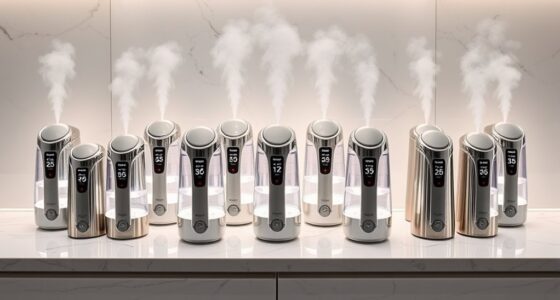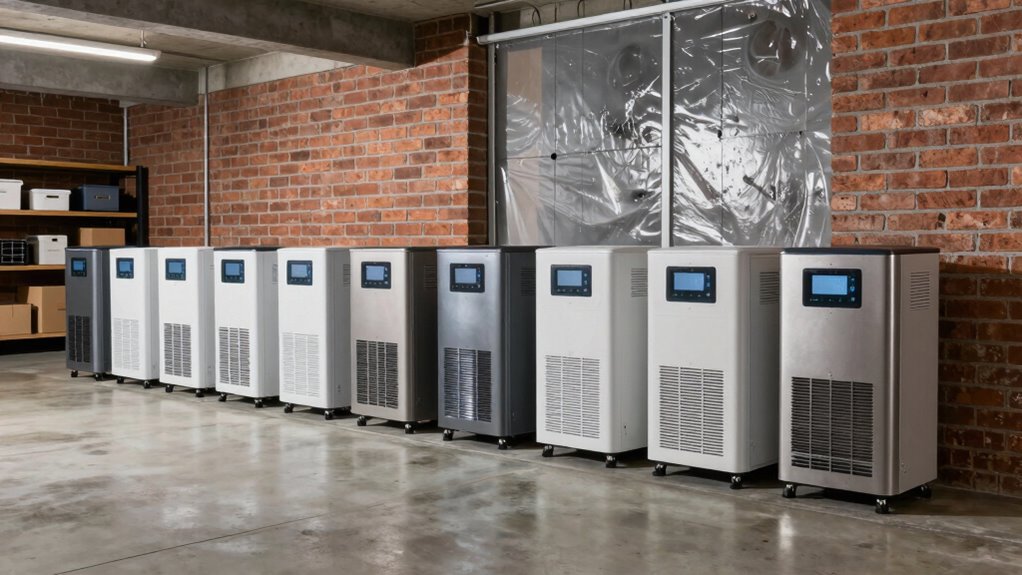

For most large basements, I’d start with the AEOCKY RHEA-002 as the best overall balance of coverage and efficiency; the 155-pint commercial model with pump is a stronger fit for severe, persistent dampness, while the VEAGASO 34-pint suits smaller spaces. The main tradeoff is between a portable, household-style unit that is easier to live with and a commercial machine built for heavier moisture loads, which can require more room and a better drainage plan. Rated coverage and pint capacity help with comparisons, but neither replaces matching the unit to real basement conditions. I’ll explain how the 15 options differ, what features affect day-to-day ownership, and which buyer each one suits.

Get cleaning gear delivered free with Prime
- Fast, free delivery on millions of items
- Prime Video, Amazon Music and more included
- Member-only deals all year
Complete the kit


Key Takeaways
- The lineup spans two different jobs: household-style models rated for large areas and commercial units with higher extraction capacities or built-in pumps. A large square-footage figure alone does not make a residential-style unit commercial-grade.
- The AEOCKY RHEA-002 is my best overall starting point for buyers who want substantial stated coverage without jumping straight to a dedicated commercial machine.
- For severe moisture, pump-equipped commercial models deserve closer attention. The 155-pint unit and AVAHUM 160-pint model foreground both high extraction capacity and pumping, addressing drainage as well as moisture removal.
- Several AEOCKY models occupy similar territory. Compare their rated capacity, coverage, and stated efficiency designation rather than assuming the newest label or largest area claim automatically fits your basement better.
- The smallest listed option is not a bargain substitute for a heavy-duty unit. The VEAGASO 34-pint model is aimed at more modest spaces, while large or persistently damp basements call for greater capacity and a workable continuous-drain setup.
| AEOCKY LEO-Lite-2 5,500 Sq. Ft. Energy Star Version 6.0 Dehumidifier |  | Best for High Moisture Removal | Coverage area: Up to 5,500 sq. ft. | Capacity at 95°F and 95% RH: Up to 105 pints per day | Capacity at 86°F and 80% RH: 72 pints per day | VIEW ON AMAZON | See Our Full Breakdown |
| Ludatido 80-Pint Energy Star Dehumidifier for Home |  | Best for Flexible Basement Drainage | Model: 527BZV1R5 | Capacity: 80 pints per day | Listed coverage: Up to 5,000 sq. ft. | VIEW ON AMAZON | See Our Full Breakdown |
| AEOCKY 50-Pint Dehumidifier with Drain Hose |  | Best Compact Pick for Smaller Basements | Moisture removal: Up to 50 pints per day at 95°F and 95% RH | Coverage: Up to 3,000 sq. ft. | Tank capacity: 0.5 gallon | VIEW ON AMAZON | See Our Full Breakdown |
| Manastin 80-Pint Dehumidifier for Rooms up to 5,500 Sq. Ft. with Drain Hose |  | Best for Cooler Basements | Coverage area: Up to 5,500 sq. ft. | Capacity at 95°F and 95% RH: Up to 80 pints per day | Capacity at 86°F and 80% RH: 50 pints per day | VIEW ON AMAZON | See Our Full Breakdown |
| AEOCKY RHEA-002 Dehumidifier, 6,000 Sq. Ft., ENERGY STAR Most Efficient 2024 |  | Best Efficiency-Focused Large-Basement Pick | Coverage area: Up to 6,000 sq. ft. | Capacity at 95°F and 95% RH: 105 pints per day | Capacity at 86°F and 80% RH: 83 pints per day | VIEW ON AMAZON | See Our Full Breakdown |
| Gasbye 6000 Sq.Ft 2026 Energy Star Dehumidifier for Basement Max 115Pints/D |  | Best for Quiet, Efficient Basement Coverage | Moisture removal: Up to 115 pints/day at 86°F, 80% RH; 73 pints/day at 80°F, 60% RH | Listed coverage: 4,500 sq. ft. in feature specs; up to 6,000 sq. ft. in title | Energy certification: ENERGY STAR 2026 | VIEW ON AMAZON | See Our Full Breakdown |
| Waykar 80-Pint Dehumidifier for Spaces up to 5,000 Sq. Ft. |  | Best for Adjustable Humidity Control | Moisture removal: 80 pints/day at 95°F, 90% RH | Coverage: Up to 5,000 sq. ft. | Humidity range: 30%–80% RH | VIEW ON AMAZON | See Our Full Breakdown |
| 155 Pint Commercial Dehumidifier with Pump and Drain, Energy Star |  | Best for Pump-Assisted Heavy-Duty Drainage | Maximum moisture removal: 155 pints/day under near-saturated conditions | AHAM capacity: 70 pints/day | Coverage: Up to 7,500 sq. ft. | VIEW ON AMAZON | See Our Full Breakdown |
| AEOCKY 5500 Sq.Ft Energy Star Most Efficient 2025 Dehumidifier Max 80Pint/D |  | Best for Energy-Conscious Finished Basements | Moisture removal: Up to 80 pints/day at 95°F, 95% RH; 56 pints/day at 86°F, 80% RH | Coverage: Up to 5,500 sq. ft. | Energy designation: ENERGY STAR Most Efficient 2025 | VIEW ON AMAZON | See Our Full Breakdown |
| Airecoler GT-X5 Commercial Dehumidifier, 125-Pint |  | Best for Compact Commercial-Style Capacity | Maximum capacity: 125 pints/day | AHAM capacity: 60 pints/day | Coverage: Up to 6,000 sq. ft. | VIEW ON AMAZON | See Our Full Breakdown |
| VEAGASO 34-Pint Dehumidifier for Rooms up to 2,500 Sq. Ft. |  | Best for Smaller Basements | Moisture removal: 34 pints per day | Recommended floor area: Up to 2,500 sq. ft. | Tank volume: 0.53 gallons (2 liters) | VIEW ON AMAZON | See Our Full Breakdown |
| KNKA Energy Star Dehumidifier, 80-Pint, for Spaces up to 5,500 Sq. Ft. |  | Best Energy-Efficient Large-Basement Pick | Moisture removal: Up to 80 pints/day at 95°F, 95% RH; 56 pints/day at 86°F, 80% RH | Coverage: Up to 5,500 sq. ft. | Energy certification: Energy Star certified | VIEW ON AMAZON | See Our Full Breakdown |
| AEOCKY 8000Sq.Ft Commercial Dehumidifier, Energy Star Most Efficient 2025 |  | Best for Very Large Basements | Moisture removal: 140 pints/day at 95°F, 95% RH; 95 pints/day at 86°F, 80% RH | Coverage: Up to 8,000 sq. ft. | Energy certification: Energy Star Most Efficient 2025 | VIEW ON AMAZON | See Our Full Breakdown |
| AVAHUM 160-Pint Commercial Dehumidifier with Pump |  | Best for Pumped Drainage | Moisture removal: Up to 160 pints/day at 95°F, 90% RH; listing also states 20 gallons/day | Coverage area: Up to 7,500 sq. ft. | Pump lift: Up to 16.4 feet | VIEW ON AMAZON | See Our Full Breakdown |
| AlorAir Helios MP35 70-Pint Crawl Space and Commercial Dehumidifier with Pump |  | Best Compact Commercial Pick | Moisture removal: 70 pints/day under saturated conditions; 35 pints/day under AHAM standards | Coverage area: Up to 1,000 sq. ft. | Pump lift: Up to 19.6 feet | VIEW ON AMAZON | See Our Full Breakdown |
| industrial dehumidifier for basement | Moisture removal | Power |
|---|---|---|
| AEOCKY LEO-Lite-2 5,500 Sq. Ft | — | — |
| Ludatido 80-Pint Energy Star D | — | — |
| AEOCKY 50-Pint Dehumidifier wi | Up to 50 pints per day at 95°F and 95% RH | — |
| Manastin 80-Pint Dehumidifier | — | 480 W |
| AEOCKY RHEA-002 Dehumidifier | — | — |
| Gasbye 6000 Sq.Ft 2026 Energy | Up to 115 pints/day at 86°F, 80% RH; 73 pints/day at 80°F, 60% RH | 500 watts, 115 volts |
| Waykar 80-Pint Dehumidifier fo | 80 pints/day at 95°F, 90% RH | — |
| 155 Pint Commercial Dehumidifi | — | 860 watts |
| AEOCKY 5500 Sq.Ft Energy Star | Up to 80 pints/day at 95°F, 95% RH; 56 pints/day at 86°F, 80% RH | 280 watts, 120 volts |
| Airecoler GT-X5 Commercial Deh | — | — |
| VEAGASO 34-Pint Dehumidifier f | 34 pints per day | 230 watts |
| KNKA Energy Star Dehumidifier | Up to 80 pints/day at 95°F, 95% RH; 56 pints/day at 86°F, 80% RH | — |
| AEOCKY 8000Sq.Ft Commercial De | 140 pints/day at 95°F, 95% RH; 95 pints/day at 86°F, 80% RH | 400 watts |
| AVAHUM 160-Pint Commercial Deh | Up to 160 pints/day at 95°F, 90% RH; listing also states 20 gallons/day | 950 watts |
| AlorAir Helios MP35 70-Pint Cr | 70 pints/day under saturated conditions; 35 pints/day under AHAM standards | 323 watts |
More Details on Our Top Picks
AEOCKY LEO-Lite-2 5,500 Sq. Ft. Energy Star Version 6.0 Dehumidifier
For a basement where dampness is a persistent, whole-room problem, the LEO-Lite-2’s stated 105-pint daily capacity gives it an advantage over the AEOCKY 50-Pint Dehumidifier, which is better matched to smaller or less demanding spaces. Its coverage claim reaches 5,500 square feet, and Energy Star Version 6.0 certification is a useful efficiency marker for buyers expecting extended operation. Automatic defrost may help it keep running when basement temperatures fall, while power-off memory can restore its prior settings after an outage. The 44 dB low fan setting is appealing if the basement is near a living area. Capacity depends on test conditions, though, and the supplied details omit dimensions and drainage setup, making fit and water handling harder to judge before buying.
Pros:- Stated capacity of up to 105 pints per day under 95°F and 95% RH conditions
- Automatic defrost supports operation in cooler basement conditions
- Power-off memory can resume the previous settings after power returns
- Low fan speed is rated at 44 dB
Cons:- The 105-pint figure applies to specific high-temperature, high-humidity conditions
- Provided product information does not give dimensions or drainage details
- Coverage and capacity claims alone do not establish performance in a cool basement
Best for: Owners of large, persistently damp basements who want high stated moisture removal and automatic restart after power interruptions.
Not ideal for: Buyers who need confirmed dimensions, tank capacity, or a documented drain-hose arrangement before choosing a basement unit.
- Coverage area:Up to 5,500 sq. ft.
- Capacity at 95°F and 95% RH:Up to 105 pints per day
- Capacity at 86°F and 80% RH:72 pints per day
- Certification:Energy Star Version 6.0
- Type:Compressor dehumidifier
- Low fan speed noise:44 dB
- Defrost:Automatic
- Other features:Smart humidity control; power-off memory
Our verdict“Choose the LEO-Lite-2 for a large, damp basement when high stated capacity matters more than having complete fit and drainage details up front.”
Ludatido 80-Pint Energy Star Dehumidifier for Home
The Ludatido combines an 80-pint daily rating with continuous-drain support, making it a practical choice for a basement where nobody wants to empty a reservoir every day. Compared with the Manastin 80-Pint Dehumidifier, it offers a wider listed humidity-setting range, from 30% to 80%, but its 1.72-gallon tank still makes the hose connection the better choice for sustained damp conditions. Sleep, fan, and dry modes give buyers a straightforward set of operating options, while the child lock and timer add useful household controls. Its stated 5,000-square-foot coverage is slightly below the Manastin’s claim, and the product information contains a conflicting floor-area figure. I would treat the coverage claim cautiously and confirm basement suitability with the seller before relying on it for a large space.
Pros:- Rated to remove up to 80 pints per day
- Continuous-drain hose connection can reduce manual tank emptying
- Humidity settings adjust from 30% to 80%
- Includes sleep, fan, and dry modes, plus a 24-hour timer and child lock
Cons:- The 1.72-gallon tank may require frequent emptying without continuous drainage
- Provided details conflict on floor area, so the stated coverage needs verification
- The listed coverage is 5,000 square feet, below the Manastin’s 5,500-square-foot claim
Best for: Homeowners with a damp basement near a suitable drain who want adjustable humidity settings and a continuous-drain option.
Not ideal for: Buyers who need clearly consistent coverage information or expect to rely on the tank rather than connect a drain hose.
- Model:527BZV1R5
- Capacity:80 pints per day
- Listed coverage:Up to 5,000 sq. ft.
- Humidity range:30%–80%
- Tank capacity:1.72 gallons
- Drainage:Continuous drain hose connection
- Noise level:35 dB
- Dimensions:12.2 × 9.13 × 19.5 in.
- Modes and controls:Sleep, fan, and dry modes; child lock; 24-hour timer
Our verdict“Pick the Ludatido if you can use continuous drainage and value adjustable humidity controls, but verify its coverage details for a large basement.”
AEOCKY 50-Pint Dehumidifier with Drain Hose
Among these five options, the AEOCKY 50-Pint is the more space-conscious pick for a smaller basement or a defined problem area rather than a sprawling, wet lower level. Its 8.03 × 11.1 × 15.75-inch dimensions are much easier to accommodate than the larger coverage-focused AEOCKY RHEA-002, though its stated coverage is also lower at up to 3,000 square feet. The included hose and garden-hose adapter make continuous gravity drainage possible, which matters because the half-gallon tank is small for ongoing moisture removal. Sleep, Auto, and Constant Humidity modes offer useful control without changing its modest footprint. The capacity is stated for very humid, warm conditions, and the supplied information gives no independent noise or performance measurements, so I would not treat it as a proven substitute for a commercial basement unit.
Pros:- Compact listed dimensions suit tighter basement corners
- Includes a continuous-drain hose and garden hose adapter
- Offers Sleep, Auto, Continuous, and Constant Humidity modes
- Brushless DC inverter motor is specified
Cons:- The 0.5-gallon tank can fill quickly without continuous drainage
- Rated coverage of up to 3,000 square feet is lower than the larger AEOCKY models here
- The provided details include no independent performance or noise measurements
Best for: Owners of smaller basements, utility rooms, or localized damp areas who need a compact unit and can use gravity drainage.
Not ideal for: Buyers managing a large, heavily water-affected basement who need higher stated capacity or independently documented performance.
- Moisture removal:Up to 50 pints per day at 95°F and 95% RH
- Coverage:Up to 3,000 sq. ft.
- Tank capacity:0.5 gallon
- Dimensions:8.03 × 11.1 × 15.75 in.
- Drainage:Continuous gravity drainage; hose and garden hose adapter included
- Modes:Continuous, Sleep, Auto, and Constant Humidity
- Constant Humidity range:40%–80%
- Auto mode range:45%–55%
- Motor:Brushless DC inverter motor
Our verdict“Choose this AEOCKY for a compact basement setup with gravity drainage, not as the main solution for a large, heavily damp space.”
Manastin 80-Pint Dehumidifier for Rooms up to 5,500 Sq. Ft. with Drain Hose
Basements that stay cool can challenge dehumidifiers, so the Manastin’s automatic defrost and stated operation down to 41°F make it a better fit for that setting than the Ludatido, whose supplied specifications do not state a minimum operating temperature. Its capacity reaches 80 pints per day under warm, very humid conditions and is listed at 50 pints per day under a less extreme test, a useful reminder that output changes with the room. The 78-inch drain hose supports continuous drainage, while swivel wheels and side handles help when the unit needs to move between areas. A 1.6-gallon tank is still limited for prolonged use without the hose. Its 5,500-square-foot coverage claim is generous, but buyers should weigh the conditions behind that figure rather than equating it with commercial-scale performance.
Pros:- Listed to operate down to 41°F with automatic defrost
- Includes a 78-inch drain hose for continuous drainage
- Swivel wheels and built-in handles support repositioning
- Provides separate capacity figures for two temperature and humidity conditions
Cons:- The 1.6-gallon tank may need frequent emptying without hose drainage
- Capacity falls from 80 to 50 pints per day between the stated test conditions
- Its 80-pint rating is lower than the 105-pint claims for the AEOCKY LEO-Lite-2 and RHEA-002
Best for: Homeowners with cool, damp basements who want automatic defrost, continuous drainage, and wheels for moving the unit.
Not ideal for: Buyers seeking a high-capacity commercial unit for severe water intrusion or expecting the tank to handle long runs without frequent emptying.
- Coverage area:Up to 5,500 sq. ft.
- Capacity at 95°F and 95% RH:Up to 80 pints per day
- Capacity at 86°F and 80% RH:50 pints per day
- Power:480 W
- Water tank:1.6 gallons
- Drain hose:78 inches
- Operating temperature:Down to 41°F
- Noise level:40 dB
- Other features:Automatic defrost; 30%–80% humidity range; 24-hour timer; four swivel wheels
Our verdict“The Manastin is the stronger match for a cool basement that can use its drain hose, while buyers with extreme moisture loads may need more capacity.”
AEOCKY RHEA-002 Dehumidifier, 6,000 Sq. Ft., ENERGY STAR Most Efficient 2024
The RHEA-002 pairs the lineup’s largest stated coverage claim with 105 pints per day at 95°F and 95% RH, making it the clearest fit here for buyers targeting a broad, damp basement. Its listed 83-pint capacity at 86°F and 80% RH gives a more useful comparison point than the LEO-Lite-2’s 72 pints under the same stated conditions. ENERGY STAR Most Efficient 2024 certification distinguishes it from the LEO-Lite-2’s Version 6.0 certification, though the supplied data do not provide enough detail to compare real-world energy use. Automatic defrost, smart humidity control, and power-off memory add practical basement-oriented features. The main limitation is incomplete water management information: no tank capacity or drainage option is provided, so I would confirm how it handles condensate before choosing it for continuous operation.
Pros:- Coverage claim extends up to 6,000 square feet
- Rated for up to 105 pints per day under 95°F and 95% RH conditions
- Lists 83 pints per day at 86°F and 80% RH, above the LEO-Lite-2’s stated 72 pints under those conditions
- Includes automatic defrost, smart humidity control, and power-off memory
Cons:- Tank capacity and drainage options are not specified in the supplied details
- Capacity figures depend on stated temperature and humidity conditions
- The 44 dB low-fan rating does not describe noise at other settings
Best for: Owners of large basements who prioritize a high stated moisture-removal capacity and the listed ENERGY STAR Most Efficient 2024 certification.
Not ideal for: Buyers who need documented tank size, continuous-drain compatibility, or complete operating details before setting up a basement unit.
- Coverage area:Up to 6,000 sq. ft.
- Capacity at 95°F and 95% RH:105 pints per day
- Capacity at 86°F and 80% RH:83 pints per day
- Certification:ENERGY STAR Most Efficient 2024
- Type:Compressor dehumidifier
- Lowest fan noise:44 dB
- Defrost:Automatic
- Controls and memory:Smart humidity control; power-off memory
Our verdict“Choose the RHEA-002 for a large basement when its capacity and certification appeal, but verify condensate drainage before committing to continuous use.”
Gasbye 6000 Sq.Ft 2026 Energy Star Dehumidifier for Basement Max 115Pints/D
The Gasbye DryPrime is a strong fit for a large finished basement where noise and ongoing power use matter alongside moisture removal. Its 2026 ENERGY STAR certification, 500-watt draw, and listed 45 dB operation give it a quieter, lower-draw profile than the more commercial Airecoler GT-X5, which uses 830 watts and moves more air. Capacity figures vary by test conditions: Gasbye lists 115 pints per day in hot, very humid conditions, but 73 pints at 80°F and 60% RH, so I would judge it by the latter when sizing for ordinary basement use. Three drainage choices include a 1.7-gallon tank, supplied hose, or garden-hose connection. The tradeoff is its 43-pound body and modest tank, which can mean frequent emptying if a drain is unavailable; its listed coverage also varies between 4,500 and 6,000 square feet.
Pros:- ENERGY STAR 2026 certification with a listed 500-watt draw
- Listed operating noise of about 45 dB suits occupied basement spaces
- Tank, included drain hose, and threaded garden-hose outlet offer drainage flexibility
- Automatic restart restores prior settings after a power outage
Cons:- The 1.7-gallon tank needs regular emptying without continuous drainage
- Capacity changes substantially with test conditions, and listed coverage conflicts between 4,500 and 6,000 square feet
- At 43 pounds, it is not a lightweight unit to move between floors
Best for: Owners of large, finished basements who want Energy Star efficiency, relatively quiet operation, and a choice of drainage setups.
Not ideal for: Buyers needing a heavy-duty pump for a basement without a gravity drain, or anyone relying on a single clearly stated coverage figure.
- Moisture removal:Up to 115 pints/day at 86°F, 80% RH; 73 pints/day at 80°F, 60% RH
- Listed coverage:4,500 sq. ft. in feature specs; up to 6,000 sq. ft. in title
- Energy certification:ENERGY STAR 2026
- Power:500 watts, 115 volts
- Water tank:1.72 gallons
- Drainage:Tank, included 5-foot hose, or threaded 3/4-inch garden-hose outlet
- Noise:About 45 dB
- Dimensions and weight:11 × 15 × 24 inches; 43 pounds
Our verdict“Choose the Gasbye for a large basement where quiet operation and efficient everyday moisture control matter more than built-in pumping or maximum commercial capacity.”
Waykar 80-Pint Dehumidifier for Spaces up to 5,000 Sq. Ft.
The Waykar stands out for buyers who want hands-on control over basement humidity rather than a specialized crawl-space machine. Its 30%–80% humidity range allows a low target for persistent dampness, while 90° auto-swing airflow helps distribute dry air around a broad room. Compared with the Gasbye DryPrime, Waykar has a smaller stated 80-pint capacity but gives a clear humidity range and a 24-hour timer; compared with the Airzentti commercial unit, it is less focused on unattended pumping and restoration-scale moisture removal. Tank and continuous-drain options cover both occasional and ongoing use, though the 1.14-gallon tank is small for a unit intended for large spaces. The capacity is stated at 95°F and 90% RH, so I would not assume it will extract 80 pints in a cooler, less saturated basement.
Pros:- Humidity settings span 30%–80% RH
- 90° auto-swing airflow helps spread output through a large basement
- Around 42 dB operation and a 24-hour timer support use near living areas
- ENERGY STAR certification and auto-defrost protection
Cons:- The 1.14-gallon tank can fill quickly during humid conditions
- The 80-pint figure is measured at 95°F and 90% RH, not typical cooler basement conditions
- The included drain hose is only 3.3 feet long
Best for: Basement owners who want to set a specific humidity target, schedule operation, and choose between tank emptying and hose drainage.
Not ideal for: People managing severe water intrusion or a large, continuously wet basement who need a built-in pump or commercial-grade output.
- Moisture removal:80 pints/day at 95°F, 90% RH
- Coverage:Up to 5,000 sq. ft.
- Humidity range:30%–80% RH
- Airflow:90° auto-swing
- Noise:Around 42 dB
- Water tank:4.3 L (1.14 gal)
- Drain hose:3.3 feet
- Certifications and protection:ENERGY STAR, DOE compliant, CSA, CEC; auto defrost and overload protection
Our verdict“Pick the Waykar when adjustable humidity targets and timed everyday operation matter more than pump-assisted drainage or the higher stated capacities of commercial models.”
155 Pint Commercial Dehumidifier with Pump and Drain, Energy Star
For a basement where hauling water is the main chore, the Airzentti’s built-in pump is its clearest advantage: it can send water up to 16.4 feet, making it more flexible than gravity-drain options such as the Airecoler GT-X5. It is also the highest-capacity choice in this group by its stated maximum of 155 pints per day, although the listing gives a much lower 70-pint AHAM figure and product specs also show 73.5 liters per day. Those measures are not interchangeable, so I would size it using the applicable rating and real basement conditions rather than the headline alone. At 220 CFM and 59 pounds, this is a substantial machine intended for large, damp areas, not a discreet finished-room appliance. Its 6.56-foot gravity hose remains useful if a floor drain is available, but the pump adds complexity compared with simpler units.
Pros:- Built-in pump moves condensate up to 16.4 feet
- High stated maximum capacity for large or heavily damp spaces
- 220 CFM airflow and listed coverage up to 7,500 square feet
- Auto defrost, auto drain, screen lock, and timer support extended operation
Cons:- Capacity figures differ by test basis: 155 pints/day maximum versus 70 pints/day AHAM
- At 59 pounds and 24.3 inches wide, it is bulky compared with residential models
- Commercial-focused capacity may be excessive for a small or moderately damp basement
Best for: Owners of large, persistently damp basements who need to lift condensate to a sink, drain, or other elevated outlet.
Not ideal for: People with a small or mildly damp basement who prioritize compact placement, low noise, or simple operation.
- Maximum moisture removal:155 pints/day under near-saturated conditions
- AHAM capacity:70 pints/day
- Coverage:Up to 7,500 sq. ft.
- Airflow:220 CFM
- Power:860 watts
- Built-in pump:Pumps water up to 16.4 feet
- Gravity drain hose:6.56 feet
- Dimensions and weight:14.2 × 24.3 × 15 inches; 59 pounds
Our verdict“Choose the Airzentti when basement drainage requires a pump and moisture loads justify a large commercial unit, but compare capacity ratings carefully before sizing.”
AEOCKY 5500 Sq.Ft Energy Star Most Efficient 2025 Dehumidifier Max 80Pint/D
The AEOCKY RHEA-001 is the efficiency-minded pick for a basement that needs steady humidity control but is also used as living space. Its ENERGY STAR Most Efficient 2025 designation and listed 280-watt draw distinguish it from heavier commercial choices such as the Airzentti, whose higher airflow and pump suit tougher drainage demands but draw substantially more power. The AEOCKY lists 56 pints per day at 86°F and 80% RH, a more relevant reference for warm, damp conditions than its 80-pint maximum at 95°F and 95% RH. At 31 pounds and 44 dB on low, it is easier to place and less imposing than the 43-pound Gasbye. The tradeoffs are its smaller 1.45-gallon tank and no stated built-in pump, so a basement without a nearby gravity drain may require frequent manual emptying.
Pros:- ENERGY STAR Most Efficient 2025 designation
- Listed power draw of 280 watts
- 31-pound weight and compact 8.66-inch width make placement easier
- Low fan setting is listed at 44 dB, with power-off memory
Cons:- The 1.45-gallon tank may need frequent emptying during sustained damp conditions
- No built-in pump is specified for routing water to an elevated drain
- The headline 80-pint capacity is measured at very high temperature and humidity
Best for: Homeowners running a dehumidifier for long periods in a finished basement who value low stated power use, portability, and quieter operation.
Not ideal for: Owners facing major moisture loads or needing pumped drainage to reach an elevated outlet; the tank and listed capacity are less suited to that job.
- Moisture removal:Up to 80 pints/day at 95°F, 95% RH; 56 pints/day at 86°F, 80% RH
- Coverage:Up to 5,500 sq. ft.
- Energy designation:ENERGY STAR Most Efficient 2025
- Power:280 watts, 120 volts
- Water tank:1.45 gallons
- Airflow:9,006 cubic feet per hour
- Noise:44 dB on lowest fan speed
- Dimensions and weight:14.45 × 8.66 × 24.09 inches; 31 pounds
Our verdict“Choose the AEOCKY for a frequently occupied basement where efficiency and a smaller footprint outrank pump drainage and maximum extraction.”
Airecoler GT-X5 Commercial Dehumidifier, 125-Pint
The Airecoler GT-X5 offers a useful middle ground for basement owners who want commercial-style extraction without the Airzentti’s built-in pump and larger footprint. It lists 125 pints per day maximum but also provides a 60-pint AHAM capacity, a practical distinction when comparing performance across test conditions. Its 265 CFM airflow and 6,000-square-foot coverage target larger spaces, while the roughly 19.2 × 12.2 × 13.4-inch body can fit more readily into a utility area than the wider Airzentti. Continuous gravity drainage, automatic restart, defrost, and a timer support unattended use when the hose can reach a lower drain. The tradeoff is that there is no pump listed, so elevated drainage is not covered, and the 830-watt draw is well above the AEOCKY RHEA-001’s listed 280 watts for a basement where long-run efficiency is the priority.
Pros:- 125-pint maximum capacity with a separately listed 60-pint AHAM rating
- 265 CFM airflow and coverage listed up to 6,000 square feet
- Continuous drainage, automatic restart, automatic defrost, and timer
- Warranty covers the full unit for two years and the dehumidification system for three additional years
Cons:- No built-in pump is listed, limiting drainage to a suitable gravity route
- 830-watt draw is higher than the efficiency-focused AEOCKY RHEA-001
- The maximum and AHAM capacities differ substantially, so buyers must compare on a consistent test basis
Best for: Owners of large basements with a nearby floor drain who need stronger extraction than a typical residential unit in a relatively compact commercial-style body.
Not ideal for: Buyers who must pump water upward, need a low-power unit for continuous use, or want a clearly stated humidity-control range.
- Maximum capacity:125 pints/day
- AHAM capacity:60 pints/day
- Coverage:Up to 6,000 sq. ft.
- Airflow:265 CFM
- Power and voltage:830 watts, 115 volts
- Drain hose:6.56 feet; continuous gravity drainage
- Dimensions and weight:19.2 × 12.2 × 13.4 inches; 50 pounds
- Warranty:2 years for the dehumidifier; 3 additional years for the dehumidification system
Our verdict“Pick the GT-X5 for a large basement with gravity-drain access when you want commercial-style airflow without stepping up to a pump-equipped unit.”
VEAGASO 34-Pint Dehumidifier for Rooms up to 2,500 Sq. Ft.
The VEAGASO is the smaller, simpler fit in this group for a basement that needs routine humidity control rather than heavy-duty moisture removal. Its listed 34-pint daily capacity, three modes, and included drain hose give it more flexibility than a basic portable unit, while the casters make it easier to reposition between rooms. Compared with the KNKA 80-Pint, it has less capacity and is a weaker match for a large, persistently damp basement; its lower stated wattage and compact footprint may suit a more modest space better. The main compromise is the 0.53-gallon tank, which can require frequent emptying if you do not connect the hose. The listing also gives conflicting capacity figures of 34 and up to 36 pints, so I would treat the lower figure as the dependable reference.
Pros:- Three modes cover humidity control, drying, and continuous operation.
- Included drain hose allows ongoing drainage without repeated tank emptying.
- Swivel casters and recessed handle support moving it around the home.
- LED controls show humidity and include a timer and power-failure memory.
Cons:- The 0.53-gallon tank may need frequent emptying when used without the hose.
- Capacity is listed as both 34 and up to 36 pints per day, creating uncertainty.
- Its stated 2,500-square-foot coverage and capacity are limited compared with larger basement-focused models.
Best for: Homeowners with a smaller basement or laundry area who want multiple operating modes, portable placement, and the option of continuous drainage.
Not ideal for: Owners of large or seriously water-prone basements who need high-capacity moisture removal or do not have a convenient drain for the small tank.
- Moisture removal:34 pints per day
- Recommended floor area:Up to 2,500 sq. ft.
- Tank volume:0.53 gallons (2 liters)
- Operating modes:Continuous, Dry, Dehumidify
- Power:230 watts
- Noise level:Up to 40 dB on low speed
- Drainage:Removable tank or included drain hose
- Dimensions:19 × 10 × 12.5 inches
Our verdict“Choose the VEAGASO for a smaller basement with a practical drain option, but step up to the KNKA or a commercial unit for a larger damp space.”
KNKA Energy Star Dehumidifier, 80-Pint, for Spaces up to 5,500 Sq. Ft.
The KNKA is the balanced choice for a large basement where capacity and ongoing energy use both matter. It removes up to 80 pints per day in high humidity, with a more specific 56-pint figure for typical basement conditions, and its Energy Star certification helps distinguish it from capacity-first alternatives such as the AVAHUM 160-Pint. The washable filter, casters, child lock, and adjustable humidity settings make it practical for regular household operation rather than occasional cleanup alone. Its 40–45 dB noise range is also a more living-space-friendly specification than many commercial units. The tradeoff is that it is not the strongest option here for severe moisture loads, and the optional 2.64-gallon external tank costs extra. The included internal tank is only 1.45 gallons, so hose drainage is the better setup for unattended basement use.
Pros:- Energy Star certified for buyers prioritizing efficient regular operation.
- Lists capacity for both high-humidity conditions and a typical basement environment.
- Continuous hose drainage avoids relying on the 1.45-gallon internal tank.
- Washable filter, casters, child lock, and humidity display support routine home use.
Cons:- The optional 2.64-gallon external tank is sold separately.
- Its 80-pint maximum is below the listed capacities of the AEOCKY 140-pint and AVAHUM 160-pint models.
- Humidity readings may differ from readings on an external hygrometer.
Best for: Owners of large, regularly used basements who want substantial moisture removal, Energy Star certification, and household-friendly controls.
Not ideal for: Buyers dealing with severe flooding or exceptionally high moisture loads who need the greater removal capacity and pump options of a commercial model.
- Moisture removal:Up to 80 pints/day at 95°F, 95% RH; 56 pints/day at 86°F, 80% RH
- Coverage:Up to 5,500 sq. ft.
- Energy certification:Energy Star certified
- Internal tank capacity:1.45 gallons
- Drain hose length:6.56 ft. (2 m)
- Humidity setting range:30%–80% RH
- Noise level:40–45 dB
- Operating modes:Auto, Dry, Setting
Our verdict“Pick the KNKA for an efficiently operated large basement, and choose a higher-capacity commercial model if moisture loads are unusually heavy.”
AEOCKY 8000Sq.Ft Commercial Dehumidifier, Energy Star Most Efficient 2025
For an oversized basement or a whole-house moisture problem, the AEOCKY RHEA-003 brings the highest listed coverage in this group and substantial capacity under demanding conditions. Its figures distinguish 140 pints per day at 95°F and 95% RH from 95 pints per day in warm, damp basement conditions, giving buyers a more useful reference than a single maximum claim. Energy Star Most Efficient 2025 certification and a stated 400-watt draw set it apart from the AVAHUM 160-Pint, whose listed power is 950 watts, though those figures alone do not establish real-world operating costs. This is still a sizable, 43.4-pound compressor unit, and its 1.85-gallon tank makes a drain hose preferable for ongoing use. The broad coverage may also be excessive for a small basement.
Pros:- Lists up to 140 pints/day in saturated conditions and 95 pints/day in warm, damp basement conditions.
- Energy Star Most Efficient 2025 certification is a clear efficiency distinction.
- Coverage is listed up to 8,000 square feet.
- Power-failure memory supports resuming prior operation after an outage.
Cons:- The 1.85-gallon tank is small relative to its listed removal capacity, making hose drainage preferable.
- At 43.4 pounds and over 24 inches tall, it is larger and heavier than compact basement models.
- Its maximum capacity and coverage may be unnecessary for a smaller, localized basement area.
Best for: Owners of very large basements or connected lower-level spaces who want high removal capacity alongside a high-efficiency certification.
Not ideal for: People with compact basements, limited room for a larger appliance, or moisture problems better handled by a smaller, targeted unit such as the AlorAir Helios MP35.
- Moisture removal:140 pints/day at 95°F, 95% RH; 95 pints/day at 86°F, 80% RH
- Coverage:Up to 8,000 sq. ft.
- Energy certification:Energy Star Most Efficient 2025
- Tank volume:1.85 gallons
- Power:400 watts
- Operating modes:Auto, Constant Humidity, Continuous, Smart Drying, Sleep
- Dimensions:17.7 × 10.1 × 24.1 inches
- Weight:43.4 pounds
Our verdict“Choose the AEOCKY RHEA-003 when a very large basement needs high-capacity removal with an efficiency-focused certification, not for a small damp room.”
AVAHUM 160-Pint Commercial Dehumidifier with Pump
The AVAHUM is the strongest fit here when a basement has a heavy moisture burden and its drain sits above the unit. Its built-in pump pushes water up to 16.4 feet, avoiding the need to place the machine beside a floor drain; gravity drainage remains another option. The stated 7,500-square-foot coverage and commercial construction make it a more substantial choice than the household-oriented KNKA, while automatic defrost and restart support longer unattended operation. The key caveat is a specification conflict: the listing claims 160 pints per day but also gives a 20-gallon-per-day capacity, figures that do not match. Warranty information conflicts too, citing both five years and one year. I would compare the pump and drainage setup against the AEOCKY before buying, but verify the capacity and warranty with the seller.
Pros:- Built-in pump supports upward drainage to a stated height of 16.4 feet.
- Gravity drainage provides an alternative where a suitable low drain is available.
- Automatic defrost and restart support continued operation in basement conditions.
- Alloy-steel construction, wheels, and a washable filter suit regular maintenance.
Cons:- Capacity information conflicts: the listing states 160 pints/day and 20 gallons/day.
- Warranty information is inconsistent, listing both a five-year limited warranty and a one-year manufacturer warranty.
- At 950 watts, the stated power draw is higher than the AEOCKY RHEA-003’s 400 watts.
Best for: Owners of large, persistently damp basements who need a built-in pump to route condensate upward to a drain or other discharge point.
Not ideal for: Buyers who need consistent, verifiable capacity and warranty terms before purchasing, or who have a small basement with ordinary humidity needs.
- Moisture removal:Up to 160 pints/day at 95°F, 90% RH; listing also states 20 gallons/day
- Coverage area:Up to 7,500 sq. ft.
- Pump lift:Up to 16.4 feet
- Humidity control range:10%–98% RH
- Power:950 watts
- Operating temperature:41°F–95°F
- Drainage:Built-in pump or gravity drainage
- Dimensions:15.74 × 15.74 × 25 inches
Our verdict“Choose the AVAHUM if its built-in upward-pumping drainage solves your basement layout, but confirm the capacity and warranty terms before ordering.”
AlorAir Helios MP35 70-Pint Crawl Space and Commercial Dehumidifier with Pump
The AlorAir Helios MP35 takes a different approach from the large-room units: it is a compact, targeted dehumidifier for a crawl space or a smaller basement section, not a whole-basement workhorse. Its built-in pump lifts water up to 19.6 feet, giving it more drainage reach than the AVAHUM’s stated 16.4 feet, while its corrosion-resistant casing suits damp, dusty utility spaces. The capacity needs careful reading: the headline is 70 pints per day under saturated conditions, but the AHAM figure is 35 pints per day. That makes it less suited to a large, wet basement than the KNKA or AEOCKY RHEA-003. Its compact 16.1 × 11.8 × 13.1-inch body and 323-watt draw are better aligned with dedicated, space-limited installations. Installation accessories are sold separately.
Pros:- Built-in pump discharges water up to 19.6 feet vertically.
- Compact dimensions fit tighter utility spaces than the large-capacity models.
- Corrosion-resistant casing suits damp, dusty areas.
- Power-outage restart preserves previous settings.
Cons:- Capacity is 35 pints/day under AHAM standards, well below its saturated-condition headline figure.
- Coverage is limited to up to 1,000 square feet.
- Optional installation accessories are sold separately.
Best for: Homeowners managing a crawl space or smaller basement zone who need a compact unit with pumped drainage and a corrosion-resistant casing.
Not ideal for: Owners of large or severely damp basements who need high AHAM-rated capacity across a broad area.
- Moisture removal:70 pints/day under saturated conditions; 35 pints/day under AHAM standards
- Coverage area:Up to 1,000 sq. ft.
- Pump lift:Up to 19.6 feet
- Airflow:126 CFM
- Power:323 watts
- Voltage:115 volts
- Dimensions:16.1 × 11.8 × 13.1 inches
- Warranty:6-year limited warranty; first 2 years full coverage
Our verdict“Pick the Helios MP35 for a compact, targeted basement or crawl-space installation with high-lift drainage, not for broad, high-volume moisture removal.”

How We Picked
I ranked these dehumidifiers around the problems basement owners actually need to solve: the amount of moisture to remove, the size and conditions of the space, and how reliably collected water can be drained. I compared stated pint capacity and coverage as starting points, then looked for practical distinctions such as a pump, a drain hose, an efficiency designation, and whether the product is positioned for household or commercial use. Those distinctions matter because a basement with recurring water intrusion or high humidity has different needs from a finished basement that only feels clammy in summer.
The ranking favors options that appear to balance meaningful capacity with a usable fit for a typical large basement, while dedicated commercial and pump-equipped models rise for buyers facing heavier moisture or difficult drainage. Smaller units rank lower for this particular use case, not because they lack a place, but because they suit more limited spaces. I did not treat claimed square footage as a guarantee of performance: ceiling height, temperature, air movement, and moisture sources can change what a basement needs. Buyers should check each model’s specifications and installation requirements before choosing.
Factors to Consider When Choosing Industrial Dehumidifier For Basements
Choosing an industrial dehumidifier for a basement is less about picking the largest number on a product page and more about matching capacity, drainage, and operating conditions to the moisture problem. I’d use the following factors to narrow the field before deciding between a large household unit and a commercial machine.
Match Capacity to the Moisture Problem, Not Just the Floor Area
Square-footage ratings offer a rough screening tool, but basements vary widely in ceiling height, air circulation, temperature, and how much moisture enters the space. A large finished basement with mild seasonal humidity may need less capacity than a smaller below-grade room with wet walls or persistent seepage. Treat pint-per-day figures as useful comparisons under the manufacturer’s stated conditions, not a promise that the unit will remove that amount in every basement. If the room stays damp despite ordinary ventilation and source repairs, compare higher-capacity models rather than relying on a bigger coverage claim alone. If moisture comes from a leak or water intrusion, address that source first; a dehumidifier cannot repair it. This distinction helps prevent both an undersized purchase and paying for capacity the space cannot use.
Decide How Water Will Leave the Basement
A dehumidifier may collect water in a tank, drain by gravity through a hose, or use a pump to move water upward or farther away. Tank drainage can work for a short-term or lightly damp space, but frequent emptying becomes a chore during humid weather or in a basement that runs unattended. Gravity drainage is simple when there is a suitable floor drain below the unit, but it cannot move water uphill. A built-in pump can solve that layout problem, though it adds another feature to maintain and a pump failure can interrupt drainage. Before buying, measure the route to the drain and check the model’s hose, lift, and placement requirements. A practical drain plan can matter more day to day than a modest difference in rated capacity.
Choose Household-Style or Commercial Construction Deliberately
The models in this roundup range from portable home dehumidifiers to dedicated commercial equipment, and those categories are not interchangeable just because their coverage claims overlap. A household-style unit may be easier to fit into a finished basement and may suit seasonal humidity control without the footprint of a commercial machine. Commercial models are more relevant when moisture loads are persistent, the space is unfinished, or the unit must operate as part of a demanding drying setup. They can take up more room and may require extra planning for placement, drainage, and airflow. Avoid buying a commercial unit solely because its capacity figure is larger; check whether the basement needs that level of extraction and whether the product’s physical setup works in the room. The right category is the one that matches both the moisture load and your willingness to manage the equipment.
Account for Basement Temperature and Airflow
Basements can be cooler than the rest of the home, and a unit’s performance may change in cooler conditions. Check the manufacturer’s stated operating temperature range and any defrost guidance before choosing a model for an unheated space. A high-capacity rating will not make a poor placement effective: walls, stored belongings, and closed-off rooms can restrict airflow. Leave the clearances specified by the manufacturer and consider whether one unit can circulate air through the whole basement. If the space is divided into separate rooms, you may need to improve airflow or use a different arrangement rather than simply selecting a model with a larger coverage number. These checks help set realistic expectations for how evenly humidity can be managed.
Weigh Efficiency Against Runtime and Workload
Efficiency labels can help distinguish products, but they do not tell you exactly how much electricity a particular basement setup will use. Runtime depends on incoming moisture, target humidity, temperature, and how often doors or windows introduce humid air. A more efficient model can be a sensible choice for long operating periods, while a high-capacity commercial unit may make more sense when rapid moisture removal is the priority. Compare operating specifications where available and consider whether the unit will run continuously or only during humid seasons. Avoid assuming that the lowest-capacity option will cost less to own if it must run longer and still cannot keep the space dry. A realistic view of workload makes the efficiency comparison more useful than a label alone.
Plan for Noise, Placement, and Maintenance
Basement use can make noise less noticeable than use in a bedroom, but a unit near a home office, family room, or finished living area can still be disruptive. Check dimensions and weight as well as how the machine will reach its operating location, especially if it must pass through a narrow stairwell. Filters and water pathways need routine attention, and a drain hose or pump adds setup points that should remain accessible. Leave enough space around the unit to clean it and inspect the drain rather than wedging it into a corner. Before choosing a model with a large capacity, confirm that its footprint and maintenance needs suit the way the basement is used. Convenient placement can make sustained humidity control much easier to keep up with.
Frequently Asked Questions
Should I choose a commercial dehumidifier or a large household model for my basement?
I’d choose based on the moisture workload and operating setup, not the word “commercial” alone. A large household-style model may suit a finished basement with seasonal dampness if its capacity and drainage meet the need. Commercial models make more sense for persistent heavy moisture, demanding drying jobs, or spaces where a pump and higher extraction capacity are useful. Check the unit’s size, operating requirements, and drain arrangement before assuming it will be easier or more effective. If the dampness comes from active leaks or seepage, fix that source before sizing a dehumidifier to compensate.
Is a pump worth choosing if my basement has a floor drain?
Usually, a floor drain below the unit makes gravity drainage a simpler option, provided the hose can run downhill without kinks. A pump is more useful when water needs to travel upward or to a drain that is not close to the dehumidifier. It can also offer more flexibility in where the unit sits, but it adds a component and setup details to maintain. Measure the drain route and confirm the product’s pump lift and hose requirements before deciding. If gravity drainage is straightforward, you may not need the extra feature.
Can I rely on the stated square-footage rating to size a unit?
Use the coverage figure to narrow options, not as a guarantee that a unit will handle your basement. Ratings do not capture every difference in ceiling height, room layout, temperature, air movement, or moisture entering through walls and floors. A divided basement may also need better airflow than a single open room of the same area. Compare the stated extraction capacity and operating range alongside the coverage claim. If the space has persistent dampness, prioritize addressing the moisture source and choosing a unit suited to that workload.
Which matters more for a damp basement: higher pint capacity or continuous drainage?
They solve different problems, so neither feature replaces the other. Higher capacity can help remove moisture faster when the load is heavy, while continuous drainage reduces the need to empty a tank. A powerful unit with no practical way to manage collected water can be inconvenient during extended operation. A drain hose or pump cannot compensate for a machine that is too small for the space. I’d first identify the moisture severity, then make sure the drainage method fits the basement layout.
Should I run a basement dehumidifier during cold weather?
That depends on the unit’s specified operating temperature range and the temperature in the basement. Some dehumidifiers may lose effectiveness or require defrost operation in colder spaces, so a high pint rating does not settle the question. Check the manufacturer’s instructions for minimum temperatures and any placement or defrost guidance. If the basement is unheated, measure its typical temperature before selecting a model. Also address cold surfaces and sources of moisture rather than expecting a dehumidifier to solve every cause of condensation.
Conclusion
For most buyers, my best overall pick is the AEOCKY RHEA-002, which offers a strong starting point among the large-capacity household-style options. For best value, I’d compare the AEOCKY 50-Pint with Drain Hose against the VEAGASO 34-Pint and choose based on basement size and moisture load; the smaller VEAGASO is a better fit for modest spaces, not a substitute for heavy-duty extraction. The best premium direction is a pump-equipped commercial model such as the AVAHUM 160-Pint or the 155-pint commercial unit for buyers with persistent, demanding moisture conditions. For beginners, a household-style model with a clear hose-drain setup is easier to match to ordinary basement humidity than jumping straight to commercial equipment. For specific needs, choose the AlorAir Helios MP35 when a crawl-space-oriented format suits the installation, or a pump-equipped commercial option when the drain sits above or away from the unit. Match capacity to the actual moisture problem, and settle the drainage plan before choosing.
Fall Picks
Arlo Essential Wireless Security Camera 2K (3rd Gen), 3-Camera Set with Yard Sign
As an affiliate, we earn on qualifying purchases.