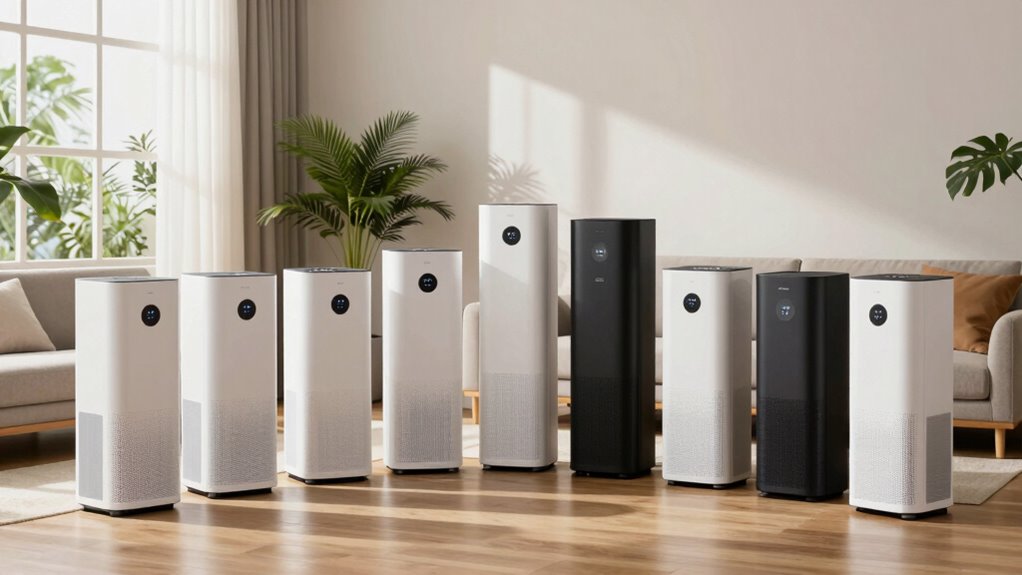
For most buyers seeking a HEPA air purifier for large rooms, I’d start with the LEVOIT Vital 200S-P for its smart controls and practical fit for shared living spaces. The Blueair Blue Pure 211i Max stands out for buyers prioritizing strong room coverage, while the DBFIT AP300 offers a large stated coverage area and an onboard particle display. The main tradeoff is that advertised square footage can reflect very different air-cleaning rates, while larger units may bring more noise, bulk, or filter upkeep. I compare these 15 options by room fit, usability, filtration details, and maintenance—not coverage claims alone. Read on for the full breakdown and guidance on matching a purifier to your room and routine.

Get cleaning gear delivered free — and shop member deals
- Fast, free delivery on millions of items
- Access to Prime Big Deal Days deals on October 6–7
- Prime Video, Amazon Music and more included
Complete the kit

Key Takeaways
- Coverage numbers aren’t directly interchangeable: Compare a purifier’s stated room area with the air-cleaning rate behind that claim, and check whether it matches how often you want air circulated.
- The LEVOIT Vital 200S-P offers the clearest smart-home fit: Its connected controls set it apart from simpler high-coverage models that focus on particle displays or basic operation.
- The Blueair Blue Pure 211i Max is the standout for buyers prioritizing a major-brand large-room option: It competes on a different footing from the many high-coverage models in the list whose claims deserve careful room-rate comparison.
- Several models emphasize monitoring and washable pre-filters: DBFIT AP300, MOOKA PR1, and HEARBOBO give buyers more visible particle feedback or a reusable first layer, but those features don’t replace checking HEPA filtration and replacement-filter needs.
- Compact, familiar picks still have a place: Coway Mighty and PuroAir 240 may suit smaller or more defined spaces better than a room-filling unit, while Honeywell HPA4300B appeals to buyers who prefer a traditional controls-and-filter format.
| DBFIT AP300 Air Purifier for Large Rooms up to 3000 sq ft with HEPA Filter and PM2.5 Display |  | Best for Quiet, Sensor-Led Purification | Coverage area: Up to 3,000 sq ft | Filter: H13 HEPA, washable pre-filter, and activated carbon | Fan speeds: 6 | VIEW ON AMAZON | See Our Full Breakdown |
| FreAire HAP611WF Air Purifier for Large Rooms (Up to 3,850 Sq Ft) |  | Best for Maximum Stated Coverage | Model: HAP611WF | Coverage area: Up to 3,850 sq ft | CADR: 450 CFM | VIEW ON AMAZON | See Our Full Breakdown |
| ECOSELF Air Purifier for Large Rooms up to 2400 Sq Ft with True HEPA Filter |  | Best for Simple Automatic Air Monitoring | Coverage area: Up to 2,400 sq ft | Filter: True HEPA | Air-quality sensing: Infrared sensor with AQI display | VIEW ON AMAZON | See Our Full Breakdown |
| LEVOIT Vital 200S-P Smart Air Purifier for Large Rooms |  | Best for Verified Airflow and Pet Hair | Coverage area: Up to 1,875 sq ft | Smoke CADR: 250 CFM | Dust CADR: 254 CFM | VIEW ON AMAZON | See Our Full Breakdown |
| MOOKA PR1 Air Purifier for Large Rooms (Up to 2200 sq.ft) with PM 2.5 Display, Pet Mode, and Washable Filter |  | Best for Pet-Focused Controls | Model: PR1 | Coverage area: Up to 2,200 sq ft | Filtration: 4-stage HEPA with washable pre-filter | VIEW ON AMAZON | See Our Full Breakdown |
| HEARBOBO Air Purifier for Large Rooms (Up to 3000 sq ft) with H13 HEPA Filter, PM2.5 Sensor, and Washable Pre-Filter |  | Best for Quiet, Sensor-Guided Operation | Model: K06 | Coverage area: Up to 3,000 sq ft | Filter type: H13 HEPA with washable pre-filter | VIEW ON AMAZON | See Our Full Breakdown |
| Coway Mighty AP-1512HH(W) Air Purifier, White |  | Best for Established Filtration and Odor Control | Model: Mighty AP-1512HH(W) | Coverage: Up to 1,748 sq ft in 60 minutes | Filtration: Four-stage system with washable pre-filter, deodorization filter, bipolar device, and HEPA filter | VIEW ON AMAZON | See Our Full Breakdown |
| FreAire HAP605 Air Purifier – White (covers up to 2600 ft²) |  | Best for Pet Households | Model: HAP605 | Coverage area: Up to 2,600 ft² | Filter type: HEPA with washable pre-filter | VIEW ON AMAZON | See Our Full Breakdown |
| SIESEAN H13 True HEPA Air Purifier for Large Rooms up to 3500 Sq Ft |  | Best for Maximum Stated Coverage | Coverage area: Up to 3,500 sq ft | CADR: 235 CFM | Filter type: H13 True HEPA and activated carbon | VIEW ON AMAZON | See Our Full Breakdown |
| Blueair Blue Pure 211i Max Air Purifier for Large Rooms |  | Best for App-Based Smart Control | Coverage area: Up to 3,235 sq ft | Filtration technology: HEPASilent dual filtration | Air intake: 360° | VIEW ON AMAZON | See Our Full Breakdown |
| FreAire Air Purifier for Large Rooms up to 2,600 sq ft |  | Best for Broad Stated Coverage | Coverage: Up to 2,600 sq ft per hour | Filtration: HEPA filter captures 99.97% of airborne particles | Air intakes: Triple intake | VIEW ON AMAZON | See Our Full Breakdown |
| KNKA APH4000 Air Purifier, White |  | Best for Clearly Specified Airflow | Model: APH4000 | Smoke/dust/PM2.5 CADR: 226 CFM (384 m³/h) | Pollen CADR: 244 CFM (415 m³/h) | VIEW ON AMAZON | See Our Full Breakdown |
| MOOKA Air Purifier for Large Rooms, White |  | Best for Quiet Nighttime Use | Coverage: Up to 2,200 sq ft | Filter system: Three-stage filtration with washable pre-filter and HEPA filter | Air-quality monitoring: PM2.5 sensor and display | VIEW ON AMAZON | See Our Full Breakdown |
| Honeywell Allergen Plus HEPA Air Purifier for Large Rooms, Black, HPA4300B |  | Best for Verified Room-Size Performance | Model: HPA4300B | Filtration: Four-layer system: pre-filter, True HEPA, activated carbon, extra layer | Particle capture: 99.97% of particles 0.3 microns and larger | VIEW ON AMAZON | See Our Full Breakdown |
| PuroAir 240 HEPA Air Purifier for Home, Pets, and Bedroom |  | Best for Mid-Size Rooms and Simple Controls | Coverage: Up to 1,000 sq ft in one hour | Filtration system: Three-layer: pre-filter, HEPA, activated carbon | Efficiency: Removes 99.9% of pollutants | VIEW ON AMAZON | See Our Full Breakdown |
| hepa air purifier for large room | Coverage area | Sleep-mode noise |
|---|---|---|
| DBFIT AP300 Air Purifier for L | Up to 3,000 sq ft | As low as 15 dB |
| FreAire HAP611WF Air Purifier | Up to 3,850 sq ft | 20 dB |
| ECOSELF Air Purifier for Large | Up to 2,400 sq ft | 22 dB |
| LEVOIT Vital 200S-P Smart Air | Up to 1,875 sq ft | — |
| MOOKA PR1 Air Purifier for Lar | Up to 2,200 sq ft | As low as 26 dB |
| HEARBOBO Air Purifier for Larg | Up to 3,000 sq ft | 20dB |
| Coway Mighty AP-1512HH(W) Air | — | — |
| FreAire HAP605 Air Purifier | Up to 2,600 ft² | 20dB |
| SIESEAN H13 True HEPA Air Puri | Up to 3,500 sq ft | 30dB |
| Blueair Blue Pure 211i Max Air | Up to 3,235 sq ft | — |
| FreAire Air Purifier for Large | — | 22 dB |
| KNKA APH4000 Air Purifier | — | — |
| MOOKA Air Purifier for Large R | — | As low as 20 dB |
| Honeywell Allergen Plus HEPA A | — | — |
| PuroAir 240 HEPA Air Purifier | — | — |
More Details on Our Top Picks
DBFIT AP300 Air Purifier for Large Rooms up to 3000 sq ft with HEPA Filter and PM2.5 Display
The DBFIT AP300 pairs a stated 3,000-square-foot coverage area with dual-side air intake, giving it a strong case for open living spaces where air enters from more than one direction. Its PM2.5 display and auto mode offer a visible way to track air quality and adjust operation, while the washable pre-filter can catch larger debris before it reaches the main filter. Compared with the higher-capacity FreAire HAP611WF, DBFIT covers less area but offers a lower stated sleep-mode noise level of 15 dB and more fan-speed choices. That makes it a better fit for buyers prioritizing quiet bedroom use alongside broad coverage. The tradeoffs are its sizable footprint and a main filter that needs replacement every three to six months; the coverage figure alone does not indicate how frequently it will exchange air in a particular room.
Pros:- Dual-side intake is designed to draw air from both sides.
- PM2.5 display and auto mode provide sensor-guided operation.
- Washable pre-filter catches larger particles and can reduce buildup on the main filter.
- Sleep mode is rated as low as 15 dB.
Cons:- Main filter replacement is specified every three to six months.
- The large unit may be awkward in compact rooms.
- The listed coverage area does not specify the air-change rate at that room size.
Best for: Households wanting a large-room purifier with a live PM2.5 readout, quiet sleep mode, and a washable pre-filter.
Not ideal for: People with little floor space or buyers who want to avoid recurring filter replacements.
- Coverage area:Up to 3,000 sq ft
- Filter:H13 HEPA, washable pre-filter, and activated carbon
- Fan speeds:6
- Sleep-mode noise:As low as 15 dB
- Air-quality monitoring:PM2.5 display with auto mode
- Timer:2, 4, or 8 hours
- Power consumption:0.6 kWh per 24 hours at maximum speed
- Additional features:Essential oil diffuser, child lock, and filter replacement reminder
Our verdict“Choose the DBFIT AP300 if quiet operation and an air-quality display matter more than the FreAire HAP611WF’s larger stated coverage.”
FreAire HAP611WF Air Purifier for Large Rooms (Up to 3,850 Sq Ft)
For buyers focused on a very large open area, the FreAire HAP611WF has the broadest stated coverage in this five-product group: up to 3,850 square feet, with a listed 450 CFM CADR. That separates it from the DBFIT AP300, whose stated coverage is 3,000 square feet and whose sleep mode is quieter on paper. FreAire instead adds app control, real-time PM2.5 monitoring, and a dedicated Pet Mode, so it suits a shared space where several people may want control or pets contribute hair and odors. Its 20 dB sleep mode and darkened display also favor bedroom use. The compromises are the need for genuine FreAire replacement filters to preserve warranty validity and a stated three-to-six-month filter replacement interval. Buyers should also match the coverage claim to their room and desired cleaning frequency rather than treating square footage as a complete performance measure.
Pros:- Highest stated coverage in this group at up to 3,850 sq ft.
- Listed 450 CFM CADR provides a second capacity reference beyond square footage.
- App and touch-panel controls pair with real-time PM2.5 monitoring.
- Pet Mode, washable pre-filter, and a 20 dB sleep mode support homes with pets and bedrooms nearby.
Cons:- Warranty validity requires genuine FreAire replacement filters.
- Filter replacement is specified every three to six months.
- Its 20 dB sleep-mode rating is higher than the DBFIT AP300’s stated 15 dB.
Best for: Owners of large open-plan homes who want app control, a PM2.5 readout, and a dedicated mode for pet-related debris and odors.
Not ideal for: Buyers seeking maximum sleep-mode quiet, flexible third-party filter choices, or a compact unit.
- Model:HAP611WF
- Coverage area:Up to 3,850 sq ft
- CADR:450 CFM
- Filter:HEPA with reusable washable pre-filter
- Sleep-mode noise:20 dB
- Controls:Touch panel and smart app
- Monitoring and modes:Real-time PM2.5 monitoring and Pet Mode
- Certifications:ETL, FCC, EPA, CARB, CA65, and DOE
- Warranty:1 year or longer
Our verdict“Pick the FreAire HAP611WF when its larger stated coverage and app controls matter more than the DBFIT AP300’s quieter sleep-mode rating.”
ECOSELF Air Purifier for Large Rooms up to 2400 Sq Ft with True HEPA Filter
The ECOSELF is a middle-capacity choice for buyers who want automated fan adjustment without the larger footprint implied by the FreAire HAP611WF’s 3,850-square-foot rating. Its stated coverage reaches 2,400 square feet, and an infrared sensor feeds an AQI display that adjusts fan speed as air quality changes. That gives it a straightforward role for living areas where users would rather let auto mode respond than select among multiple speeds themselves. Its 22 dB sleep-mode rating is quiet, though the DBFIT AP300 lists a lower 15 dB figure and more manual speed options. ECOSELF also includes aromatherapy, but that is an extra rather than a reason to choose it over a purifier with clearer airflow-capacity data. The supplied information does not include a CADR, and the recommendation to use official replacement filters may limit sourcing flexibility.
Pros:- Stated coverage of up to 2,400 sq ft suits larger rooms.
- Infrared sensing and an AQI display support automatic fan adjustment.
- 22 dB sleep mode is suited to quiet nighttime operation.
- Includes aromatherapy and a filter indicator.
Cons:- No CADR figure is provided in the supplied product data.
- Official ECOSELF replacement filters are recommended for performance.
- Its stated coverage is below the DBFIT AP300 and FreAire HAP611WF.
Best for: People with a large living area who want automatic sensor-based fan adjustment and a simple AQI display.
Not ideal for: Buyers who need a published CADR to compare airflow or want freedom to use alternative replacement filters.
- Coverage area:Up to 2,400 sq ft
- Filter:True HEPA
- Air-quality sensing:Infrared sensor with AQI display
- Automatic operation:Auto mode adjusts fan speed based on air quality
- Sleep-mode noise:22 dB
- Additional features:Aromatherapy and filter indicator
- Certifications:ETL, FCC, EPA, CARB, and DOE
- Warranty:1 year or longer
Our verdict“Choose ECOSELF for hands-off AQI-based operation in a large room, but favor the FreAire HAP611WF if you need a stated CADR and broader coverage.”
LEVOIT Vital 200S-P Smart Air Purifier for Large Rooms
The LEVOIT Vital 200S-P is the most evidence-led pick here for shoppers comparing airflow rather than relying on room-size claims alone. Its AHAM verification and independently tested CADR figures—250 CFM for smoke, 254 for dust, and 289 for pollen—give buyers useful benchmarks that the ECOSELF and MOOKA PR1 data do not provide. The U-shaped inlet is designed to draw in airborne pet hair, alongside a traditional inlet, making this a sensible fit for homes where fur and common allergens are frequent concerns. Its stated coverage, up to 1,875 square feet, is more modest than the DBFIT AP300’s 3,000-square-foot claim, so it is less compelling for the largest open-plan spaces. The supplied details do not state noise levels, operating costs, or a filter replacement interval, leaving ongoing-use comparisons incomplete.
Pros:- AHAM verified with independently tested CADR figures for smoke, dust, and pollen.
- U-shaped inlet is intended to capture airborne pet hair.
- Targets pollen, pet hair, dander, dust, and odors.
- Traditional and U-shaped inlets offer two air-entry designs.
Cons:- Stated coverage is lower than the DBFIT AP300 and FreAire HAP611WF.
- Supplied data does not include a noise-level rating.
- Supplied data does not state operating costs or filter replacement interval.
Best for: Pet owners and allergy-conscious buyers who want independently tested CADR figures to compare against their room needs.
Not ideal for: Shoppers prioritizing the largest stated coverage or requiring published noise and filter-replacement details before buying.
- Coverage area:Up to 1,875 sq ft
- Smoke CADR:250 CFM
- Dust CADR:254 CFM
- Pollen CADR:289 CFM
- Air inlets:Traditional and U-shaped
- Verification:AHAM verified
- Targeted pollutants:Pollen, pet hair, dander, dust, and odors
Our verdict“Choose the LEVOIT Vital 200S-P if verified CADR data and pet-hair handling outweigh the larger coverage claims of the DBFIT AP300.”
MOOKA PR1 Air Purifier for Large Rooms (Up to 2200 sq.ft) with PM 2.5 Display, Pet Mode, and Washable Filter
The MOOKA PR1 puts pet-related needs at the center of its design, combining a dedicated Pet Mode with a PM2.5 display, auto mode, and a washable pre-filter. Its stated coverage of up to 2,200 square feet places it between the LEVOIT Vital 200S-P and DBFIT AP300 by room-size claim, though unlike LEVOIT, the supplied product data gives no CADR figures for a direct airflow comparison. The six listed modes provide more named operating choices than ECOSELF’s auto-focused feature set, while its 26 dB sleep rating is less quiet on paper than the DBFIT’s 15 dB or FreAire’s 20 dB. The washable pre-filter needs regular cleaning to keep airflow from being obstructed, and the main filter is specified for replacement every three to six months. A startup indicator also flashes for a minute during preheating.
Pros:- Dedicated Pet Mode targets pet-related hair and odors.
- PM2.5 display works with auto mode for air-quality-responsive operation.
- Washable pre-filter can catch larger debris before it reaches the main filter.
- Six modes include sleep, auto, and pet settings.
Cons:- Washable pre-filter needs regular cleaning to maintain performance.
- Main filter replacement is specified every three to six months.
- Sleep mode is rated at 26 dB, above the DBFIT AP300 and FreAire HAP611WF figures.
Best for: Pet households wanting a dedicated operating mode, a PM2.5 display, and a washable pre-filter in a large-room purifier.
Not ideal for: Buyers who need published CADR figures, the quietest stated sleep mode, or minimal pre-filter upkeep.
- Model:PR1
- Coverage area:Up to 2,200 sq ft
- Filtration:4-stage HEPA with washable pre-filter
- Sleep-mode noise:As low as 26 dB
- Fan modes:6: Sleep, I, II, III, Auto, and Pet
- Air-quality monitoring:PM2.5 display with auto mode
- Certifications:CARB, ETL, DOE, and FCC
- Ozone release:None
Our verdict“Pick the MOOKA PR1 for its pet-specific controls and washable pre-filter, but choose the LEVOIT Vital 200S-P if verified CADR figures are your priority.”
HEARBOBO Air Purifier for Large Rooms (Up to 3000 sq ft) with H13 HEPA Filter, PM2.5 Sensor, and Washable Pre-Filter
The HEARBOBO pairs dual-sided intake with an H13 HEPA filter and a washable pre-filter, making it a strong fit for homes that want broad circulation without frequent pre-filter replacement. Its PM2.5 display and auto mode give it more real-time feedback than a basic large-room purifier, while the 20dB sleep setting suits bedrooms where fan noise matters. Compared with the FreAire HAP605, HEARBOBO lists a larger coverage figure, though the stated 3,000-square-foot reach depends on test conditions and should not be treated as equivalent cleaning speed in every open-plan home. The main HEPA filter still needs replacement every 3–6 months, and the aroma pad does not include essential oils. I’d pick it for quiet monitoring, not for buyers who need independently specified cleaning speed.
Pros:- Dual-side intake is designed to draw air from more than one direction.
- Washable pre-filter can catch larger debris before it reaches the HEPA filter.
- PM2.5 display and auto mode respond to changing air quality.
- 20dB sleep setting is suited to noise-sensitive rooms.
Cons:- The main HEPA filter is not washable and calls for replacement every 3–6 months.
- The 3,000-square-foot coverage claim may not reflect performance in every open layout.
- Essential oils for the aroma pad are not included.
Best for: Bedroom or nursery owners who want quiet operation, automatic fan adjustment, and a washable first-stage filter.
Not ideal for: Buyers who need a clearly stated CADR or dependable high-speed cleaning across a large, open floor plan.
- Model:K06
- Coverage area:Up to 3,000 sq ft
- Filter type:H13 HEPA with washable pre-filter
- Sleep-mode noise:20dB
- Height:16.14 inches
- Air-quality features:PM2.5 sensor and auto mode
- Filter replacement interval:Every 3–6 months
- Certifications:CARB, ETL, FCC, RoHS, GS
Our verdict“Choose HEARBOBO for quiet, sensor-led use in a large bedroom or living area, but look elsewhere if you need a stated CADR to judge cleaning speed.”
Coway Mighty AP-1512HH(W) Air Purifier, White
The Coway Mighty takes a more grounded approach to large-room coverage than the high-area claims of the HEARBOBO or SIESEAN: its stated reach is up to 1,748 square feet in 60 minutes. That makes the coverage figure easier to interpret, though it may be modest for buyers expecting rapid cleaning across a very large open plan. Its four-stage system combines a washable pre-filter, deodorization filter, bipolar device, and HEPA filter, giving it a broader filtration setup than a simple HEPA-and-prefilter arrangement. Auto and Eco modes, air-quality monitoring, and filter alerts make routine operation straightforward. The tradeoff is ongoing filter care, and the supplied information does not give a noise figure or CADR for direct comparison with the SIESEAN’s 235 CFM. I’d favor Coway when filtration stages and clear maintenance prompts matter more than maximum stated reach.
Pros:- Four-stage system includes both a deodorization filter and a HEPA filter.
- Washable pre-filter helps catch larger particles before they reach the other filters.
- Auto mode adjusts operation based on monitored air quality.
- Filter alerts, timer, and light-off option support routine use.
Cons:- Stated coverage is up to 1,748 sq ft in 60 minutes, below several other models in this group.
- Filter replacement and regular pre-filter cleaning are required.
- The provided specifications do not state a noise level or CADR.
Best for: Households with a medium-to-large living area that want HEPA filtration, odor reduction, and maintenance alerts.
Not ideal for: Owners of very large open-plan spaces who want a purifier with a higher stated coverage area or a listed CADR.
- Model:Mighty AP-1512HH(W)
- Coverage:Up to 1,748 sq ft in 60 minutes
- Filtration:Four-stage system with washable pre-filter, deodorization filter, bipolar device, and HEPA filter
- Particle filtration:Reduces 99.97% of 0.3-micron particles
- Modes:Auto and Eco
- Controls and alerts:Air-quality indicator, filter alerts, timer, and light-off option
- Warranty:3 years
- Color:White
Our verdict“Choose the Coway Mighty for staged particle and odor filtration with clear maintenance prompts, not for the widest stated coverage.”
FreAire HAP605 Air Purifier – White (covers up to 2600 ft²)
For homes where pet hair and dander are the main concern, the FreAire HAP605 has a specific advantage over the Coway Mighty: its Turbo Pet Mode is designed to raise airflow when the room needs a stronger cleanup. The triple-air intake draws from three directions, while a washable pre-filter gives owners a convenient way to remove larger debris between HEPA filter changes. Its PM2.5 sensor and auto mode bring useful monitoring, and the 20dB sleep mode switches off display lights for bedrooms. The stated coverage reaches 2,600 square feet, below the SIESEAN’s 3,500-square-foot claim, and the listed warranty is one year. Buyers should also plan on HEPA filter replacements every 3–6 months and use genuine FreAire replacements. I’d choose it for pet-focused airflow and quiet nighttime operation rather than maximum coverage.
Pros:- Turbo Pet Mode provides a dedicated higher-airflow setting for pet-heavy rooms.
- Triple intake is designed to draw air from three directions.
- PM2.5 sensing and auto mode adjust fan speed as air quality changes.
- 20dB sleep mode turns off display lights.
Cons:- Coverage claim of up to 2,600 sq ft is lower than the SIESEAN’s stated 3,500 sq ft.
- HEPA filter replacement is needed every 3–6 months.
- The manufacturer recommends genuine replacement filters, and the warranty is one year.
Best for: Pet owners who want a dedicated higher-airflow mode, washable pre-filter, and quiet nighttime settings.
Not ideal for: Buyers prioritizing the largest stated coverage or a longer listed warranty.
- Model:HAP605
- Coverage area:Up to 2,600 ft²
- Filter type:HEPA with washable pre-filter
- Pet setting:Turbo Pet Mode
- Air-quality sensor:PM2.5 sensor with auto fan adjustment
- Sleep-mode noise:20dB
- Warranty:1 year
- Color:White
Our verdict“Pick the HAP605 for pet-focused airflow and quiet sleep settings, but choose a higher-coverage model for the largest open spaces.”
SIESEAN H13 True HEPA Air Purifier for Large Rooms up to 3500 Sq Ft
The SIESEAN offers the largest stated coverage in this five-product group, paired with a listed 235 CFM CADR that gives buyers more information about airflow than the coverage figures supplied for HEARBOBO or FreAire HAP605. Its H13 True HEPA and activated carbon combination targets fine particles as well as odors, while dual-sided airflow supports circulation through large spaces. A PM2.5 display and auto mode provide basic air-quality feedback, and ENERGY STAR certification plus stated consumption as low as 0.66 kWh per day may appeal to households that run a purifier for long periods. The tradeoffs are a 30dB sleep setting—louder on paper than the 20dB options—and filter changes every 3–4 months. Compared with the Blueair 211i Max, SIESEAN gives a higher coverage claim and listed CADR, but its floor-standing design needs room.
Pros:- Up to 3,500 sq ft is the highest stated coverage among these five options.
- 235 CFM CADR provides an additional airflow figure for comparing performance.
- H13 True HEPA and activated carbon address particles and odors.
- ENERGY STAR certification and stated low daily energy use suit extended operation.
Cons:- 30dB sleep mode is louder on paper than the 20dB HEARBOBO and FreAire HAP605.
- Filter replacement is specified every 3–4 months.
- Floor-standing design occupies usable floor space.
Best for: Owners of large open-plan homes who want the highest stated coverage in this group and a published CADR.
Not ideal for: Light sleepers who prioritize the lowest listed sleep noise or buyers without floor space for a standing unit.
- Coverage area:Up to 3,500 sq ft
- CADR:235 CFM
- Filter type:H13 True HEPA and activated carbon
- Filtration efficiency:99.97% at 0.1μm
- Sleep-mode noise:30dB
- Power consumption:As low as 0.66 kWh/day
- Filter replacement interval:Every 3–4 months
- Certifications:CARB, DOE, EPA, UL, ENERGY STAR
- Features:PM2.5 display, auto mode, child lock, timer, and dimmer
Our verdict“Choose SIESEAN when broad stated coverage and a listed CADR lead your priorities, provided its noise level and floor footprint suit the room.”
Blueair Blue Pure 211i Max Air Purifier for Large Rooms
The Blueair Blue Pure 211i Max stands out for buyers who want app-based monitoring alongside automatic air-quality response. Its HEPASilent dual filtration and 360-degree intake are designed for large rooms, with a stated reach of up to 3,235 square feet—between the FreAire HAP605’s 2,600 and the SIESEAN’s 3,500. That makes it a plausible middle ground on coverage, while the connected controls distinguish it from the more straightforward HEARBOBO, which provides a PM2.5 display directly on the unit. The tradeoff is that full monitoring and control depend on the mobile app, so buyers who prefer simple onboard controls may find it less appealing. Its large footprint also needs a considered placement. The supplied data does not specify CADR, filter life, or noise level, limiting direct performance comparisons.
Pros:- Stated coverage reaches up to 3,235 sq ft.
- Built-in air-quality sensors automatically adjust fan speed.
- Mobile app provides monitoring and filter-life information.
- 360-degree intake supports air draw from around the unit.
Cons:- Full monitoring and control features require the mobile app.
- Large footprint can be difficult to place in smaller rooms.
- The supplied specifications do not state CADR, noise level, or filter replacement interval.
Best for: Connected-home users who want app monitoring and automatic fan adjustment in a large living room or office.
Not ideal for: Buyers who avoid app-dependent controls, need a compact unit, or want a stated CADR and filter replacement interval before choosing.
- Coverage area:Up to 3,235 sq ft
- Filtration technology:HEPASilent dual filtration
- Air intake:360°
- Smart sensors:Built-in air-quality sensors with automatic fan adjustment
- App features:Mobile app monitoring and filter-life information
- Design:Scandinavian design
- Operation:Quiet and energy-efficient
Our verdict“Choose the Blueair 211i Max for app-connected air-quality control across a large room, but favor a simpler model if you want key performance details or controls on the unit.”
FreAire Air Purifier for Large Rooms up to 2,600 sq ft
The FreAire pairs a 2,600-square-foot-per-hour coverage claim with triple air intakes, a washable pre-filter, and automatic fan adjustment. That combination suits buyers who want a purifier to respond to changing particle levels without constant manual changes. Its 22 dB sleep mode is quieter on paper than the Honeywell HPA4300B, whose supplied specs do not give a sleep-mode decibel figure. The tradeoff is that the coverage figure alone does not tell you how often air is refreshed across a large room, so I would compare it with the KNKA APH4000’s explicit refresh-rate and CADR data when sizing for a specific space. Filter upkeep also needs planning: replacements are recommended every three to six months, and the manufacturer advises using its own filters.
Pros:- Triple air intakes support the stated coverage of up to 2,600 sq ft per hour
- PM2.5 monitoring can trigger automatic fan adjustment
- Washable pre-filter helps catch larger debris before it reaches the main filter
- Sleep mode is rated at 22 dB
Cons:- Coverage information does not specify air changes per hour for a large room
- Replacement filters are recommended every 3–6 months
- Manufacturer recommends its own replacement filters
Best for: Buyers prioritizing a broad stated coverage area, automatic air-quality response, and a washable pre-filter for routine upkeep
Not ideal for: Shoppers who want clearly stated CADR or large-room air-change figures, or who prefer flexibility in choosing replacement filters
- Coverage:Up to 2,600 sq ft per hour
- Filtration:HEPA filter captures 99.97% of airborne particles
- Air intakes:Triple intake
- Air-quality sensor:PM2.5
- Fan speeds:4
- Sleep-mode noise:22 dB
- Pre-filter:Washable
- Recommended filter replacement:Every 3–6 months
Our verdict“Choose the FreAire if broad stated coverage and quiet automatic operation matter more to you than detailed CADR and room-refresh data.”
KNKA APH4000 Air Purifier, White
The KNKA APH4000 is the most data-forward choice here for matching purifier output to room size: it lists CADR figures and distinguishes frequent cleaning in rooms up to 350 sq ft from once-per-hour coverage up to 1,695 sq ft. That makes its limits easier to interpret than the broad coverage claims on the FreAire and MOOKA models. Dual three-stage filters add washable pre-filters and activated carbon, while PET, ECO, Auto, and Sleep modes give households more ways to tailor operation. The main compromise is capacity at the maximum stated area: 1,695 sq ft means one air refresh per hour, not the faster turnover specified for smaller rooms. Buyers needing stronger large-room circulation should compare the Honeywell HPA4300B’s stated 4.8 air changes per hour in a much smaller area.
Pros:- Lists smoke/dust/PM2.5 and pollen CADR figures
- States different refresh rates for smaller and larger spaces
- Dual three-stage filters include washable pre-filters and activated carbon
- Real-time AQI display and PET, ECO, Sleep, and Auto modes
Cons:- Coverage up to 1,695 sq ft is rated for one air refresh per hour
- Filters are recommended for replacement every 3–6 months
Best for: Buyers who want CADR figures and stated air-refresh rates to size a purifier for a defined room, especially pet households using PET mode
Not ideal for: People who need frequent air changes throughout a room near 1,695 sq ft or want to avoid regular filter replacement
- Model:APH4000
- Smoke/dust/PM2.5 CADR:226 CFM (384 m³/h)
- Pollen CADR:244 CFM (415 m³/h)
- Coverage:Up to 1,695 sq ft at one air refresh per hour
- Air-refresh rate:4.8 times per hour in rooms up to 350 sq ft
- Filtration:Dual three-stage filters: washable pre-filter, high-efficiency filter, activated carbon filter
- Modes:PET, ECO, Sleep, and Auto
- Sleep noise:22–24 dB
- Filter replacement interval:Every 3–6 months
Our verdict“Pick the KNKA if you value airflow figures that clarify room-size limits more than the bigger coverage claims on the FreAire or MOOKA.”
MOOKA Air Purifier for Large Rooms, White
MOOKA’s stated 20 dB sleep mode is the clearest reason to choose it over the other large-room options in this group, including the KNKA APH4000 at 22–24 dB and the FreAire at 22 dB. It also supplies a PM2.5 display, automatic mode, timer settings, and a washable pre-filter, making it a feature-rich choice for a bedroom or shared living space. Its coverage claim reaches 2,200 sq ft, but the supplied details do not say how often air is refreshed across that full area; I would not treat the number as equivalent to the Honeywell HPA4300B’s explicit 4.8 changes per hour in a smaller room. The aromatherapy pad is optional, not a built-in scent supply, and replacement filters must be bought separately.
Pros:- Sleep mode is rated as low as 20 dB, the lowest stated level among these five products
- PM2.5 sensor and display support air-quality monitoring
- Washable pre-filter and filter reminder support routine maintenance
- Auto mode, four fan speeds, timer, child lock, and lights-off sleep mode
Cons:- The 2,200 sq ft coverage figure does not specify an air-refresh rate
- Replacement filters must be purchased separately
- Aromatherapy requires adding essential oil to the pad
Best for: Light sleepers seeking a quiet purifier with air-quality monitoring and automatic operation for a large bedroom or living area
Not ideal for: Buyers who need a stated air-change rate for a very large room or want replacement filters included with ongoing ownership
- Coverage:Up to 2,200 sq ft
- Filter system:Three-stage filtration with washable pre-filter and HEPA filter
- Air-quality monitoring:PM2.5 sensor and display
- Fan speeds:4
- Timer:2, 4, 6, or 8 hours
- Sleep-mode noise:As low as 20 dB
- Maximum-speed energy use:0.63 kWh per 24 hours
- Certifications:CARB, ETL, DOE
Our verdict“Choose this MOOKA for especially quiet nighttime operation, but look elsewhere if you need a documented refresh rate across the full stated coverage area.”
Honeywell Allergen Plus HEPA Air Purifier for Large Rooms, Black, HPA4300B
The Honeywell is the strongest fit for buyers who want a defined high-turnover room size rather than relying on a maximum-area claim alone: it is rated for 4.8 air changes per hour in rooms up to 354 sq ft, with a larger 1,718 sq ft figure listed for one change per hour. That distinction makes it easier to judge against the KNKA APH4000, which also separates smaller-room refresh performance from broad coverage. Its four-layer system combines True HEPA and activated carbon, while AQSense Auto Mode adjusts fan speed based on air quality. The one-click LessMess filter change and carry handle help with upkeep and moving it between rooms. Its high-turnover coverage is far smaller than the MOOKA’s stated 2,200 sq ft, and its footprint may not suit tight spaces.
Pros:- AHAM Verifide, with room coverage stated for both 4.8 and one air change per hour
- Four-layer filtration includes True HEPA and activated carbon
- AQSense Auto Mode adjusts fan speed using air-quality readings
- One-click LessMess filter change, carry handle, and child lock
Cons:- The 4.8-air-changes-per-hour rating applies to rooms up to 354 sq ft, not the maximum listed area
- Larger footprint may be awkward in crowded spaces
- Replacement filter costs may add up over time
Best for: Allergy- or smoke-sensitive households prioritizing AHAM-verified circulation, automatic sensing, and straightforward filter changes in a room around 354 sq ft
Not ideal for: Buyers expecting frequent air changes across a very large open-plan space or seeking a compact purifier for a crowded room
- Model:HPA4300B
- Filtration:Four-layer system: pre-filter, True HEPA, activated carbon, extra layer
- Particle capture:99.97% of particles 0.3 microns and larger
- High-turnover coverage:Up to 354 sq ft at 4.8 air changes per hour
- Maximum room size:Up to 1,718 sq ft at one air change per hour
- Air-quality controls:AQSense Auto Mode and color-coded air-quality indicator
- Maintenance features:One-click LessMess filter change
- Certification:AHAM Verifide
Our verdict“Choose the Honeywell when clearly stated high-turnover coverage and easier filter changes matter more than covering the largest area at a slower rate.”
PuroAir 240 HEPA Air Purifier for Home, Pets, and Bedroom
The PuroAir 240 takes a simpler approach than the sensor-rich FreAire and MOOKA: its useful headline is coverage up to 1,000 sq ft in one hour, paired with a three-layer pre-filter, HEPA, and activated-carbon system. A smart particle sensor and Auto Mode provide automatic operation, while Sleep Mode gives bedroom users a quieter setting, though no decibel figure is supplied. Compared with the Honeywell HPA4300B, PuroAir offers a larger stated one-hour coverage area but does not provide a high-turnover air-change figure or AHAM verification in the supplied specs. Its two-year warranty is a helpful ownership detail. The gaps are practical: filter replacement timing and cost are unspecified, leaving ongoing maintenance harder to plan than with the KNKA, FreAire, or MOOKA.
Pros:- Coverage is stated as up to 1,000 sq ft in one hour
- Three-layer filtration combines pre-filter, HEPA, and activated carbon
- Smart particle sensor supports Auto Mode
- Includes a two-year warranty
Cons:- No sleep-mode noise figure is provided
- Filter replacement interval and cost are unspecified
- Supplied specs do not state CADR or a high-turnover air-change rate
Best for: Households wanting a straightforward HEPA purifier for a room up to 1,000 sq ft, with automatic sensing and a stated two-year warranty
Not ideal for: Buyers who need frequent air changes in a large open-plan space, published noise data, or clear filter replacement guidance
- Coverage:Up to 1,000 sq ft in one hour
- Filtration system:Three-layer: pre-filter, HEPA, activated carbon
- Efficiency:Removes 99.9% of pollutants
- Features:Smart particle sensor, Sleep Mode, Auto Mode
- Warranty:2 years
- Certifications:CARB, ETL, ISO, UL
Our verdict“Pick the PuroAir 240 for a mid-size room and simple automatic operation, but choose the Honeywell or KNKA if airflow-rate details are a priority.”

How We Picked
I ranked these purifiers around the needs that matter in a large room: credible room-fit information, filtration clarity, operating controls, upkeep, and how practical the unit is likely to be in daily use. I treated advertised square footage as a starting point rather than proof of equivalent performance, since room coverage can depend on the air-change rate used to calculate it. I also looked at features that can affect day-to-day decisions, such as particle displays, smart controls, pet modes, and washable pre-filters.
The order favors options with a useful balance of large-room intent and buyer-friendly features, rather than the biggest coverage number alone. The LEVOIT Vital 200S-P ranks highly for its smart-use case; Blueair Blue Pure 211i Max is a strong alternative for buyers drawn to its large-room positioning; and DBFIT AP300 stands out for visible particle monitoring. Models with less clear differentiation, more limited room fit, or a narrower use case sit lower. Filter availability, noise at useful fan settings, and replacement schedules can change the best choice for a particular household, so I call out those tradeoffs rather than treating any one feature as decisive.
Factors to Consider When Choosing Hepa Air Purifier For Large Rooms
Before choosing a large-room purifier, I’d match the unit to the room and the way you’ll run it—not just the largest coverage figure on the box. These checks can help distinguish a genuinely suitable everyday machine from one that only appears powerful on paper.
Match Coverage to Air Changes, Not Just Floor Area
A coverage claim is most useful when you know the air-change rate it assumes. The same purifier may be advertised for a very large area at a low circulation rate and a smaller area when cleaning air more frequently. For allergy symptoms or recurring smoke, faster turnover may matter more than covering the full open-plan footprint at a gentle setting. Measure the room, account for connected spaces, and compare the manufacturer’s room-size figures at the air-change rate you want. If that rate isn’t clearly stated, treat the largest square-foot figure as a rough ceiling, not a guarantee. A unit sized with some headroom can also run at a quieter setting than one pushed to its limit.
Check What the HEPA Claim Actually Means
“HEPA” and “True HEPA” appear across this category, but buyers should check the exact filter description and replacement part rather than relying on a badge or a model name. A purifier’s result also depends on how air moves through the complete unit, including seals and the filter housing. Some listings pair a HEPA layer with carbon or another stage; that can help with odors, but the amount and type of carbon matter. For particles, focus on the stated filtration standard and whether replacement filters are easy to identify. Don’t assume a washable pre-filter can be washed together with, or replace, the main HEPA filter. Verify the care instructions before planning maintenance.
Think About Where the Air Can Flow
Large-room performance depends on placement as well as machine capacity. A purifier tucked behind a sofa or pressed close to curtains may have restricted intake or exhaust, reducing useful circulation. Open-plan layouts can be trickier than one enclosed room because walls, doorways, and furniture interrupt airflow. Look at the intake and outlet direction before choosing a spot, and leave the clearances the manufacturer specifies. If the space has separate rooms, one large purifier may not clean them as evenly as smaller units placed where people spend time. This is a layout problem, not something a larger coverage number automatically fixes.
Balance Fan Speed, Noise, and Runtime
The highest fan setting often produces the most air movement, but it may be too loud for work, conversation, or sleep. A common mistake is selecting a unit by peak performance and then rarely using it above a quiet setting. Check whether the purifier offers a useful middle speed, a sleep mode, a timer, or scheduling that fits your routine. Auto mode can reduce manual adjustments, but its sensors respond to what they detect near the unit and may not represent every corner of a large room. If you need frequent particle removal, favor a model you’re willing to run consistently. A quieter unit at a practical setting may serve you better than a larger one that stays switched off.
Budget for Replacement Filters and Cleaning
Purchase cost is only one part of ownership; replacement filters and their recommended intervals shape the longer-term commitment. Before settling on a model, look up the correct filter part, confirm that it is sold separately, and read how often the maker advises replacing it. Homes with pets, smoke, or heavy dust may load pre-filters faster and call for more frequent cleaning. Washable pre-filters can reduce the need to replace that first layer, but they still require hands-on care and do not remove the need to maintain the main filter. Consider how easy it is to open the unit and vacuum or wash the pre-filter. A purifier that is simple to maintain is more likely to stay in regular use.
Choose Extras That Solve Your Actual Problem
Particle displays, app controls, pet modes, and timers can make a purifier easier to manage, but they don’t all improve filtration itself. A live PM2.5 reading may help you see changes in detected particles near the device; it doesn’t certify that the whole room is clean. Smart scheduling is useful if you want operation to follow a household routine, while basic controls may be preferable if you want less setup. Carbon filtration is more relevant when odors or some gases are a concern, though a small carbon layer may have limited capacity. Start with your main issue—dust, seasonal allergens, pet dander, or smoke—and pay for extras only when they address it. This keeps convenience features from distracting from room fit and filter upkeep.
Frequently Asked Questions
How do I know whether a purifier’s large-room coverage claim is enough for my space?
Check the room size listed for the air-change rate you want, not only the largest square-foot claim. If the maker gives multiple coverage figures, the smaller one may reflect more frequent air circulation and be more relevant for allergy or smoke concerns. Measure the area you actually want cleaned, including connected sections only if air can move freely between them. High ceilings, closed doors, and obstructed airflow can make a nominally suitable unit less effective in practice. When the air-change information is missing, compare cautiously rather than assuming all large-room claims mean the same thing.
Is one large purifier better than two smaller purifiers for an open-plan home?
One large unit can be a tidy choice for a mostly open area where air can circulate around the purifier. Two smaller units may work better when the floor plan has separate zones, doorways, or barriers that limit airflow. Splitting the units can also let you target a bedroom and living space independently, though it means maintaining two sets of filters. Compare the combined room-rate information and filter upkeep with the single-unit alternative. Placement and the way your household uses the rooms should decide the setup, not coverage totals added together in isolation.
Can a washable pre-filter replace the HEPA filter?
No. A washable pre-filter usually catches larger particles such as lint, hair, and visible dust, helping protect the finer filtration stage. The main HEPA filter has a different job and generally requires replacement according to the manufacturer’s schedule. Washing a filter that is not designed to be washable can damage it or reduce its performance. Follow the model’s care instructions, including drying requirements for any washable component. A washable pre-filter can reduce some routine replacement needs, but it does not make the main filter maintenance-free.
Should I prioritize a particle sensor or smart app controls?
Choose based on the task you want to make easier. A particle display can show changes detected near the purifier, which may help you decide when to increase fan speed, but it cannot report air quality uniformly across a large room. App controls are more useful when you want remote operation, scheduling, or adjustments without walking to the machine. Neither feature guarantees stronger particle removal; that depends on the unit’s filtration and airflow. If you prefer simple operation, a clear control panel and a suitable automatic mode may be more useful than adding connected features.
Which features matter most if I have pets and allergies?
Start with a suitable room rate and a clearly specified HEPA filter, then look at how easily you can clean the pre-filter and replace the main one. Pet hair and larger debris can collect on the first layer, so accessible cleaning can make routine care less of a chore. A pet mode may offer a convenient setting, but compare what it actually changes—such as fan speed or runtime—rather than treating the label as a separate filtration system. Odor control may call for a carbon stage, though its capacity varies by design. For allergies, consistent operation and timely filter care matter as much as extra modes or displays.
Conclusion
For the broadest mix of smart controls and large-room usability, I’d choose the LEVOIT Vital 200S-P as the best overall. The DBFIT AP300 is my value-minded pick for buyers who want a high stated coverage figure and visible particle readings, provided they verify room-rate details and replacement-filter costs before buying. If you want a premium-positioned alternative, consider the Blueair Blue Pure 211i Max; its large-room focus makes it the clearest fit for shoppers drawn to a major-brand option. For beginners who prefer a familiar, straightforward format, the Coway Mighty AP-1512HH(W) is a sensible starting point for a more defined room rather than a sprawling open plan. Pet owners can compare the MOOKA PR1 and HEARBOBO for pet-oriented features and washable pre-filters, while buyers focused on traditional controls can look at Honeywell HPA4300B. Whichever one you choose, confirm the room-rate assumptions, filter availability, and placement needs before treating a coverage claim as a match.
Fall Picks
fall essentials
As an affiliate, we earn on qualifying purchases.