For most buyers seeking a floor polisher for marble and stone, I would start with the Prolux Core 13-inch: its wider cleaning path is better suited to broad floor areas than the handheld polishers here. The Ewbank EP170 is a more approachable multi-use option for routine care, while the iMeshbean 860W suits focused polishing and detail work with diamond pads. The key tradeoff is between an upright machine that covers more floor and a wet polisher that offers more control over smaller sections. Stone type, finish, and the right pad matter just as much as motor power, so a polisher is not a substitute for choosing stone-safe materials. Read on for the full breakdown and a guide to matching a machine to your floor.

Get cleaning gear delivered free with Prime
- Fast, free delivery on millions of items
- Prime Video, Amazon Music and more included
- Member-only deals all year
Complete the kit


Key Takeaways
- The Prolux Core’s 13-inch path gives it the clearest role for larger floor areas; the four-inch wet polishers are better suited to localized work.
- The Ewbank EP170 favors routine, multi-use floor care over the focused stone-polishing approach of the diamond-pad handheld models.
- Four-inch pads trade coverage for control, making the iMeshbean, Bonvoisin, Antstone, and VEVOR more practical around small sections and edges than across an entire room.
- Included diamond pads and speed settings vary by model; buyers should check the pad sequence and compatibility rather than treating a larger kit as proof of a better finish.
- No single model fits every marble or stone job: floor size, stone sensitivity, water control, and operator experience shape the right choice more than wattage alone.


| floor polisher for marble and stone | Brand | Power | Model | Included components |
|---|---|---|---|---|
| iMeshbean 860W Variable-Speed | iMeshbean | 860W | 20970 | Wet polisher grinder, wet grinding discs, diamond polishing pad, 4-inch millstones, dust cover, side handle, carbon brushes, faucet, water pipe, and wrench |
| Ewbank EP170 Multi-Use Floor C | Ewbank | 160 watts | EP170 | — |
| Prolux Core 13-inch Electric F | — | — | — | — |
| Bonvoisin 800W 4-Inch Wet Poli | Bonvoisin | 800 watts | YJWDD-70 | — |
| Antstone Wet Polisher 800W 6 V | Antstone | 800 W | — | Electric wet stone polisher, self-adhesive polishing disc, water shroud, U-type auxiliary handle, iron hoop, 7 wet polishing pads, hex wrench, wrench, side handle, 2 carbon brushes, and ground fault circuit interrupter |
| VEVOR 800W Wet Polisher with 6 | VEVOR | 800 W | — | 7 polishing kits, GFCI switch, wet polisher |
More Details on Our Top Picks
iMeshbean 860W Variable-Speed Wet Polisher Grinder with 4-Inch Diamond Polishing Pad
The iMeshbean 860W offers the broadest speed range in this group, topping out at 5,000 RPM. That higher ceiling gives stoneworkers more flexibility for polishing tasks, while the water distribution system supports wet work on marble, concrete, and tile. It comes with a diamond pad, grinding discs, and handles, so buyers have useful starting accessories rather than a bare tool. Compared with the Bonvoisin 800W Wet Polisher, it reaches a higher maximum speed but does not list GFCI protection among its features. Its 59-inch cable also gives less reach than a full-size floor buffer’s long cord, and this 4-inch grinder is better suited to edges, smaller areas, and focused surface work than polishing an entire room. Wet operation requires a water connection.
Pros:- Variable speed from 1,100 to 5,000 RPM offers a wide working range.
- Water distribution supports wet polishing of stone and marble.
- Includes a diamond polishing pad, grinding discs, and other accessories.
- Top and side handles provide alternative grip positions.
Cons:- Wet polishing requires a water connection and creates water-management needs.
- The 4-inch working format is slow for large floor areas.
- The listed 59-inch cable limits reach without an extension.
Best for: DIY stoneworkers who want variable speed and a higher RPM ceiling for polishing smaller marble or stone sections, edges, and tile.
Not ideal for: People polishing large uninterrupted floors or anyone who needs a clearly specified GFCI-equipped tool and does not want to manage a water connection.
- Brand:iMeshbean
- Model:20970
- Power:860W
- Voltage:110V
- Speed:1,100–5,000 RPM
- Material:Aluminum
- Dimensions:12 x 17 x 12 in
- Cable length:59 in
- Included components:Wet polisher grinder, wet grinding discs, diamond polishing pad, 4-inch millstones, dust cover, side handle, carbon brushes, faucet, water pipe, and wrench
Our verdict“Choose the iMeshbean for small-area stone work where its higher speed range matters more than broad floor coverage or longer reach.”
Ewbank EP170 Multi-Use Floor Cleaner, Scrubber, and Polisher
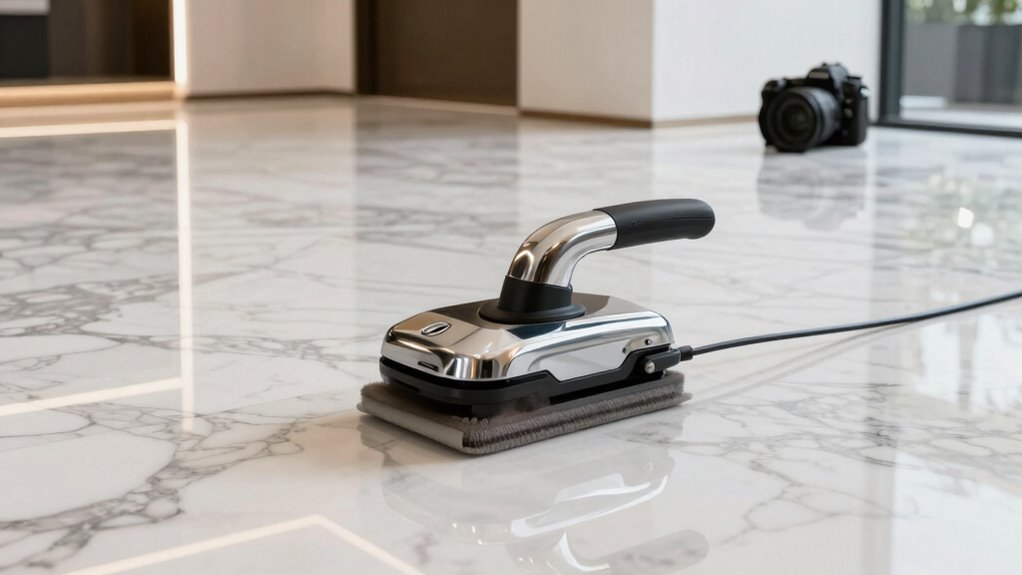
The Ewbank EP170 is the household-floor option here: its contra-rotating discs and included brushes and pads handle cleaning, scrubbing, and polishing without requiring a specialist stone-grinding setup. At less than 8 pounds, it is easier to guide around a furnished room than the heavier Prolux Core 13-inch Electric Floor Buffer. The tradeoff is a 9.5-inch cleaning path and 160-watt motor, which suit regular care better than intensive restoration or removing deep damage from marble. Its interchangeable pads also make it more adaptable to mixed hard floors, but the unit is intended for bare floors, not carpets. I would choose it for maintenance and surface cleaning rather than for a buyer seeking the water-fed diamond polishing approach offered by the Bonvoisin or Antstone.
Pros:- Combines cleaning, scrubbing, and polishing in one machine.
- Includes interchangeable brushes, scouring pads, cleaning pads, and polishing pads.
- Weighs less than 8 pounds for easier handling around furniture.
- 23-foot power cord offers more reach than the iMeshbean’s listed cable.
Cons:- The 9.5-inch cleaning path means more passes across broad floors.
- Its 160-watt design is aimed at maintenance rather than demanding stone restoration.
- Designed for bare hard floors rather than carpet cleaning.
Best for: Homeowners maintaining marble or granite alongside other bare hard floors who want one lightweight machine for routine cleaning and buffing.
Not ideal for: Stone restoration buyers who need diamond abrasives, wet grinding, or a wider path for large floor areas.
- Brand:Ewbank
- Model:EP170
- Functions:Cleaning, scrubbing, and polishing
- Disc speed:2,200 rpm
- Power:160 watts
- Voltage:120 V
- Cleaning path:9.5 inches
- Power cord:23 feet
- Weight:Less than 8 lbs
Our verdict“Pick the Ewbank for lightweight, recurring care of marble and other hard floors, not for repairing or aggressively polishing stone.”
Prolux Core 13-inch Electric Floor Buffer, Scrubber & Polisher
For polishing and scrubbing a larger expanse of marble or other hard flooring, the Prolux Core’s 13-inch cleaning path covers more ground per pass than the Ewbank EP170’s 9.5-inch path. Its low-speed, high-torque motor runs at 150 RPM, a very different approach from the high-speed, 4-inch wet grinders in this lineup: this is a floor buffer for broad-area maintenance, not a detail polisher for edge work or focused stone correction. Five interchangeable pads let buyers match the task to a pad, and the 50-foot cord helps reach across rooms without frequent outlet changes. The cost of that coverage is a heavier machine that can be less nimble in tight spaces. Its listed details do not specify water delivery or diamond pads, so it is not a substitute for the Bonvoisin or Antstone wet-polishing kits.
Pros:- 13-inch cleaning path covers more floor per pass than the Ewbank EP170.
- Low-speed, high-torque motor is designed for floor scrubbing and buffing.
- Includes five interchangeable cleaning and buffing pads.
- 50-foot cord supports work across larger rooms.
Cons:- Heavier construction can make tight turns and frequent repositioning harder.
- Its 13-inch format is less suited to narrow spaces and detailed edge work.
- Listed specifications do not include a water system or diamond polishing pads for stone restoration.
Best for: Home, office, or restaurant operators maintaining broad hard-floor areas who want a low-speed buffer with a long cord and multiple pads.
Not ideal for: Buyers restoring scratched marble, polishing edges, or seeking a compact wet grinder with diamond pads and water delivery.
- Cleaning path:13 inches
- Extension cord length:50 feet
- Included pads:5 cleaning/buffing pads
- Motor speed:150 RPM
- Motor type:High torque
- Handle:Telescoping T-handle
- Motor guarantee:5 years
Our verdict“Choose the Prolux Core for broad-area floor maintenance, but select a 4-inch wet polisher for focused marble restoration.”
Bonvoisin 800W 4-Inch Wet Polisher with 6 Speeds and 7 Diamond Pads
The Bonvoisin 800W pairs a 700–3,000 RPM range with seven diamond pads spanning 50–3000 grit, giving stoneworkers a defined progression for polishing marble, granite, tile, or concrete. Its lower top speed than the iMeshbean makes it the more measured pick on paper, while GFCI protection and double insulation are specified safety features absent from that model’s supplied details. The water system and splash guard help control dust during wet work, and the lock trigger and ergonomic handles support longer sessions. Like the Antstone, though, this remains a 4-inch tool: it is better for focused sections and edges than whole-room floor coverage. The hose requirement adds setup and cleanup, and buyers should not expect it to replace a wide-path floor buffer such as the Prolux Core.
Pros:- Six speeds from 700 to 3,000 RPM provide adjustable control.
- Includes seven diamond pads ranging from 50 to 3000 grit.
- GFCI protection and double insulation are listed safety features.
- Water system and splash guard support wet, lower-dust polishing.
Cons:- Wet operation requires a hose and adds water-handling cleanup.
- The 4-inch pad format is inefficient for large floor areas.
- Lower maximum speed than the iMeshbean limits its listed speed range.
Best for: DIYers and stoneworkers polishing smaller marble or granite areas who want a diamond-pad kit and specified electrical safety features.
Not ideal for: People covering large floors, working without a water supply, or seeking a wide-path buffer for routine whole-room maintenance.
- Brand:Bonvoisin
- Model:YJWDD-70
- Power:800 watts
- Speed:700–3,000 RPM; 6 speeds
- Pad size:4 inches
- Included polishing pads:7 diamond pads, 50–3000 grit
- Power source:Corded electric
- Suitable materials:Stone, granite, marble, tile, and concrete
- Safety features:GFCI protection and double-insulated motor
Our verdict“Choose the Bonvoisin for controlled, wet stone polishing with specified safety features, especially on areas too small for a floor buffer.”
Antstone Wet Polisher 800W 6 Variable Speed 4″ Electric Granite Polisher Grinder Buffer with 7 Diamond Polishing Pads
The Antstone 800W wet polisher is a close alternative to the Bonvoisin: both use a 4-inch format, six speeds from 700 to 3,000 RPM, water delivery, and seven diamond pads. Antstone’s stated soft-start trigger and dual handles give it a useful comfort emphasis for buyers doing repeated passes on smaller marble or stone sections. Its Class A GFCI and double insulation also make safety part of the feature set. Those similarities mean the choice is less about polishing range than about the handling details each buyer prefers; the Bonvoisin also lists a lock trigger, while Antstone describes its trigger as soft-start. Neither is a practical substitute for the Prolux Core when the job is routine coverage across a broad floor. Antstone is corded and described as heavy, so extended sessions and large job sites may become tiring.
Pros:- Six speeds from 700 to 3,000 RPM allow adjustment for different polishing tasks.
- Includes seven wet polishing pads and a water shroud.
- GFCI protection and double insulation are listed safety features.
- Soft-start trigger and dual handles support controlled handling.
Cons:- The 4-inch working diameter is slow for full-room floor coverage.
- Corded operation limits movement around larger job sites.
- The unit is described as heavy, which can increase fatigue during extended work.
Best for: DIY stoneworkers polishing small marble, granite, or tile areas who value soft-start operation, dual handles, and a bundled wet-polishing kit.
Not ideal for: Buyers polishing large uninterrupted floors, needing cordless mobility, or wanting a light machine for long sessions.
- Brand:Antstone
- Model number:JY-15
- Power source:Corded electric
- Power:800 W
- Variable speeds:6 speeds, 700–3,000 RPM
- Polisher diameter:4 inches
- Included components:Electric wet stone polisher, self-adhesive polishing disc, water shroud, U-type auxiliary handle, iron hoop, 7 wet polishing pads, hex wrench, wrench, side handle, 2 carbon brushes, and ground fault circuit interrupter
- Safety features:Class A GFCI and double insulation
Our verdict“Choose Antstone for controlled wet polishing on smaller stone areas when its soft-start handling matters more than broad floor coverage.”
VEVOR 800W Wet Polisher with 6 Speeds and 7 Polishing Pads
The VEVOR earns its place for stone owners who want speed control across a broad range of polishing work. Its six settings span 700–3,000 RPM, giving more room to adjust for different materials and stages than a fixed-speed floor buffer such as the Prolux Core 13-inch. Seven included pads, ranging from 50 to 3,000 grit, also let buyers move from coarse work toward a finer finish without sourcing a full pad set separately. Water injection helps cool and lubricate the work surface, while the GFCI switch and splash guard address risks that come with wet, powered polishing. The tradeoff is that this is a corded, handheld-style polisher, not a wide-area floor machine; it also requires a waterproof rubber sleeve during use according to its instructions. I’d choose it for targeted stone work, not routine polishing of large rooms.
Pros:- Six speed settings from 700 to 3,000 RPM allow adjustments for different materials and polishing stages.
- Seven included pads cover grits from 50 to 3,000 for coarse-to-fine work.
- Water injection supports cooling and lubrication during polishing.
- GFCI switch and splash guard add wet-work safety features.
Cons:- Corded power limits reach and mobility around a room.
- Instructions require a waterproof rubber sleeve during use, adding preparation and cleanup.
- Its focused polishing format is less suited to covering broad floors quickly than a wide-area buffer.
Best for: Stone and tile owners who need adjustable speeds and a broad grit selection for focused polishing or restoration jobs.
Not ideal for: Buyers polishing large floor areas or seeking a simple plug-in floor buffer; its cord limits movement, and the rubber sleeve requirement adds setup.
- Brand:VEVOR
- Model number:MY3017
- Power:800 W
- Power source:Corded electric
- Speed range:700–3,000 RPM
- Speed settings:6
- Included polishing pads:7
- Pad grit range:50–3,000 grit
- Included components:7 polishing kits, GFCI switch, wet polisher
Our verdict“Choose the VEVOR for adjustable, wet polishing on marble, granite, and other stone when pad range matters more than wide floor coverage.”

How We Picked
I compared the six machines by how well their design matches the real work of caring for marble and stone: polishing-area size, control, pad format, intended tasks, and the amount of setup and handling a buyer can expect. A wide upright buffer has an advantage for covering open floor, while a compact wet polisher is easier to direct over a small work area but calls for more hands-on control. I also looked at whether a model is positioned for focused diamond-pad polishing or broader cleaning and maintenance.
The ranking reflects those differences, not a claim that one tool suits every stone or finish. The Prolux Core leads for its wider path and floor-area focus; the Ewbank earns a distinct place for multi-use maintenance, while the handheld wet polishers are grouped around control, included pad kits, and their suitability for localized work. I give no model an automatic advantage for motor wattage or pad count: safe stone compatibility, suitable technique, and the scale of the job matter more.
| floor polisher for marble and stone | Brand |
|---|---|
| iMeshbean 860W Variable-Speed | iMeshbean |
| Ewbank EP170 Multi-Use Floor C | Ewbank |
| Prolux Core 13-inch Electric F | — |
| Bonvoisin 800W 4-Inch Wet Poli | Bonvoisin |
| Antstone Wet Polisher 800W 6 V | Antstone |
| VEVOR 800W Wet Polisher with 6 | VEVOR |
Factors to Consider When Choosing Floor Polisher For Marble And Stone
Choosing a machine is only part of getting a sound result on marble or stone. I would match the tool to the floor’s finish, the size of the work area, and the level of control the job requires before comparing accessory counts or power figures.
Match the tool to the floor area
Think about how much uninterrupted floor you need to cover, not just the room’s total square footage. A wider upright machine can reduce repeated passes on open areas, while a compact handheld polisher is easier to steer around edges, narrow thresholds, and isolated dull spots. A small pad can make a large floor job slow and tiring, even when the tool has ample motor power. Conversely, a broad buffer may be awkward for a repair that covers only a few inches. Measure tight spaces and check the machine’s working width and handling needs before buying.
Confirm the stone and finish are compatible
Marble, granite, limestone, and other stone surfaces do not all respond the same way to polishing products or abrasives. A finish may be honed, polished, sealed, or coated, and an abrasive approach intended for one surface can mark or alter another. Identify the stone and finish first, then check the machine and pad maker’s compatibility guidance. If the surface has a coating, do not assume a diamond pad is appropriate. Test the planned method on an inconspicuous area or consult a stone-care professional when the finish is uncertain.
Choose pads by sequence and task
A kit with several pads is useful only if its grits or stages suit the work you need to do. Buyers often focus on the number of included pads without checking what each one is for or whether replacements are easy to obtain. Polishing a surface, removing scratches, and routine cleaning are different jobs and may call for different materials and steps. Confirm pad size, attachment method, and replacement availability before purchase. Follow the maker’s sequence rather than skipping straight to a finishing pad to save time.
Treat water control as part of the decision
Wet polishing can help manage heat and dust, but it also creates slurry that must be contained and cleaned up. Check whether the work area can handle water, where runoff will go, and whether the machine’s instructions specify a wet-use procedure. Do not assume that every polisher is safe to operate wet just because it is marketed for stone. Electrical safety, cord placement, and keeping connections away from water deserve attention before work begins. For occupied homes or finished rooms, cleanup and protection may matter as much as polishing speed.
Be realistic about control and operator effort
Handheld polishers offer direct control, but keeping pressure and movement even across a floor takes practice. Upright buffers can cover more area, though their size and movement may make edges or small rooms less convenient. Variable speed gives the operator more adjustment, but it does not automatically make a tool beginner-proof. If you are new to stone care, start with a small test area and learn the recommended pad technique before working across the room. A professional may be the safer choice for deep scratches, uneven stone, or a valuable surface.
Compare the full ownership setup
The machine is only one part of the job: pads, a suitable water supply or containment plan, protective gear, and cleanup materials can all affect the final effort. Check whether common replacement pads fit the tool and whether the included accessories cover the stages you need. A low-effort maintenance machine may suit regular cleaning but not restoration, while a polishing-focused tool can require more setup and skill. Consider storage, cord reach, weight, and access to parts alongside the headline specifications. Paying more makes sense when the added coverage, control, or support directly matches your floor and workload.
Frequently Asked Questions
Can I use a four-inch wet polisher to polish an entire stone floor?
You can use a four-inch tool across a floor, but its small working area means many passes and sustained hands-on control. That format is generally a better fit for edges, localized dull spots, and smaller sections than broad, open rooms. For larger areas, compare the time and effort with an upright buffer’s wider path. Check the tool’s instructions for continuous-use limits and the required pad sequence. If the floor has widespread damage or an uneven finish, ask a stone-care professional before attempting a full-floor restoration.
Is a floor buffer safer for marble than a diamond-pad wet polisher?
Neither format is automatically safer: the outcome depends on the stone, existing finish, pad, and operating method. A buffer may suit routine floor care, while a wet polisher with diamond pads is more focused on abrasive polishing tasks. Using an unsuitable pad or compound can damage or change a finish regardless of machine size. Confirm compatibility with the stone and its current coating, and test a hidden area first. For delicate, coated, or historically significant floors, seek guidance from a stone specialist.
Do I need all the included diamond pads to polish marble?
Not necessarily; the right pad stages depend on whether you are maintaining a finish, correcting a defect, or polishing a newly worked surface. A multi-pad kit can offer flexibility, but pad count alone does not tell you whether the grits match your job. Skipping stages or using an aggressive pad on a finished surface can leave visible marks. Read the pad maker’s sequence and confirm that the set is intended for your stone. If the surface only needs routine care, a diamond-pad polishing kit may be more tool than the task calls for.
Should a beginner choose the Ewbank EP170 or a handheld wet polisher?
The choice depends on whether your priority is routine floor care or focused abrasive polishing. The Ewbank EP170 is the more natural match for buyers seeking a multi-use cleaner, scrubber, and polisher, while handheld wet polishers offer more direct control for localized stone work. Neither removes the need to check surface compatibility and follow instructions. A beginner should avoid starting with an aggressive pad or a large, visible area. If the goal is scratch removal or finish restoration, consider getting professional advice before choosing a handheld tool based on its included pads alone.
When is it better to hire a stone-care professional instead of buying a polisher?
Professional help is worth exploring when the floor has deep scratches, uneven tiles, widespread etching, or a finish you cannot identify. These conditions can call for more than routine polishing, and using the wrong abrasive may make the problem larger. A professional can assess the stone and recommend a suitable process before work begins. For a small, clearly defined maintenance task, a compatible machine may be more practical. If the floor is valuable or the result must be uniform across a large area, compare the cost and risk of DIY work with a specialist’s service.
Conclusion
For broad floor areas, I would choose the Prolux Core 13-inch as the best overall fit in this lineup. The Ewbank EP170 is my best value-style choice for buyers who want a multi-use machine for routine care rather than dedicated diamond polishing, and it is also the more approachable starting point for beginners whose tasks suit that design. For focused stone work, the iMeshbean 860W is my lead handheld pick; the Bonvoisin, Antstone, and VEVOR are alternatives for shoppers comparing compact wet polishers with multiple speed settings and included pads. None is a best premium choice on the information provided alone, so I would not assign that label without evidence of stronger build, support, or performance. Match the machine to your floor size and stone finish, and leave substantial damage or uncertain surfaces to a specialist.