Shopping for a dust extractor vacuum with a cyclone separator means juggling three things that never seem to live on the same product page: raw suction, filter protection, and compliance-grade filtration. Cyclone pre-separation is the feature that ties them together — by spinning heavy debris out of the airstream before it hits the filter, it keeps airflow stable through long jobs and cuts down on maintenance. My top pick is the Bosch VAC090AH, which pairs automatic filter cleaning with HEPA filtration and OSHA Silica Table 1 compliance, making it the safest bet for professionals. For woodshops moving serious chips and shavings, the 9-Gallon Dual Cyclone Wet/Dry Extractor delivers the most aggressive two-stage separation of the group at a lower commitment level. And if you already own a shop vacuum, the 2-in-1 Wall-Mounted Cyclone Collector retrofits cyclone protection onto it for a fraction of the cost of a new machine.

Get cleaning gear delivered free with Prime
- Fast, free delivery on millions of items
- Prime Video, Amazon Music and more included
- Member-only deals all year
Complete the kit


Key Takeaways
- The Bosch VAC090AH is the only pick here with automatic filter cleaning and OSHA Silica Table 1 compliance, which is why it earns the top spot for job-site professionals.
- The 9-Gallon Dual Cyclone extractor is the strongest match for the title’s core promise — dedicated two-stage cyclone separation ahead of the filter — making it ideal for woodshops.
- The 2-in-1 cyclone collector is not a vacuum at all; it adds cyclone separation to a shop vac you already own, which is the cheapest path to filter protection.
- The FoxAlien HFS-800 fills a niche role: desktop CNC dust collection with HEPA plus activated carbon, useless for anything beyond bench-scale work.
- The main tradeoff in this category is convenience versus containment — self-cleaning integrated extractors cost more, while add-on cyclones and compact units demand compromises in capacity or reach.
| Bosch VAC090AH 9-Gallon Dust Extractor with Auto Filter Cleaning |  | Best Overall | Capacity: 9 Gallon | Airflow: 150 CFM | Static Pressure: 97 in. water lift | VIEW ON AMAZON | See Our Full Breakdown |
| 9 Gallon 1400W Dual Cyclone Wet/Dry Dust Extractor with HEPA Filter |  | Best for Woodshops | Motor Power: 1400 W | Suction: Up to 19 KPA | Cyclone Stages: Dual-stage pre-separation | VIEW ON AMAZON | See Our Full Breakdown |
| 2-in-1 Wall-Mounted and Wheeled Dust Cyclone Collector with 5-Gallon Bucket |  | Best Value Retrofit | Installation: Wall-mounted or wheeled | Bucket Capacity: 5 Gallon, removable | Hose Length: Approximately 2 meters | VIEW ON AMAZON | See Our Full Breakdown |
| FoxAlien HFS-800 800W Desktop Dust Collector | 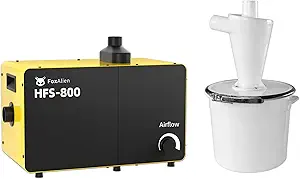 | Best for Desktop CNC | Power: 800 W | Voltage: 110 V | Filtration: HEPA + Activated Carbon | VIEW ON AMAZON | See Our Full Breakdown |
| dust extractor vacuum with cyclone separator | Capacity | Filter Type |
|---|---|---|
| Bosch VAC090AH 9-Gallon Dust E | 9 Gallon | HEPA (99.97% at 0.3 microns) |
| 9 Gallon 1400W Dual Cyclone We | 9 Gallon wet/dry | HEPA final-stage |
| 2-in-1 Wall-Mounted and Wheele | — | — |
| FoxAlien HFS-800 800W Desktop | — | — |
More Details on Our Top Picks
Bosch VAC090AH 9-Gallon Dust Extractor with Auto Filter Cleaning
The Bosch VAC090AH earns the top spot because it solves the problem every other product in this lineup addresses only partially: keeping suction constant without operator intervention. Its automatic filter cleaning pulses every 15 seconds, which functions much like a cyclone pre-separator in that debris never gets to choke the HEPA element — except here the cleaning is built into the machine rather than bolted on. Compared with the 9-Gallon Dual Cyclone extractor, the Bosch trades a dedicated two-stage separator for smarter engineering and much stronger credentials: 99.97% capture at 0.3 microns and OSHA Silica Table 1 compliance that jobsite inspectors actually recognize.
The 150 CFM airflow and 97-inch static water lift give it enough muscle to run alongside miter saws, grinders, and SDS hammers, and power-tool activation means the vacuum switches on and off with the tool. That hands-free operation is something none of the other three picks offer. The tradeoff is that this is a single-stage machine at its core — if you regularly hog away huge volumes of chips and shavings at a planer or router table, the Dual Cyclone unit will slow filter loading better over marathon sessions, and a separate cyclone stage can still be added downstream. Buyers who don’t need compliance-grade filtration may also find they’re paying for capability they’ll never use. Still, for professional dust extraction where health rules and productivity both matter, this option makes the most sense.
Pros:- Automatic filter cleaning every 15 seconds keeps suction consistent without stopping work
- HEPA filtration captures 99.97% of particles at 0.3 microns for genuinely safe air quality
- Power tool activation starts and stops the vacuum automatically for hands-free use
- Supports OSHA Silica Table 1 compliance, a requirement on regulated jobsites
Cons:- No dedicated external cyclone stage, so bulk-chip producers may still want a pre-separator
- Premium professional feature set that casual users will pay for without benefiting
- Heavier and less portable than bucket-style or desktop alternatives
Best for: Contractors and serious woodworkers who need compliant, hands-free extraction on real jobsites
Not ideal for: Hobbyists or desktop CNC users who would be overbuying capacity, compliance, and bulk they don’t need
- Capacity:9 Gallon
- Airflow:150 CFM
- Static Pressure:97 in. water lift
- Filter Type:HEPA (99.97% at 0.3 microns)
- Filter Cleaning:Automatic (every 15 seconds)
- Compliance:OSHA Silica Table 1
- Power Tool Activation:Yes
- Model:VAC090AH
Our verdict“The most complete package here: compliant filtration, self-maintaining suction, and jobsite-grade build justify the top ranking for anyone doing this professionally.”
9 Gallon 1400W Dual Cyclone Wet/Dry Dust Extractor with HEPA Filter
If the title of this roundup describes a single product literally, it’s this one: a true two-stage cyclone separator mounted ahead of the HEPA filter, with nothing left for the buyer to assemble or adapt. Dust-laden air spins through two cyclone stages that fling chips, shavings, and coarse dust against the chamber walls and into the 9-gallon tank before the airstream ever reaches the filter. Compared with the Bosch VAC090AH, this design shifts the filter-protection burden from automatic pulsing to mechanical pre-separation — meaning there’s no cleaning cycle to trust, but also no compliance certification to lean on. For a woodshop full of table saws, planers, and routers, I’d argue the cyclone-first approach is actually more durable, because it slows filter loading at the source rather than scrubbing the filter after the fact.
The 1400W motor and 19KPA of suction give it dependable pickup on coarse debris, and the wet/dry tank handles damp sawdust and non-corrosive spills that would sideline a dry-only machine. The anti-static 8.2-foot hose is a thoughtful touch that the Bosch matches but the bucket-style collector doesn’t attempt. Where it falls short of the Bosch is fine-dust governance and integration: no power-tool activation, no documented OSHA pathway, and the HEPA claim lacks the certification specificity that regulated shops need. Against the 2-in-1 cyclone collector, though, it wins outright — it’s a complete vacuum, not an accessory that depends on something else to generate suction.
Pros:- Dual cyclone stages intercept chips and shavings before they reach the HEPA filter
- Slower filter loading keeps airflow stable across extended, uninterrupted work sessions
- 9-gallon wet/dry tank handles coarse debris, damp waste, and liquid spills alike
- Anti-static hose reduces annoying dust cling and shock during dry operation
Cons:- No automatic filter cleaning, so the final-stage HEPA element still needs manual attention
- Lacks certified fine-dust compliance documentation that professional sites require
- No power-tool activation, so the vacuum must be switched manually between cuts
Best for: Woodworkers and small cabinet shops producing heavy chip and shavings volumes who want cyclone protection built in
Not ideal for: Contractors who need certified silica compliance or power-tool activation on regulated sites
- Motor Power:1400 W
- Suction:Up to 19 KPA
- Cyclone Stages:Dual-stage pre-separation
- Capacity:9 Gallon wet/dry
- Filter Type:HEPA final-stage
- Hose:8.2 FT anti-static
- Intended Debris:Wood chips, shavings, coarse sawdust, wet waste
- Work Settings:Woodshops, CNC areas, jobsites, garages
Our verdict“The purest expression of the cyclone-plus-extractor concept in this lineup, and the strongest value for shops drowning in wood chips.”
2-in-1 Wall-Mounted and Wheeled Dust Cyclone Collector with 5-Gallon Bucket
This option takes a completely different approach: instead of being a vacuum, it’s a cyclone separator you attach to the shop vac you already own. That distinction defines both its appeal and its limits. The value case is strong — the 5-gallon removable bucket catches the bulk of debris before it ever reaches your vacuum’s filter, extending filter life and sparing you the constant canister dumps that ruin a work session. The dual wall-mount or wheeled configuration is genuinely useful, letting small garages reclaim floor space while still allowing mobile use when a job moves across the shop. With 2-inch to 2.5-inch connectors and a roughly 2-meter hose, compatibility with common vacuums is broad rather than brand-locked.
Compared with the 9-Gallon Dual Cyclone extractor, this is the budget-conscious sibling: you supply the suction, it supplies the separation. What you give up is capacity — 5 gallons empties far more often than 9 — and raw separation sophistication, since a single-stage bucket cyclone is coarser than a dual-stage chamber. It also does nothing for fine dust; the HEPA stage remains whatever your host vacuum offers, so buyers chasing clean air should look at the Bosch or FoxAlien instead. And the design leans toward dust rather than bulky chips, which can clog the separator inlet. This pick makes the most sense for hobbyists with a serviceable shop vac who want most of the cyclone benefit for a small fraction of a new machine’s cost.
Pros:- Retfits cyclone separation onto most existing shop vacuums for a low total cost
- Wall-mount or wheeled setup adapts to cramped shops and mobile jobs alike
- Removable 5-gallon bucket makes emptying fast and tool-free
- Broad 2-inch to 2.5-inch connector compatibility avoids brand lock-in
Cons:- Requires a separate vacuum to generate suction, so it’s not a standalone solution
- Smaller 5-gallon capacity means more frequent emptying during heavy stock removal
- Focused on dust rather than bulky debris, which can bottleneck the separator
Best for: Hobbyists and garage woodworkers who already own a shop vac and want filter protection cheaply
Not ideal for: Buyers who need a complete vacuum, fine-dust filtration, or high-volume chip capacity
- Installation:Wall-mounted or wheeled
- Bucket Capacity:5 Gallon, removable
- Hose Length:Approximately 2 meters
- Connector Size:2” to 2.5”
- Material:Industrial-grade robust materials
- Separation Method:Cyclonic pre-separation
- Application:Woodworking, workshops, household, industrial waste
Our verdict“The smartest low-cost entry point into cyclone dust collection — as long as you already have a vacuum worth protecting.”
FoxAlien HFS-800 800W Desktop Dust Collector
The FoxAlien HFS-800 is the specialist of the group, and I mean that literally — outside a desktop CNC or laser bench, it has no real job. Within that niche, though, it does something none of the bigger units attempt: HEPA plus activated carbon dual-stage purification with an integrated cyclone separator upstream. The carbon stage matters for CNC users cutting materials that produce odors and fumes, not just particles, and the cyclone keeps the expensive filter elements from clogging with chips. Adjustable airflow lets you dial suction down when noise matters, and the standard 1.5-inch hose mates with most compact machine enclosures without adapters.
The honest tradeoff is scale. An 800W desktop unit cannot serve a table saw or a miter station the way the 9-Gallon Dual Cyclone extractor or the Bosch VAC090AH can — its reach, capacity, and airflow are all bench-sized by design. Compared with the Bosch, it also trades compliance-grade documentation for convenience features like speed control and odor filtration, which reflects its hobbyist audience. Noise at maximum speed is the other sticking point; despite the adjustable output, running it flat-out to capture aggressive cuts can get loud on a small bench. But for someone running a compact CNC router who is tired of shop vacs that overwhelm the workspace, this option stands out as purpose-built rather than adapted.
Pros:- Compact desktop form factor sized correctly for bench-scale CNC work
- HEPA plus activated carbon captures micro-dust and reduces material odors
- Integrated cyclone separator prevents chip buildup and extends filter life
- Adjustable airflow balances suction power against noise and energy use
Cons:- Noise climbs noticeably at maximum airflow despite the speed control
- 800 W output and small capacity are unusable for full-size woodworking machines
- 1.5-inch hose limits compatibility with larger-diameter dust ports
Best for: Desktop CNC and laser engraving users who need source capture with odor filtration in a small footprint
Not ideal for: Anyone with floor-standing machinery or jobsite extraction needs beyond a single bench
- Power:800 W
- Voltage:110 V
- Filtration:HEPA + Activated Carbon
- Cyclone Separator:Included, integrated
- Hose Diameter:1.5″ (38 mm)
- Adjustable Speed:Yes
- Intended Use:Desktop CNC machines
Our verdict“A purpose-built bench companion that beats adapted shop vacs for desktop CNC work — just don’t ask it to be anything more.”

How We Picked
I judged every option against one question: how well does the cyclone stage protect airflow and filter life, and what does the buyer give up to get it? That meant weighing separator design first, then filtration quality, then capacity, mobility, and compatibility. I also looked at whether each unit works as a complete system or depends on other equipment, since that changes the true cost of ownership. A desktop CNC collector and a jobsite silica-compliant extractor serve entirely different buyers, so I assigned each product a distinct role rather than ranking them on a single score. Finally, I favored options with documented filter-cleaning or pre-separation mechanics over vague marketing claims, because that is where cheap dust extractors usually fall apart.
| dust extractor vacuum with cyclone separator | Filter Type |
|---|---|
| Bosch VAC090AH 9-Gallon Dust E | HEPA (99.97% at 0.3 microns) |
| 9 Gallon 1400W Dual Cyclone We | HEPA final-stage |
| 2-in-1 Wall-Mounted and Wheele | — |
| FoxAlien HFS-800 800W Desktop | — |
Factors to Consider When Choosing Dust Extractor Vacuum With Cyclone Separator
Choosing among these four comes down to matching the cyclone concept to your actual dust problem. Here’s how I’d break the decision down.Integrated Cyclone vs. Add-On Separator
An integrated cyclone extractor like the 9-Gallon Dual Cyclone model is a complete system — one purchase, one footprint, engineered separation. An add-on separator like the 2-in-1 collector costs less but depends on your existing vacuum’s motor and filter, so total performance is capped by whatever machine you pair it with. If your current vac is weak or undersized, the add-on route will disappoint.
Filter Protection Strategy
There are two ways to keep suction alive: separate debris before the filter (cyclone) or clean the filter during operation (automatic pulsing, as on the Bosch VAC090AH). The best setups combine both — which is why pairing the Bosch with a downstream cyclone is a common professional configuration despite the Bosch’s self-cleaning cycle.
Filtration Grade and Compliance
If you work with concrete, stone, or any silica-generating material, certified HEPA capture and OSHA Table 1 compliance aren’t optional extras — they’re the law on regulated sites. The Bosch is the only pick here that addresses this directly. For wood-only shops, a good HEPA final stage without formal certification is usually a reasonable compromise.
Capacity, Mobility, and Scale
Think in terms of debris volume per session. A 5-gallon bucket suits intermittent hobby work; a 9-gallon tank handles planer and table saw output; a desktop unit is sized for a single bench machine. Wheeled bases, wall mounts, and hose length all determine whether the extractor moves to the work or the work comes to it.
Frequently Asked Questions
Do I still need a cyclone separator if my extractor has automatic filter cleaning?
Not always, but it can still help. Automatic cleaning like the Bosch VAC090AH’s 15-second pulsing keeps the filter surface clear on its own, which covers most jobsite scenarios. However, if you generate large volumes of chips and shavings — think planer or router work — a cyclone pre-separator intercepts that bulk before it reaches the machine at all, which reduces tank emptying frequency and reduces wear on the filter itself. Many professionals run both, treating the cyclone as insurance for high-volume days rather than a replacement for self-cleaning.
Can I use a cyclone separator with any shop vacuum?
Mostly yes, provided the hose and port diameters match. The 2-in-1 collector reviewed here includes 2-inch to 2.5-inch connectors, which fit the majority of consumer shop vacuums. What you should verify is your vacuum’s airflow rating — a cyclone adds a small amount of resistance to the system, so an underpowered vac will lose noticeable suction. As a rule, if your vacuum already struggles with your dust load, an add-on separator won’t fix the underlying power deficit; it will only protect the filter.
Is a cyclone separator a substitute for HEPA filtration?
No, and this is a common misconception. Cyclonic separation works by inertia — heavy particles get flung to the walls and drop into the container, but fine particles that stay suspended in the airstream pass straight through to the filter. That means a cyclone protects your HEPA filter and extends its life, but it cannot capture sub-micron dust on its own. If fine-dust exposure is a health concern, you still need a HEPA final stage, which is why every integrated extractor in this lineup pairs its cyclone stage with one.
What capacity do I actually need for a home workshop?
It depends on your machinery more than your shop size. Occasional drill-press and sanding work generates modest debris, and a 5-gallon bucket attached to a shop vac handles it fine with frequent emptying. Add a table saw or planer, and volume jumps dramatically — a 9-gallon tank like the Dual Cyclone extractor’s becomes the practical floor, because stopping to empty a 5-gallon bucket mid-session gets old fast. The real question is how often you’re willing to interrupt work; bigger capacity buys longer uninterrupted runs.
Will a desktop dust collector work for a full-size workshop?
I wouldn’t recommend trying. A unit like the FoxAlien HFS-800 is engineered around a 1.5-inch hose and 800W of suction, which is sized for capturing debris from a single bench-top machine at close range. Full-size table saws and planers move far more air and produce far more chips than that class of motor can handle, and the small hose would bottleneck any attempt to connect it to standard 4-inch dust ports. Desktop collectors are excellent at their intended job — source capture for compact CNC and laser machines — but they’re not scalable substitutes for floor-standing extraction.
Conclusion
If you extract dust professionally or on regulated jobsites, the Bosch VAC090AH is the clear choice — its automatic filter cleaning, certified HEPA capture, and OSHA Silica Table 1 compliance are capabilities no other pick matches. Woodshop owners producing heavy chip volumes should go with the 9-Gallon Dual Cyclone Extractor, whose two-stage separation is the most literal fulfillment of the cyclone-plus-vacuum concept and the best fit for planers, table saws, and CNC routers. Hobbyists on a budget who already own a serviceable shop vac should buy the 2-in-1 Wall-Mounted Cyclone Collector and spend the difference on lumber. And if your dust problem lives on a desktop — a compact CNC or laser engraver — the FoxAlien HFS-800 is the only option here designed for that scale, with carbon filtration the others don’t offer. Match the machine to your dust volume and compliance needs, not the other way around, and you’ll land on the right pick.
Halloween Picks
halloween
As an affiliate, we earn on qualifying purchases.