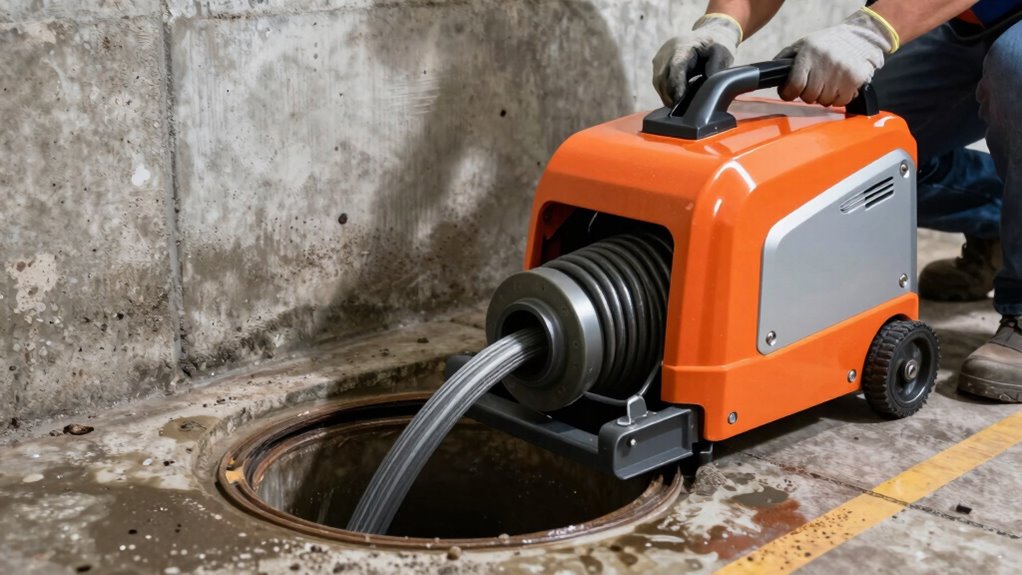
For most buyers, the RIDGID K-7500 is the strongest overall drain cleaning machine for a main sewer line because its drum-machine format and AUTOFEED are geared toward demanding clearing work. The Bluerock SDS200 stands out when sectional cable handling and a cutter set are priorities, while the General Wire JM-1450-A offers a water-jet approach rather than a conventional cable. The main tradeoff is between the controlled reach and cutting action of a cable machine, the cleanup and technique demands of sectional systems, and the different blockage-clearing method of a jetter. Cable diameter and usable reach matter as much as motor power: a long, heavy cable is not automatically the right match for every line. Read on for the full comparison, selection criteria, and guidance on choosing a machine that fits your pipe, blockage, and experience.

Get cleaning gear delivered free with Prime
- Fast, free delivery on millions of items
- Prime Video, Amazon Music and more included
- Member-only deals all year
Complete the kit


Key Takeaways
- The RIDGID K-7500 models lead for heavy-duty cable work. Their place at the top reflects a lineup focused on main-line capability; buyers should still compare the listed kit contents, since one version specifies AUTOFEED and a tool set.
- The Bluerock SDS200 and SDS200B are the sectional-cable alternatives. Their 120-foot, two-section setup and cutter-oriented format suit buyers who value modular cable handling, but sectional machines call for more hands-on cable management than drum models.
- Longer reach does not automatically mean a better fit. The 120-foot VEVOR and RIDGID K-400 listings can appeal when reach is a priority, but buyers should check cable diameter, pipe compatibility, and the machine’s intended duty before choosing by length alone.
- Several listings overlap closely rather than offering distinct platforms. The two 100-foot VEVOR 3/4-inch machines and multiple GarveeTech 100-foot models should be compared by exact configuration and included accessories, not just brand or headline length.
- The General Wire JM-1450-A is the method outlier. It is an electric water jetter, not a cable-and-cutter machine, so it is a better match for buyers who specifically want jetting and can accommodate its different operating demands.


| drain cleaning machine for main sewer line | Weight | Model | Cable length | Cable diameter |
|---|---|---|---|---|
| POPULO PEDC-75 Generation Two | 93 lbs | PEDC-75 | 75 ft | 1/2 in |
| GarveeTech Auto-Feed Drain Cle | 106.5 lbs | — | 100 ft | 1/2 in |
| VEVOR Drain Cleaner Machine | 181 lbs | JR-7500 | 100 ft | 3/4 in |
| Bluerock SDS200 2"-8" Sectiona | 280 lbs | SDS200 + 2 Cables | 120 ft; stated maximum run 165 ft | 1-1/4 in |
| RIDGID 61102 K-7500 Drain Clea | 149 lbs | 61102 K-7500 | — | — |
| VEVOR Drain Cleaner Machine wi | — | — | 100 ft | 3/4 in |
| General Wire JM-1450-A Electri | 111 lb | JM-1450-A | — | — |
| 100 FT x 1/2 Inch Drain Cleane | 103 lb | DCM100FT | 100 ft | 1/2 in |
| BLUEROCK SDS200B Sectional Pip | 280 lb | — | 120 ft in 15 ft sections | 1-1/4 in |
| GarveeTech 100 ft Electric Dra | 149.5 lb | — | 100 ft | 3/4 in |
| VEVOR 120 ft Electric Drain Cl | — | — | — | — |
| RIDGID K-400 120V Drum Drain C | — | K-400 | — | — |
| RIDGID K-7500 Drum Machine wit | — | K-7500 | — | — |
More Details on Our Top Picks
POPULO PEDC-75 Generation Two Electric Drain Snake Auger, 75 ft x 1/2 in
The POPULO PEDC-75 is a practical fit for homeowners and small service crews clearing typical 2–4-inch sewer lines. Its 75-foot reinforced, half-inch cable offers useful reach for many residential runs, while the automatic feed cuts down on the effort of advancing and retrieving cable. Eight cutters, including a root-killer blade, give it more clog-specific options than a basic auger. Compared with the GarveeTech 100 ft Auto-Feed Drain Cleaner, the POPULO gives up 25 feet of reach but is specified for the same upper pipe diameter and weighs less. That is still 93 pounds, so moving it between jobs is no small task. I’d favor it for routine residential clearing, not larger-diameter mains or buyers who need the longest reach in this group.
Pros:- 75-foot reinforced cable reaches many residential main-line clogs.
- Automatic feed reduces manual cable handling.
- Eight cutters include a root-killer blade for varied obstructions.
- Specified for 2–4-inch pipes common in residential drainage.
Cons:- At 93 pounds, it is difficult to carry up stairs or load without help.
- Its 75-foot cable offers less reach than the GarveeTech 100-foot option.
- The stated free replacement benefit has registration and eligibility conditions.
Best for: Homeowners and small plumbing crews clearing accessible 2–4-inch residential main lines who want automatic feed and several cutter choices.
Not ideal for: Contractors handling long sewer runs or 4–8-inch mains, and anyone who needs a machine that one person can lift or carry easily.
- Model:PEDC-75
- Cable length:75 ft
- Cable diameter:1/2 in
- Compatible pipe size:2–4 in
- Feed system:Automatic
- Included cutters:8, including a root-killer blade
- Weight:93 lbs
- Dimensions:22 x 20 x 20 in
Our verdict“Choose the POPULO for residential 2–4-inch lines where automatic feed and included root-cutting tools matter more than maximum reach.”
GarveeTech Auto-Feed Drain Cleaner Machine, 100 ft x 1/2 in Cable, 370W
For buyers who need more cable reach without moving up to a large-pipe machine, the GarveeTech Auto-Feed offers a 100-foot, half-inch cable and compatibility with 1–4-inch pipes. Its automatic feed has forward and reverse controls, while the eight cutters let operators match the head to different blockages. A built-in GFCI adds electrical protection, and the wheels and detachable handle help with job-site movement. Compared with the POPULO PEDC-75, it reaches 25 feet farther and covers smaller pipe sizes, but its 106.5-pound weight makes it harder to maneuver. It is a stronger fit for crews tackling longer, varied small-to-medium lines than for homeowners seeking a compact machine. The two-year warranty is a useful ownership detail, but it does not offset the bulk for occasional use.
Pros:- 100-foot cable reaches farther than the POPULO PEDC-75.
- Works with 1–4-inch pipes, including smaller drain lines.
- Automatic feed provides forward and reverse control.
- Built-in GFCI, wheels, and detachable handle support safer, easier job-site handling.
Cons:- At 106.5 pounds, it is cumbersome to lift and transport.
- Its half-inch cable is not specified for the larger 4–8-inch lines handled by the VEVOR 3/4-inch model.
Best for: Plumbers and property-maintenance crews who need 100 feet of reach for 1–4-inch lines and value built-in GFCI protection.
Not ideal for: Occasional DIY users with limited storage or anyone who needs to move a machine frequently without a vehicle or assistance.
- Cable length:100 ft
- Cable diameter:1/2 in
- Motor power:370 W
- Pipe compatibility:1–4 in
- Feed system:Automatic, with forward and reverse controls
- Included cutters:8
- Safety feature:Built-in GFCI
- Weight:106.5 lbs
- Warranty:2 years
Our verdict“Pick the GarveeTech when 100-foot reach across 1–4-inch pipes is more useful than a lighter, easier-to-store machine.”
VEVOR Drain Cleaner Machine, 100 ft x 3/4 in Cable, Auto Feed, 6 Cutters
The VEVOR 100 ft x 3/4 in is aimed at a different job from the half-inch machines here: it is specified for 4–8-inch pipes, making it the relevant choice for larger building mains. Its 100-foot steel cable, auto-feed, foot switch, and six interchangeable cutters support longer clearing work, while the 1700 RPM motor provides the stated operating speed. Compared with the GarveeTech Auto-Feed, this VEVOR uses a thicker cable and targets larger pipes, but it weighs 181 pounds—far more than the GarveeTech’s 106.5 pounds. The wheel arrangement helps with rolling and loading, though it does not make the machine easy to lift or store. I’d choose it for crews who regularly service larger lines, not for typical 2–4-inch household drains.
Pros:- Specified for 4–8-inch pipes, unlike the half-inch machines aimed at smaller lines.
- 100-foot, 3/4-inch steel cable is suited to larger-diameter clearing work.
- Auto-feed and foot-switch control reduce hands-on cable handling.
- Multiple wheel sets support rolling and transport.
Cons:- At 181 pounds, it is difficult to lift and maneuver in tight spaces.
- Its 4–8-inch pipe range makes it a poor match for smaller residential lines.
- Six cutters provide fewer included options than the eight-cutter POPULO and GarveeTech machines.
Best for: Drain-clearing contractors and facility teams who regularly service 4–8-inch main lines and need a 3/4-inch cable with automatic feed.
Not ideal for: Homeowners with 2–4-inch residential pipes, or buyers who need a lightweight machine that is easy to carry and store.
- Model:JR-7500
- Cable length:100 ft
- Cable diameter:3/4 in
- Compatible pipe size:4–8 in
- Motor speed:1700 RPM
- Feed system:Auto-feed
- Included cutters:6 interchangeable cutters
- Weight:181 lbs
- Dimensions:25.59 x 20.47 x 41.14 in
Our verdict“Choose this VEVOR for larger 4–8-inch mains where the thicker cable matters more than portability or small-pipe versatility.”
Bluerock SDS200 2″-8″ Sectional Pipe Drain Cleaner, 1.5 HP 110V 700 RPM Sewer Snake with 120′ Cable, Two 60′ Cables and 6-Piece Cutter Set
The Bluerock SDS200 makes the most sense when a main-line job calls for substantial reach and a heavy-duty sectional setup. Its listed 120-foot, 1¼-inch steel cable has a stated maximum run of 165 feet, and the package includes two additional 60-foot cables plus a six-piece cutter set. The 1.5 HP motor and 700 RPM operation distinguish it from the portable auto-feed machines, while its stated pipe range spans 2–8 inches. Compared with the RIDGID K-7500, the Bluerock offers a larger listed cable diameter and extended run, but it weighs 280 pounds and is far less practical to move. Buyers should also clarify how the included cables combine with the stated maximum run before purchase. This is a contractor-oriented choice, not a convenient household machine.
Pros:- Listed 120-foot cable with a stated maximum run of 165 feet.
- 1.5 HP motor is a heavy-duty specification for demanding clearing work.
- 1¼-inch steel cable and stated 2–8-inch pipe range suit larger lines.
- Package includes two additional 60-foot cables and a six-piece cutter set.
Cons:- At 280 pounds, it is difficult to transport, load, and store.
- The sectional setup is less convenient to handle than the RIDGID K-7500 drum format.
- The relationship between the included cables and stated maximum run may need confirmation.
Best for: Commercial drain crews and contractors who need long sectional cable reach across 2–8-inch pipes and have a dedicated way to transport the machine.
Not ideal for: Homeowners, solo operators without loading equipment, or crews that need quick mobility between frequent service calls.
- Model:SDS200 + 2 Cables
- Motor:1.5 HP
- Voltage:110V AC
- Operating speed:700 RPM
- Cable length:120 ft; stated maximum run 165 ft
- Cable diameter:1-1/4 in
- Compatible pipe size:2–8 in
- Weight:280 lbs
- Included additional cables:Two 60-foot cables
Our verdict“Choose the Bluerock SDS200 for long, demanding main-line jobs when sectional reach outweighs the major transport burden.”
RIDGID 61102 K-7500 Drain Cleaning Machine
The RIDGID K-7500 suits professionals who want a high-capacity drum machine for repeated main-line calls. Its automatic feed advances or retrieves cable at up to 20 feet per minute, and the corrosion-resistant drum holds either 125 feet of 3/4-inch cable or 150 feet of 5/8-inch cable. That capacity gives it more cable-choice flexibility than the POPULO PEDC-75, while its 149-pound weight is easier to manage than the 280-pound Bluerock SDS200. It remains heavy, and the product data lists conflicting machine model numbers, so buyers should confirm the exact configuration before ordering. The included cutter set, toolbox, gloves, and stated lifetime warranty add professional-use appeal, but the source data does not specify a compatible pipe-size range. I’d verify that fit before treating it as a match for a particular main line.
Pros:- Automatic feed advances and retrieves cable at up to 20 feet per minute.
- Drum capacity supports 125 feet of 3/4-inch cable or 150 feet of 5/8-inch cable.
- Corrosion-resistant drum is designed to resist dents and rust.
- Includes a nine-piece cutter set, toolbox, and protective gloves.
Cons:- At 149 pounds, it is still cumbersome to move without suitable transport.
- The product description lists conflicting machine model numbers.
- Compatible pipe sizes are not specified in the supplied product data.
Best for: Professional plumbers and maintenance teams handling frequent drain-clearing jobs who need substantial drum capacity and automatic cable feed.
Not ideal for: First-time homeowners seeking a light machine, or buyers who require a clearly stated pipe-size range before selecting equipment.
- Model:61102 K-7500
- Motor:4/10 HP
- Operation:Automatic feed
- Cable capacity:125 ft of 3/4-inch cable or 150 ft of 5/8-inch cable
- Feed speed:Up to 20 ft per minute
- Weight:149 lbs
- Dimensions:40 x 29 x 25 in
- Included accessories:5/8-inch pigtail, 9-piece blade/cutter set, toolbox, and protective gloves
- Warranty:Full lifetime warranty against material defects and workmanship
Our verdict“Choose the K-7500 for recurring professional work when drum capacity and automatic feed are priorities, after confirming the exact model and pipe-size fit.”
VEVOR Drain Cleaner Machine with Auto Feed, 100 ft x 3/4 in Sewer Snake Auger
For a main sewer line in the 4–8 inch range, this VEVOR pairs a 100-foot, 3/4-inch steel cable with auto feed, so the operator can advance or retrieve cable without manually pushing the full length. Its four interchangeable cutters give it more flexibility against different blockages than a single-head setup, while the foot switch keeps control near the work. Compared with the heavier GarveeTech 100 ft Electric Drain Cleaner, this model is a more focused alternative, but the supplied details do not list its weight, so transport needs are harder to judge. The 7.5-inch shock-absorbing wheels help on uneven surfaces; they do not make a long-cable machine compact. Its main limitation is pipe range: buyers dealing with smaller branch drains should choose a narrower-cable machine instead.
Pros:- Auto feed moves cable in or out with less manual handling.
- 100-foot, 3/4-inch steel cable is suited to long runs in 4–8 inch pipes.
- Four interchangeable cutters offer options for different blockage types.
- Shock-absorbing wheels support movement across varied surfaces.
Cons:- Recommended for 4–8 inch pipes, limiting usefulness on smaller drains.
- The long cable and machine may be cumbersome to transport or store.
- A 1700 RPM motor speed is provided, but motor power is not specified in the supplied data.
Best for: Homeowners or service professionals clearing recurring clogs in 4–8 inch main lines who want auto feed and wheels for repositioning.
Not ideal for: Buyers who need to clear smaller household drains or frequently lift and store equipment; its 3/4-inch cable and 100-foot setup are better suited to larger lines.
- Cable length:100 ft
- Cable diameter:3/4 in
- Motor speed:1700 RPM
- Recommended pipe diameter:4–8 in
- Cutters:4 interchangeable cutters
- Controls:CW/OFF/CCW knob and air-activated foot switch
- Wheel size:7.5 in
- Drum:Semi-enclosed metal
Our verdict“Choose this VEVOR for wheeled, auto-feed cleaning of 4–8 inch main lines, but pick a smaller-cable machine for household branch drains.”
General Wire JM-1450-A Electric Water Jet Drain Cleaner
The JM-1450-A takes a different approach to sewer-line cleaning: it uses a 150-foot water hose rather than a rotating cable, making it better suited to soft stoppages and ice than to cutting through roots or solid obstructions. That distinction separates it from cable machines such as the VEVOR 100 ft x 3/4 in Sewer Snake, whose cutters are designed for mechanical blockage removal. A removable reel and telescoping handle help with storage and moving the unit, though its 111-pound weight still calls for a plan for loading and transport. Safety-related pump and water-flow components include a thermal relief valve, backflow check valve, and inlet filter. The tradeoff is a narrower job profile: buyers looking for a general-purpose cutter machine for stubborn main-line clogs should choose a cable auger instead. The supplied product data lists no warranty.
Pros:- 150-foot hose offers reach for longer drain runs.
- Water-jet design is aimed at soft stoppages and ice.
- Removable hose reel and telescoping handle aid storage and movement.
- Thermal relief valve, backflow check valve, and inlet filter are included.
Cons:- At 111 pounds, it is heavy for one person to lift or load.
- Water jetting is not a substitute for a cutter-equipped cable machine on roots or hard blockages.
- No warranty is listed in the supplied product data.
Best for: Plumbers or property maintenance teams who regularly deal with soft sewer-line stoppages or ice and want a long-reach water jet.
Not ideal for: Buyers who need to cut roots or hard obstructions with a cable, or who need a lightweight machine with a stated warranty.
- Manufacturer:General Wire
- Model:JM-1450-A
- Weight:111 lb
- Dimensions:28 x 15 x 34 in
- Power source:Corded electric
- Water consumption:1.7 gpm
- Hose length:150 ft
- Tires:Two 8-inch semi-pneumatic tires
- Warranty:No warranty
Our verdict“Pick the JM-1450-A for soft stoppages and ice where water jetting fits the job, not as a replacement for a cutter-equipped sewer snake.”
100 FT x 1/2 Inch Drain Cleaner Machine, 550W Electric Drain Auger with Auto Feed, Foot Switch & 8 Cutters
This Hxgexin auger is the most versatile pipe-size match in this group for buyers whose work spans smaller drains and lines up to 4 inches. Its 1/2-inch cable can enter narrower pipes than the 3/4-inch cables on the VEVOR 100 ft x 3/4 in Sewer Snake and the GarveeTech 100-foot model, though that makes it a different fit from equipment aimed at larger main lines. A 550W motor, auto feed, pneumatic foot switch, and eight cutters give it a useful combination of reach and control for varied residential or commercial clogs. GFCI protection adds an electrical safety feature for wet work areas. At 103 pounds, it is still a substantial machine to move alone, and its 1–4 inch capacity means buyers focused on 6–8 inch sewer mains should select a larger-cable option.
Pros:- 1/2-inch cable fits a broader range of smaller pipes than the 3/4-inch models.
- 100-foot cable provides reach for extended runs.
- Eight cutter heads cover a variety of blockage types.
- Auto feed, pneumatic foot switch, and GFCI protection support controlled operation.
Cons:- 103-pound weight can make loading and repositioning difficult for one person.
- Pipe capacity tops out at 4 inches, so it is not the best match for larger main lines.
- Its narrower cable is not the larger-line choice compared with the sectional BLUEROCK SDS200B.
Best for: Plumbing contractors or property teams who need one machine for narrow drains through 4-inch lines and value a broad cutter selection.
Not ideal for: Buyers whose main task is clearing 4–8 inch sewer lines or who need equipment that one person can lift easily.
- Manufacturer:Hxgexin
- Model:DCM100FT
- Power:550W
- Cable length:100 ft
- Cable diameter:1/2 in
- Maximum speed:1700 RPM
- Weight:103 lb
- Dimensions:18 x 22.5 x 33.4 in
- Warranty:2 years
Our verdict“Choose this Hxgexin for long-reach work across smaller drains and lines up to 4 inches, not for large-diameter sewer mains.”
BLUEROCK SDS200B Sectional Pipe Drain Cleaner, 1.5 HP, 120 ft Cable with Cutter Set
Among these five, the SDS200B is the heavy-duty choice for larger lines: its 1.5 HP motor and 1-1/4-inch sectional cable are specified for 2–8 inch pipes, with 120 feet of cable supplied and a maximum run-out of 165 feet. Unlike the drum-style GarveeTech 100 ft Electric Drain Cleaner, its cable comes in 15-foot sections, which can make handling the cable in stages more practical on demanding jobs. Forward and reverse operation and a six-piece cutter set add flexibility for clearing different obstructions. The tradeoff is substantial: at 280 pounds, this is not a machine for casual storage or frequent solo transport. Its 700 RPM speed is also lower than the 1700–1850 RPM figures listed for several drum machines, so buyers should compare the machine’s intended sectional-cable workflow rather than speed alone.
Pros:- 1.5 HP motor is suited to demanding drain-cleaning work.
- 120 feet of sectional cable is supplied, with maximum cable run-out listed at 165 feet.
- 1-1/4-inch cable and 2–8 inch pipe capacity fit larger-line jobs.
- Forward and reverse operation and a six-piece cutter set add operating options.
Cons:- At 280 pounds, transport and placement can require substantial help.
- Sectional cable requires a different handling routine from a drum machine.
- The 700 RPM speed is lower than the listed speeds of the VEVOR and GarveeTech drum options.
Best for: Professional plumbing crews handling recurring blockages in 2–8 inch lines who can accommodate a 280-pound sectional machine.
Not ideal for: Homeowners needing a portable, occasional-use cleaner or buyers who want a lighter drum machine for one-person transport.
- Pipe capacity:2–8 in
- Motor power:1.5 HP
- Voltage:110V AC
- Frequency:60 Hz
- Speed:700 RPM
- Cable length:120 ft in 15 ft sections
- Maximum cable run-out:165 ft
- Cable diameter:1-1/4 in
- Weight:280 lb
Our verdict“Choose the SDS200B for professional work on 2–8 inch lines when sectional cable and high motor power outweigh portability.”
GarveeTech 100 ft Electric Drain Cleaner with Auto Feed
GarveeTech’s machine is a strong match for larger residential sewer lines when cutter choice matters: it combines a 100-foot, 3/4-inch steel-core cable with six interchangeable heads, two more than the VEVOR 100-foot 3/4-inch model listed here. Its 750W motor is rated at 1850 RPM, and auto feed plus an air-activated foot switch supports controlled operation without manually driving the cable. GFCI protection is another useful feature around wet work areas. Against the VEVOR, this is the more cutter-rich and higher-speed option on the stated specs; the cost of that setup is its 149.5-pound weight, which makes loading and storage a real part of the buying decision. Its 4–8 inch pipe range also rules it out for smaller household drains, where the 1/2-inch Hxgexin has broader reach.
Pros:- 100-foot, 3/4-inch steel-core cable is designed for 4–8 inch pipes.
- Six cutters provide a wider selection than the four supplied with the listed VEVOR model.
- Auto feed and an air-activated foot switch support controlled one-person operation.
- GFCI protection, wheels, and a retractable handle aid work and movement.
Cons:- 149.5-pound weight makes solo loading and transport difficult.
- Specified for 4–8 inch pipes, so it is not suited to smaller drain lines.
- The machine’s listed dimensions make storage space a practical concern.
Best for: Plumbing professionals or experienced property-maintenance buyers clearing 4–8 inch main lines who want six cutters, auto feed, and GFCI protection.
Not ideal for: Buyers focused on small drains or anyone who needs to move a machine frequently without help; its pipe range and 149.5-pound weight are limiting.
- Cable length:100 ft
- Cable diameter:3/4 in
- Motor power:750 W
- Motor speed:1850 RPM
- Compatible pipe size:4–8 in
- Cutters included:6
- Operation:Auto feed; CW/OFF/CCW control; air-activated foot switch
- Safety feature:GFCI protection
- Weight:149.5 lb
Our verdict“Choose GarveeTech over the VEVOR when six cutters and the stated 1850 RPM matter more than lighter handling or smaller-pipe versatility.”
VEVOR 120 ft Electric Drain Cleaner with 420W Motor
For a main sewer line where blockage distance matters, I’d favor this VEVOR over the RIDGID K-400: its 120-foot, 7/8-inch cable reaches farther than the K-400’s included 75-foot cable and is sized for pipes up to 6 inches. A separate 18-foot, 3/8-inch cable adds flexibility for smaller lines, while six interchangeable cutters let buyers match the head to different clog types. Manual feed and clockwise/counterclockwise control give the operator direct control, but they also ask for more hands-on attention than the RIDGID K-7500’s AUTOFEED. At 113.5 pounds, this is a substantial machine to move, and the product details don’t establish how noise or operation feel during a job. I’d choose it for reach and included equipment, not easy portability.
Pros:- 120-foot, 7/8-inch cable reaches deep into compatible lines
- Separate 18-foot, 3/8-inch cable extends its use to smaller pipes
- Six cutters provide options for different clog types
- Reversible rotation and manual feed give the operator direct control
Cons:- 113.5-pound weight makes moving and loading the machine difficult
- Manual feed requires more operator involvement than the RIDGID K-7500’s AUTOFEED
- Available product details do not specify operating noise or ease of use
Best for: Homeowners or maintenance crews who need long cable reach for 1.9- to 6-inch lines and can manage a heavy machine with manual feed.
Not ideal for: People who need a lightweight machine, want automatic cable feeding, or mainly clear short, small-diameter household drains.
- Motor power:420 W
- Cable lengths and diameters:120 ft x 7/8 in and 18 ft x 3/8 in
- Compatible pipe diameter:1.9–6 in
- Cable material:65Mn steel
- Feed control:Manual
- Rotation control:Clockwise and counterclockwise
- Included cutters:6
- Item weight:113.5 lb
Our verdict“Choose this VEVOR when long reach and a broad cutter set matter more than portability or automatic feeding.”
RIDGID K-400 120V Drum Drain Cleaning Machine Kit with 75 ft Cable
I’d put the RIDGID K-400 ahead of larger-capacity choices for buyers whose line runs are within its 75-foot cable reach and 1.5- to 4-inch range. Its included 1/2-inch kink-resistant cable, four-piece tool set, gloves, and wheeled cart make it a more complete transportable kit than the RIDGID K-7500, which requires a separately purchased cable. A drum-control system that stops the drum if the cable head becomes lodged adds a practical safeguard during clearing. The tradeoff is reach: compared with the VEVOR 120 ft model, the K-400’s included cable is shorter, and its maximum stated line size is smaller. It’s a drum machine, not a compact occasional-use tool, so buyers who only handle minor clogs may find the setup more machine than their needs call for.
Pros:- Includes a 75-foot, 1/2-inch kink-resistant cable for common drain-line jobs
- Drum-control system stops the drum if the cable head becomes lodged
- Wheeled cart and fold-over handle help with transport and storage
- Kit includes a four-piece tool set and gloves
Cons:- Included cable is shorter than the VEVOR’s 120-foot cable
- Stated drain-line capacity stops at 4 inches
- A drum machine may be more equipment than occasional small clogs require
Best for: Homeowners, property managers, or service workers clearing recurring blockages in 1.5- to 4-inch lines within a 75-foot reach.
Not ideal for: Buyers handling deep main-line blockages beyond 75 feet, pipes larger than 4 inches, or only infrequent minor clogs.
- Model:K-400
- Power source and voltage:AC, 115 V
- Motor speed:165 RPM
- Drain-line capacity:1.5–4 in
- Included cable:75 ft, 1/2-inch C-45 Integral Wound solid core cable
- Cable capacity:3/8- to 1/2-inch cable, up to 100 ft
- Included accessories:Four-piece tool set, gloves, operator’s manual
- Dimensions:21 x 17 x 23 in
- Warranty:Full lifetime warranty
Our verdict“Choose the K-400 for a ready-to-move kit for routine 1.5- to 4-inch drain lines, but look elsewhere when main-line reach beyond 75 feet is needed.”
RIDGID K-7500 Drum Machine with AUTOFEED and Tool Set
For repeated professional work, the RIDGID K-7500’s AUTOFEED is the differentiator: it advances and retrieves cable at up to 22 feet per minute, reducing manual cable handling during long jobs. Its drum accepts up to 125 feet of 3/4-inch cable or 150 feet of 5/8-inch cable, giving it more capacity than the K-400’s included 75-foot cable and making it a stronger fit for crews tackling varied line lengths. The nine-piece blade and cutter set, toolbox, and gloves add useful job equipment. But the cable is sold separately, so it is not ready to clear a line straight from the box; the VEVOR 120 ft model includes its cables and six cutters. This is a substantial professional machine, and its features make less sense for occasional household use.
Pros:- AUTOFEED advances and retrieves cable at up to 22 ft/min
- Drum capacity supports up to 125 ft of 3/4-inch or 150 ft of 5/8-inch cable
- Includes a nine-piece blade and cutter set, toolbox, and gloves
- Full lifetime warranty covers manufacturing defects and workmanship
Cons:- Cable is sold separately, unlike the included cables with the VEVOR 120 ft model
- Professional-scale equipment is more than many occasional household users need
- The listed data does not give the machine’s weight or dimensions for planning transport and storage
Best for: Plumbers and drain-service crews who clear long lines frequently and want powered cable advance and retrieval.
Not ideal for: Homeowners with occasional clogs or buyers who need a complete, ready-to-operate kit without purchasing a separate cable.
- Model:K-7500
- Motor:4/10 HP, belt-driven
- Motor speed:200 RPM
- AUTOFEED speed:Up to 22 ft/min (6.7 m/min)
- Drum capacity:Up to 125 ft of 3/4-inch cable or 150 ft of 5/8-inch cable
- Cable:Sold separately
- Included accessories:3/4-inch pigtail, 9-piece blade/cutter set, toolbox, and gloves
- Warranty:Full lifetime warranty against manufacturing defects and workmanship
Our verdict“Choose the K-7500 for frequent professional jobs where AUTOFEED and high drum capacity justify buying a separate cable.”

How We Picked
I ranked these machines around the demands of clearing a main sewer line: useful reach, cable format and diameter, feed control, power and cutting capability, and the practical effort involved in handling the equipment. I gave more weight to a clearly suited, heavy-duty setup than to a long cable figure by itself, since an oversized or mismatched machine can be difficult to use and may not suit a particular pipe or access point. I also distinguished drum machines, sectional machines, and the water jetter because they address the job in different ways.
The ordering reflects how clearly each listing supports main-line work and how much decision-making information it provides, not a claim that every machine fits every sewer. Where models have similar stated specs, I treat them as close alternatives rather than inventing performance differences. Kit contents, cable condition, access, pipe size, and the blockage itself can change the best choice, so buyers should confirm those details before purchase; a machine’s stated reach or motor rating alone does not establish professional suitability.
Factors to Consider When Choosing Drain Cleaning Machine For Main Sewer Line
Choosing a sewer machine is less about finding the biggest number on a product page and more about matching the equipment to the pipe, access, and work you can safely handle. These broader checks can prevent an expensive mismatch, especially when comparing long-cable drum machines with sectional equipment or a jetter.
Match Cable Diameter to the Actual Line
Start with the pipe’s inside diameter and the machine’s stated pipe range, then check that the cable and cutters are intended for that application. A 1/2-inch cable can be easier to handle in smaller lines, while a 3/4-inch cable is a heavier setup and is not a universal upgrade. A cable that is too small for the job may lack the stiffness needed for a long run; a cable that is too large can be difficult to maneuver or unsuitable for the pipe. Do not assume that a product listing’s broad pipe-size claim covers every bend, fitting, or condition. If the pipe material or condition is uncertain, ask a qualified drain professional before sending powered cable into it. The right match reduces both wasted effort and the chance of damaging a fragile or compromised line.
Choose Drum or Sectional Cable for Your Work Style
Drum machines keep the cable contained, which can limit mess and make storage more straightforward, but a loaded drum can be bulky to move and cable inspection may require extra care. Sectional machines use separate cable lengths that can be added or removed as needed, which can help with transport and managing the working length. That flexibility comes with more handling, more connection points, and a greater need to keep sections organized and clean. For occasional household use, the handling demands of sectional equipment may outweigh its modularity. For repeated work with long runs, the format can make sense if the operator has the training and space to manage it. Pick based on how the cable will be transported, fed, cleaned, and stored—not on reach alone.
Treat Cable Reach as a Working Limit, Not a Promise
A listed cable length describes the available cable, not how far it will reliably travel through a specific sewer. Bends, access points, accumulated debris, and the condition of the pipe all affect usable reach. Extra length can be helpful on a long property lateral, but excess cable can also complicate handling and make it harder to track where the cutter is. Measure from the access point to the likely problem area and allow for the route rather than choosing the longest listing by default. Check whether the stated length is one continuous cable or a set of joined sections. If the blockage location is unknown or repeated, a camera inspection may be more useful than simply buying a longer machine.
Evaluate Feed Control and Operator Experience
Auto-feed can reduce the amount of manual cable handling, but it does not remove the need to control the machine and monitor what the cable is doing. A foot switch can keep a hand free to guide cable, while drum and sectional designs each require different operator habits. New users may be tempted to treat powered feeding as a shortcut; forcing cable into resistance can kink it, damage a line, or make a jam harder to clear. Read the operating instructions and identify how the machine is stopped, reversed, and retrieved before work begins. If this is a one-time main-line problem, hiring a trained operator may be safer and more economical than learning on a difficult blockage. Choose a feature set that reduces strain without implying the machine is self-operating.
Compare Cutter Sets and the Type of Blockage
Cutter assortments are useful only when the included heads match the obstruction and pipe. Roots, grease, scale, and soft buildup call for different approaches, and an aggressive cutter can be the wrong choice for a damaged or delicate line. A larger kit does not automatically mean better coverage; check the cutter shapes, attachment compatibility, and whether replacement heads are available. Cable machines physically reach and work on an obstruction, while a water jetter uses pressurized water and follows a different operating and cleanup process. Neither method is a universal fix for a collapsed, offset, or structurally damaged pipe. When the cause is uncertain, diagnosing the line before selecting a cutter or jetting method can avoid repeated clearing attempts.
Account for Transport, Power, and Ongoing Care
Main-line machines can be heavy, awkward, and messy, so consider the route from storage to the cleanout as part of the purchase decision. Confirm the machine’s power requirements and that the work area has an appropriate electrical supply; never improvise around wet conditions or damaged cords. After use, cable cleaning, drying, inspection, and proper storage affect service life and help reveal wear before the next job. Ask whether the required cutters, cable sections, gloves, and maintenance items are included or need to be sourced separately. A lower-capability machine may be the sensible choice for occasional, accessible clogs, while frequent work can justify a more robust platform and supportable parts. The real cost of ownership includes operator time, upkeep, storage, and any professional help needed for difficult lines.
Frequently Asked Questions
Can I use a 100- or 120-foot drain machine on any main sewer line?
No. Cable length alone does not show whether a machine suits the pipe, cleanout, or blockage. Check the pipe diameter, cable diameter, cutter compatibility, and the route’s bends before buying. A long cable can be harder to control if the blockage is close to the access point or if the line is damaged. If you do not know the pipe condition or where the obstruction is, inspection by a qualified professional can help avoid forcing equipment into an unsuitable line.
Is a 3/4-inch cable better than a 1/2-inch cable for a sewer cleanout?
Not in every situation. A 3/4-inch cable is a heavier option that may make sense for larger, demanding lines, while a 1/2-inch cable can be easier to handle and may fit smaller applications. The pipe’s diameter, material, bends, and the machine’s approved use should guide the choice. A thicker cable does not compensate for the wrong cutter or a structural pipe problem. If the pipe size is unknown, verify it before selecting a machine.
Should I choose a drum machine or a sectional sewer machine?
Choose based on how you expect to move and manage the cable. A drum contains the cable and can simplify storage, though the machine may be bulky and the drum adds weight. Sectional equipment lets you add cable in lengths and can be easier to transport in pieces, but it requires more hands-on connection, cleaning, and organization. New operators often find the contained format more straightforward, while experienced users may value the flexibility of sections. Neither format eliminates the need for safe operation and line-specific judgment.
When should I buy a water jetter instead of a cable machine?
A water jetter is a different tool, not simply a more powerful cable machine. It may suit buyers seeking a water-based clearing method and who can handle its water supply, operating technique, and cleanup requirements. A cable machine is generally the more direct choice when the job calls for a cutter to reach and work through an obstruction. The right method depends on the blockage, pipe condition, and access. If roots, a collapse, or a damaged line may be involved, get the line diagnosed rather than assuming either machine can solve it.
Is a powered sewer machine a sensible purchase for one occasional clog?
Often, not unless you already have the training, safe access, and storage space to use it properly. These machines can be difficult to handle, and incorrect cable use can injure the operator or harm the pipe. For a single blockage, professional service may be the more practical option, especially when the line’s condition or clog location is unknown. Buying can make sense for repeated work when you understand the machine’s limits and can maintain it. Compare the full ownership burden—not just the machine’s advertised reach—with the cost and risk of a one-off job.
Conclusion
For most buyers seeking a cable machine for a main sewer line, I would start with the RIDGID K-7500 as the best overall direction, then confirm the exact kit configuration and fit for the pipe. The best value depends on the actual included cable, cutters, and support; compare the closely related VEVOR and GarveeTech listings carefully rather than choosing by length alone. For a best premium choice, the K-7500 listings are the lineup’s heavy-duty standouts. For beginners, a drum machine with clear instructions and manageable cable is a more sensible starting point than sectional equipment or a jetter, though professional service may be preferable for a difficult main-line blockage. Choose a Bluerock SDS200 or SDS200B for sectional-cable needs, or the General Wire JM-1450-A when a water-jet approach specifically fits the job. Match the machine to the pipe, access, and operator—not just the advertised cable length.