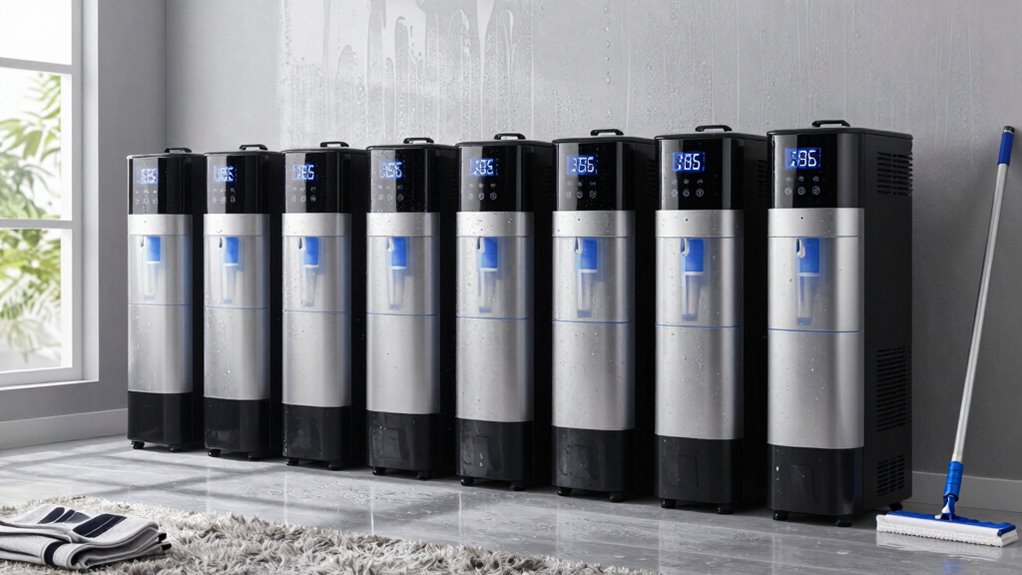

For flood cleanup, I would choose the ALORAIR Storm LGR Extreme as the best overall pick for its LGR design and built-in pump, a useful combination for sustained water removal. The Moiswell V320 stands out for buyers prioritizing high stated extraction capacity, while the Airzentti 155-Pint offers a less oversized option with a pump. The main tradeoffs are capacity versus portability, pump convenience versus simpler drainage, and a general-purpose restoration unit versus a crawl-space model. A dehumidifier can help dry damp air and materials, but it does not replace water extraction, ventilation, or professional remediation when contamination is possible. Continue reading for how the six options differ and which is the better fit for your cleanup.

Get cleaning gear delivered free with Prime
- Fast, free delivery on millions of items
- Prime Video, Amazon Music and more included
- Member-only deals all year
Complete the kit


Key Takeaways
- The ALORAIR Storm LGR Extreme ranks first because its LGR format and pump suit demanding cleanup work where continuous drainage matters; the same model appears twice in the supplied lineup, so it is counted as one distinct product, not two separate choices.
- High pint-per-day claims do not tell the whole story. The Moiswell V320 and Abestorm Hurricane 800 target heavy-duty drying, but buyers should check the conditions behind capacity figures before comparing them directly.
- A built-in pump changes placement options. The Storm LGR Extreme, Hurricane 800, and Airzentti 155-Pint can move condensate to a drain or outside a work area, reducing the need to empty a tank by hand.
- The Airzentti 155-Pint sits between compact and maximum-capacity approaches. Its stated capacity may be easier to match to a smaller cleanup than the largest listed units, though the right choice depends on room conditions and drying goals.
- The AlorAir Helios MP35 has a narrower job. Its crawl-space orientation makes it a better fit for confined under-home moisture control than for rapidly drying an open, flooded room.
| ALORAIR Storm LGR Extreme Commercial Dehumidifier with Pump |  | Best Overall for Residential Flood Cleanup | AHAM capacity: 85 pints per day | Maximum capacity: 180 pints per day at saturation | Airflow: 210 CFM | VIEW ON AMAZON | See Our Full Breakdown |
| Abestorm Hurricane 800 170-Pint Commercial Dehumidifier with Pump |  | Best for Moving Between Work Areas | AHAM capacity: 80 pints per day | Maximum capacity: Up to 170 pints per day at 90°F and 90% RH | Airflow: 200 CFM | VIEW ON AMAZON | See Our Full Breakdown |
| Moiswell V320 Commercial Dehumidifier, 305 Pints per Day |  | Best for Large-Scale Flood Restoration | AHAM capacity: 130 pints per day | Maximum capacity: 305 pints per day | Airflow: 412 CFM | VIEW ON AMAZON | See Our Full Breakdown |
| ALORAIR Storm LGR Extreme Commercial Dehumidifier with Pump |  | Best for Confined Restoration Spaces | AHAM capacity: 85 pints per day | Maximum capacity: 180 pints per day at saturation | Airflow: 210 CFM | VIEW ON AMAZON | See Our Full Breakdown |
| Airzentti 155-Pint Commercial Dehumidifier with Built-In Pump |  | Best for Flexible Drainage | AHAM capacity: 70 pints per day | Maximum capacity: 155 pints per day | Airflow: 220 CFM | VIEW ON AMAZON | See Our Full Breakdown |
| AlorAir Helios MP35 70-Pint Crawl Space Dehumidifier with Pump |  | Best for Crawl Spaces and Elevated Drainage | Capacity: 70 pints per day under saturated conditions; 35 pints per day under AHAM standards | Coverage area: Up to 1,000 sq. ft. | Pump discharge height: Up to 19.6 ft. | VIEW ON AMAZON | See Our Full Breakdown |
| dehumidifier for flood cleanup | Airflow | AHAM capacity | Maximum capacity | Coverage area |
|---|---|---|---|---|
| ALORAIR Storm LGR Extreme Comm | 210 CFM | 85 pints per day | 180 pints per day at saturation | Up to 2,300 sq ft |
| Abestorm Hurricane 800 170-Pin | 200 CFM | 80 pints per day | Up to 170 pints per day at 90°F and 90% RH | Conflicting listed figures: up to 2,100 or 2,900 sq ft |
| Moiswell V320 Commercial Dehum | 412 CFM | 130 pints per day | 305 pints per day | — |
| ALORAIR Storm LGR Extreme Comm | 210 CFM | 85 pints per day | 180 pints per day at saturation | Up to 2,300 sq ft |
| Airzentti 155-Pint Commercial | 220 CFM | 70 pints per day | 155 pints per day | Up to 7,500 sq ft |
| AlorAir Helios MP35 70-Pint Cr | 126 CFM | — | — | Up to 1,000 sq. ft. |
More Details on Our Top Picks
ALORAIR Storm LGR Extreme Commercial Dehumidifier with Pump
For a flooded basement or several connected rooms, I’d start with this Storm LGR Extreme: its 85-pint AHAM capacity and 210 CFM airflow offer a practical balance of drying output and manageable size. The built-in pump sends water through a 19.6-foot hose, which can help when a floor drain or sink is not nearby. Compared with the larger Moiswell V320, this ALORAIR runs on standard 115-volt power and takes up less room, making it a more accessible choice for many home cleanup setups. Automatic defrost and restart also cut down on hands-on monitoring. The tradeoff is that 64.3 pounds is still heavy to carry, and its commercial capacity may be excessive for a small, isolated damp area.
Pros:- 85-pint AHAM capacity and 210 CFM airflow suit substantial residential water cleanup.
- Built-in pump, 19.6-foot hose, and 14.7-foot maximum drain height allow flexible water removal.
- Standard 115-volt power avoids the special receptacle required by the Moiswell V320.
- Automatic defrost and restart reduce the need for frequent checks.
Cons:- At 64.3 pounds, it is cumbersome to carry between floors or through tight access points.
- Its commercial capacity may be unnecessary for small, contained damp areas.
Best for: Homeowners drying a flooded basement or multiple rooms who want a built-in pump and a unit that runs on standard 115-volt power.
Not ideal for: People drying a small bathroom or one lightly damp room, where this commercial unit’s size and capacity may be more than needed.
- AHAM capacity:85 pints per day
- Maximum capacity:180 pints per day at saturation
- Airflow:210 CFM
- Coverage area:Up to 2,300 sq ft
- Drainage:Built-in pump; 19.6-ft hose; 14.7-ft maximum drain height
- Dimensions:22.8 × 13.7 × 17.3 in
- Weight:64.3 lb
- Power:115 V; 640 W
Our verdict“Choose this Storm LGR Extreme for serious home flood cleanup when you want strong drying capacity without the V320’s 20-amp power requirement.”
Abestorm Hurricane 800 170-Pint Commercial Dehumidifier with Pump
If cleanup means shifting equipment from a basement to a garage or another work zone, the Hurricane 800’s wheels and retractable handle make it easier to reposition than the ALORAIR Storm LGR Extreme, which weighs less but is described with carrying handles rather than wheels. Its built-in pump and 19.6-foot hose support continuous drainage, while humidity controls, auto on/off, and power recovery help it keep working with less attention. Capacity is rated at 80 pints per day at AHAM conditions, a little below the ALORAIR’s 85, so I’d favor the Abestorm for mobility rather than maximum listed output. Product details give conflicting coverage-area and dimension figures, which makes planning for a tight space less certain; at 70.4 pounds, it is also still a heavy unit to lift.
Pros:- Wheels and a retractable handle make it easier to move across floors than the ALORAIR Storm LGR Extreme.
- Built-in pump and 19.6-foot hose support continuous drainage away from the drying area.
- Automatic defrost, humidity control, and power recovery reduce routine supervision.
- Rotomolded housing is designed for demanding work environments.
Cons:- At 70.4 pounds, lifting it over stairs or obstacles can be difficult.
- Product details conflict on both coverage area and dimensions, complicating placement plans.
- Its 80-pint AHAM capacity is lower than the 85-pint rating of the ALORAIR Storm LGR Extreme.
Best for: Restoration crews or homeowners who need to roll a commercial dehumidifier between accessible work areas and want pump drainage.
Not ideal for: Buyers who need precise fit measurements or must carry the unit up stairs, given conflicting dimensions and its 70.4-pound weight.
- AHAM capacity:80 pints per day
- Maximum capacity:Up to 170 pints per day at 90°F and 90% RH
- Airflow:200 CFM
- Coverage area:Conflicting listed figures: up to 2,100 or 2,900 sq ft
- Drainage:Built-in pump with 19.6-ft hose
- Dimensions:Conflicting listed figures: 15.2 × 14.4 × 24.8 in or 23.8 × 17.89 × 14.7 in
- Weight:70.4 lb
- Power:607 W
Our verdict“Pick the Hurricane 800 if rolling the unit between work areas matters more than having the highest AHAM capacity or perfectly clear size specifications.”
Moiswell V320 Commercial Dehumidifier, 305 Pints per Day
When floodwater affects a warehouse, large lower level, or several open commercial spaces, the V320 is the clear capacity leader here: it lists 130 pints per day at AHAM conditions and 412 CFM airflow. That is a substantial step up from the ALORAIR Storm LGR Extreme’s 85-pint AHAM rating, so it is better suited to large drying jobs than ordinary home cleanup. Casters and handles help with repositioning, and automatic humidity control, defrost, and restart reduce ongoing adjustments. The key limitation is electrical: this model requires a 20-amp NEMA 5-20 receptacle, unlike the 115-volt ALORAIR. It also has a single operating speed, giving crews less ability to tailor airflow when drying a smaller or more sensitive area.
Pros:- 130-pint AHAM capacity and 412 CFM airflow suit large-scale drying better than the smaller ALORAIR Storm LGR Extreme.
- Rated for areas up to 9,000 sq ft.
- Automatic humidity control, drainage, defrost, and restart support sustained operation.
- Four swivel casters and handles aid movement across work areas.
Cons:- Requires a 20-amp NEMA 5-20 receptacle, limiting use where that outlet is unavailable.
- Single operating speed offers less flexibility for smaller drying zones.
- Its high-capacity design can be excessive for contained residential water damage.
Best for: Commercial restoration teams and owners of large open buildings with a compatible 20-amp NEMA 5-20 outlet.
Not ideal for: Homeowners with standard household outlets or small rooms, since the power requirement and high output may not fit their setup.
- AHAM capacity:130 pints per day
- Maximum capacity:305 pints per day
- Airflow:412 CFM
- Recommended area:Up to 9,000 sq ft
- Power requirement:20-amp receptacle; NEMA 5-20 plug
- Refrigerant system:R32
- Material:Metal
- Mobility:Four swivel casters and handles
Our verdict“Choose the V320 for broad commercial flood restoration when your site has the required 20-amp outlet and its high airflow can be put to work.”
ALORAIR Storm LGR Extreme Commercial Dehumidifier with Pump
This version of the Storm LGR Extreme suits cleanup zones where the machine must fit through access points or work near a crawl space: its listed footprint is 22.8 × 13.7 × 17.3 inches, with carrying handles for positioning. It shares the 85-pint AHAM capacity, 210 CFM airflow, and pump drainage of the other Storm LGR Extreme in this roundup, so I would not treat it as a higher-output alternative. Compared with the wheeled Abestorm Hurricane 800, it is the more compact option on the listed dimensions, though the Abestorm is easier to roll across a floor. Automatic defrost and restart help during longer drying runs. The 64.3-pound weight remains a real obstacle for one-person lifting, and the six-year warranty applies only to refrigeration system parts.
Pros:- Compact listed dimensions help it fit into tighter restoration setups than the wheeled Abestorm Hurricane 800.
- Built-in pump, 19.6-foot hose, and 14.7-foot maximum drain height support flexible drainage.
- Automatic defrost and restart help reduce manual checks during extended operation.
- Adjustable humidity control allows the drying target to be set for the work area.
Cons:- At 64.3 pounds, moving it through confined access points can still take considerable effort.
- The six-year warranty covers refrigeration system parts only.
- Its 85-pint AHAM capacity is the same as the other listed Storm LGR Extreme, not a higher-output step up.
Best for: Restoration workers fitting equipment into tight crawl spaces, basements, or other locations where a compact footprint and pumped drainage matter.
Not ideal for: Buyers who need an easy-to-lift machine or want a broad warranty covering more than refrigeration system parts.
- AHAM capacity:85 pints per day
- Maximum capacity:180 pints per day at saturation
- Airflow:210 CFM
- Coverage area:Up to 2,300 sq ft
- Drainage:Built-in pump; 19.6-ft hose; 14.7-ft maximum drain height
- Dimensions:22.8 × 13.7 × 17.3 in
- Weight:64.3 lb
- Power:115 V; 646 W
- Maximum operating temperature:104°F
Our verdict“Choose this Storm LGR Extreme when fitting a capable pumped dehumidifier into a tight work area matters more than easy lifting or broader warranty coverage.”
Airzentti 155-Pint Commercial Dehumidifier with Built-In Pump
The Airzentti stands apart for offering two drainage methods: a built-in pump for elevated discharge and a gravity-drain option when a floor drain is available. That choice can make placement easier during cleanup, while its 70-pint AHAM capacity and 220 CFM airflow give it useful reach for larger residential or light commercial spaces. Its listed coverage extends to 7,500 square feet, though the Moiswell V320 is a stronger match when the job demands far more airflow and AHAM capacity. Airzentti adds a timer and automatic shutoff, but at 860 watts it uses more power than the 640-watt Storm LGR Extreme. The unit weighs 59 pounds, and continuous operation still depends on setting up a drain hose rather than relying on a collection tank.
Pros:- Pump and gravity-drain options give more setup flexibility than a pump-only arrangement.
- 70-pint AHAM capacity and 220 CFM airflow suit substantial residential and light commercial drying.
- Pump can lift drainage water up to 16.4 feet.
- Automatic defrost, restart, shutoff, and timer support less hands-on operation.
Cons:- At 860 watts, it draws more power than the 640-watt ALORAIR Storm LGR Extreme.
- Continuous operation requires a drain hose or gravity-drain setup.
- Its 70-pint AHAM capacity is below the listed ratings of both Storm LGR Extreme models and the Moiswell V320.
Best for: Homeowners and small restoration teams who need pump drainage for raised discharge but also want a gravity-drain option near a floor drain.
Not ideal for: Buyers tackling the largest commercial losses or anyone unable to route a drain hose for continuous operation.
- AHAM capacity:70 pints per day
- Maximum capacity:155 pints per day
- Airflow:220 CFM
- Coverage area:Up to 7,500 sq ft
- Drainage:Built-in pump up to 16.4 ft; gravity drain hose 6.56 ft
- Dimensions:14.2 × 24.3 × 15 in
- Weight:59 lb
- Power:860 W
- Certifications:Energy Star certified; TUV compliant
Our verdict“Pick the Airzentti when having both pumped and gravity drainage options matters more than maximum drying output or lower power draw.”
AlorAir Helios MP35 70-Pint Crawl Space Dehumidifier with Pump
For flood cleanup in a crawl space, drainage flexibility can matter as much as extraction capacity. The Helios MP35’s built-in pump sends water up to 19.6 feet, which can help when there is no nearby floor drain or the discharge point sits above the unit. It also supports gravity drainage, so buyers can choose a simpler setup when the site allows it. Its stated 70-pint daily capacity applies to saturated conditions; the AHAM figure is 35 pints per day, a more useful comparison point when judging it against larger machines such as the Moiswell V320. The corrosion-resistant casing, automatic defrost, and saved-settings restart suit damp, unattended spaces. The tradeoff is its narrower scale: it is rated for up to 1,000 square feet, and accessories including the hanging kit and remote are sold separately.
Pros:- Built-in pump can discharge water up to 19.6 feet, giving more placement options when a drain is elevated or distant.
- Can use gravity drainage where a pump is unnecessary.
- Automatic restart retains settings after a power outage, useful for unattended drying.
- Corrosion-resistant casing and automatic defrost suit damp crawl-space conditions.
Cons:- The 70-pint figure is for saturated conditions; its AHAM capacity is 35 pints per day.
- Rated for spaces up to 1,000 square feet, making it a narrower fit than high-capacity commercial units such as the Moiswell V320.
- Remote control, hanging kit, filters, and installation kit are sold separately.
Best for: Homeowners and restoration crews drying a crawl space up to 1,000 square feet where water must be pumped vertically to a drain or outlet.
Not ideal for: Teams handling large, open flood-damaged buildings that need substantially more extraction capacity than its 35-pint AHAM rating, or buyers who need installation accessories included.
- Capacity:70 pints per day under saturated conditions; 35 pints per day under AHAM standards
- Coverage area:Up to 1,000 sq. ft.
- Pump discharge height:Up to 19.6 ft.
- Airflow:126 CFM
- Power:323 watts; 115 volts
- Dimensions:16.1 × 11.8 × 13.1 in. (D × W × H)
- Features:Built-in pump, automatic defrost, GPP mode, automatic restart
- Construction and certification:Corrosion-resistant casing; ETL-listed
- Warranty:6-year limited warranty; first 2 years full coverage
Our verdict“Choose the Helios MP35 for crawl-space flood cleanup when vertical pumped drainage and dependable restart matter more than maximum extraction capacity.”

How We Picked
I ranked these products by how well their stated design and features match flood cleanup demands: sustained moisture removal, drainage that can run with less supervision, practical placement, and suitability for the scale of the job. I also looked at whether a model reads as a general restoration unit or a specialized crawl-space appliance. Capacity claims are useful for comparing intended workload, but they are not directly interchangeable unless the test conditions match.
The Storm LGR Extreme leads because its LGR design and pump align with prolonged drying work. High-capacity options follow for large or wet spaces, while the Airzentti offers a middle-ground capacity and pump combination. The Helios MP35 ranks for its specific crawl-space use rather than broad flood-room versatility. The supplied list repeats the Storm LGR Extreme, leaving five distinct models; I have not treated the duplicate as a separate product or invented performance details for any option.
| dehumidifier for flood cleanup | Coverage area | Drainage |
|---|---|---|
| ALORAIR Storm LGR Extreme Comm | Up to 2,300 sq ft | Built-in pump; 19.6-ft hose; 14.7-ft maximum drain height |
| Abestorm Hurricane 800 170-Pin | Conflicting listed figures: up to 2,100 or 2,900 sq ft | Built-in pump with 19.6-ft hose |
| Moiswell V320 Commercial Dehum | — | — |
| ALORAIR Storm LGR Extreme Comm | Up to 2,300 sq ft | Built-in pump; 19.6-ft hose; 14.7-ft maximum drain height |
| Airzentti 155-Pint Commercial | Up to 7,500 sq ft | Built-in pump up to 16.4 ft; gravity drain hose 6.56 ft |
| AlorAir Helios MP35 70-Pint Cr | Up to 1,000 sq. ft. | — |
Factors to Consider When Choosing Dehumidifier For Flood Cleanup
Choosing a flood-cleanup dehumidifier is not just a matter of picking the biggest pint-per-day number. I would match the machine to the amount of water already removed, the size and layout of the damp area, the path for draining condensate, and how long the equipment may need to run.
Match capacity to the drying task, not just the room size
Manufacturer capacity figures are measured under particular temperature and humidity conditions, and those conditions can differ between brands. A large number does not guarantee the same extraction rate in a cool basement or a partly dried room. For flood cleanup, think about the volume of wet materials, how many connected rooms need drying, and whether the space can be sealed off. One common mistake is buying for the total home when the wet area can be isolated, which may add unnecessary bulk and power demand. The opposite mistake is undersizing a machine for a large, actively damp zone and expecting it to finish quickly. I would compare models using their published test conditions and treat capacity as one input, not a promise of cleanup time.
Plan drainage before positioning the unit
A built-in pump can send collected water upward or across a room to a suitable drain, which can reduce repeated tank emptying during long runs. Check the pump’s stated lift and hose requirements rather than assuming it can reach any sink or window. Gravity-drained models may work well when a floor drain sits lower than the machine, but they limit placement if no such drain is nearby. Hoses need a stable route that will not kink, disconnect, or create a trip hazard in a busy cleanup area. A pump is useful, but it does not remove the need to check the discharge point and confirm water is moving away from the building. Choose the drainage setup around the site, not around the feature list alone.
Account for temperature and LGR design
Flooded spaces are not always warm, and cooler conditions can affect how much moisture a conventional dehumidifier removes. LGR models are designed for restoration work and may be better suited to extracting moisture in challenging drying conditions, which helps explain why the Storm LGR Extreme leads this lineup. Still, an LGR label is not a substitute for checking the unit’s operating range and rated performance at relevant conditions. If the space is cold, compare the manufacturer’s guidance and consider whether temporary heat or professional drying equipment is needed. Avoid using a warm-room capacity figure as a forecast for a cold basement. The goal is to match equipment to the actual site climate, not a best-case specification.
Separate water removal from moisture control
A dehumidifier handles moisture in the air; it does not extract standing water from carpet, remove saturated drywall, or establish that contaminated materials are safe. Begin with appropriate water removal and assess which materials can be dried and which may need removal. After major water extraction, air movement and moisture monitoring help show whether the drying plan is working. A common error is running a dehumidifier in a room with standing water and expecting it to solve the entire problem. Floodwater can carry contaminants, so cleanup methods depend on the source and duration of the flooding. When sewage, chemicals, or extensive structural damage may be involved, seek qualified remediation guidance rather than relying on an appliance alone.
Weigh portability, durability, and run-time needs
Commercial units can be heavy and awkward to move, especially across stairs or between rooms, so wheel design, handles, and door clearances matter during a multi-room cleanup. A highly capable machine may be a poor fit if one person must reposition it repeatedly. Check the manufacturer’s operating instructions for continuous-use expectations, filter cleaning, and service access before committing to a long drying schedule. Consider noise and available power as well, particularly if the unit will run near occupied rooms or share a circuit with other equipment. Paying for a larger unit makes more sense when its capacity and construction match a recurring or extensive job. For a one-time, localized incident, a smaller suitable machine or rental may be more practical than owning oversized equipment.
Use moisture measurements to decide when drying is done
Air that feels dry does not prove that framing, flooring, or wall cavities have reached a safe moisture level. A hygrometer can track room humidity, while a suitable moisture meter can help check materials at multiple points. Take readings consistently and compare affected areas with dry reference areas when possible. Do not stop solely because the dehumidifier’s collection rate has slowed; that can reflect changing conditions or a drainage issue as well as drying progress. Keep a record of readings so you can see whether moisture is falling over time. For hidden water or structural concerns, professional inspection can provide a more reliable stopping point than guesswork.
Frequently Asked Questions
Can one dehumidifier dry an entire flooded home?
Sometimes, but a single unit may work slowly if water affected several floors, closed rooms, or wall cavities. I would first isolate the damp area where practical and remove standing water and soaked materials that cannot be dried. Doorways, airflow paths, and the machine’s capacity all affect how much of the home it can serve at once. For widespread flooding, multiple drying units or a restoration contractor may be more appropriate. Use moisture readings in each affected area rather than assuming the room nearest the machine represents the whole house.
Is a pump necessary for flood cleanup?
No, but it can make extended operation easier when there is no nearby floor drain below the unit. A pump-equipped model can route condensate to a higher drain or out of the work area, subject to its lift limit and hose setup. Without a pump, you may need gravity drainage or regular tank emptying, which can interrupt unattended operation. Before paying for a pump, identify the discharge point and measure the route. A pump does not make a unit suitable for every site if the hose cannot be routed safely.
Should I choose the highest pint-per-day rating?
Not automatically. Capacity figures depend on test conditions, and a rating from one manufacturer may not compare directly with another brand’s number. The Moiswell V320 and Abestorm Hurricane 800 are aimed at demanding workloads, while a more moderate-capacity option may be easier to place for a contained cleanup. Consider temperature, room volume, wet materials, and the time available for drying alongside the published rating. If the affected area is small, a very large unit can add cost, weight, and power demands without being the most practical choice.
Can I use a crawl-space dehumidifier to dry a flooded room?
A crawl-space model such as the AlorAir Helios MP35 is designed around a more specialized under-home setting, so I would not make it my first choice for an open flooded room. Its form and stated capacity point toward moisture control in confined spaces rather than rapid room-scale restoration. Check the manufacturer’s installation and operating requirements before using any crawl-space unit elsewhere. For an open room, a commercial restoration model with a suitable drainage plan is generally a closer match. If the crawl space itself flooded, remove water and address contamination before relying on humidity control.
When should I rent equipment or call a restoration professional instead of buying?
Rental or professional service may make more sense when flooding affects several rooms, materials remain saturated, or the job requires multiple machines and moisture monitoring. It is also the safer route when water may contain sewage or chemicals, or when damage reaches electrical systems or hidden cavities. Buying can suit recurring moisture work or a contained cleanup where you can manage water removal, drainage, and readings yourself. Compare the full task, including transport, setup, drying time, and safe disposal of damaged materials, rather than focusing only on equipment ownership. If you are unsure whether materials are contaminated or structurally sound, seek qualified help before continuing.
Conclusion
For most buyers handling a serious but contained cleanup, I recommend the ALORAIR Storm LGR Extreme as the best overall because its LGR design and pump suit sustained restoration drying; note that it is listed twice here but represents one distinct model. The Airzentti 155-Pint is my best value-style fit for buyers who want a pump-equipped commercial unit without choosing the largest stated capacities, though value depends on the job and ownership needs. For a best premium or high-capacity direction, compare the Moiswell V320 and Abestorm Hurricane 800 against the size and conditions of the affected area rather than choosing on the rating alone. The Storm LGR Extreme is also the strongest beginner-friendly choice within this commercial lineup when pump drainage simplifies routine handling, but first-time owners should still plan hose routing and moisture checks. For crawl-space moisture control, choose the AlorAir Helios MP35; for an open flooded room, favor a restoration-focused model instead. If flooding is widespread or contamination is possible, professional remediation may be a better choice than any single dehumidifier.