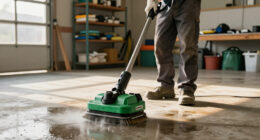
When I compare a compact auto scrubber for a small restroom, I put maneuverability and water recovery ahead of headline cleaning rates. My top pick is the IPC Eagle EM11: its 11-inch cleaning path and ability to clean and dry in reverse suit tight layouts where turning space is limited. The Dapper Supply Mini is my pick for buyers who want longer stated runtime and faster coverage across more open floor areas. The tradeoff is straightforward: the IPC is narrower and explicitly handles reverse passes, while the Dapper is lighter and lists a higher coverage rate, but its 15-inch cleaning width may be less convenient around closely spaced fixtures. Below, I explain which one fits your restroom and what each gives up.

Get cleaning gear delivered free with Prime
- Fast, free delivery on millions of items
- Prime Video, Amazon Music and more included
- Member-only deals all year
Complete the kit


Key Takeaways
- I’d choose the IPC Eagle EM11 for narrow restroom layouts because its 11-inch cleaning path is the slimmer of these two options, and it cleans and dries in reverse.
- I’d choose the Dapper Supply Mini for a small but relatively open commercial floor where its 15-inch width and stated coverage rate can help move through the work faster.
- The Dapper is lighter at 22 pounds, compared with the IPC’s 36 pounds, which may matter when moving the machine between rooms or storing it.
- The IPC includes a battery, brush, and charger; the Dapper’s listed strengths include up to 90 minutes of runtime, a 1.2-gallon solution tank, and a 1.5-gallon recovery tank.
- Neither is a carpet cleaner: the Dapper is specified for sealed hard floors, and I’d limit either choice to suitable hard flooring rather than rugs or carpet.
| IPC Eagle EM11 Walk-Behind Floor Scrubber |  | Best Overall for Tight Restroom Layouts | Cleaning path: 11 inches | Power source: Lithium-ion battery | Voltage: 36 V | VIEW ON AMAZON | See Our Full Breakdown |
| Dapper Supply Mini Automatic Floor Scrubber, 15-Inch Cleaning Width |  | Best for Longer Runs and More Open Floors | Cleaning width: 15 inches | Brush speed: 170 RPM | Coverage: Up to 12,900 sq ft per hour | VIEW ON AMAZON | See Our Full Breakdown |
| compact auto scrubber for small restroom | Coverage | Weight | Cleaning path | Power source |
|---|---|---|---|---|
| IPC Eagle EM11 Walk-Behind Flo | Up to 5,000 sq ft per hour | 36 pounds | 11 inches | Lithium-ion battery |
| Dapper Supply Mini Automatic F | Up to 12,900 sq ft per hour | 22 pounds | — | — |
More Details on Our Top Picks
IPC Eagle EM11 Walk-Behind Floor Scrubber
The IPC Eagle EM11 earns my top spot because its narrower cleaning path speaks directly to the hardest part of scrubbing a small restroom: reaching floor sections without having much room to line up or turn. At 11 inches wide, it has a four-inch advantage over the Dapper Supply Mini’s 15-inch path. That difference can make it easier to plan narrow passes between fixtures, although I would still check the room and doorway dimensions rather than assume it will clear every obstacle.
Its other standout is the stated ability to clean and dry in both forward and reverse. In a cramped room, backing out of a short pass can be more practical than repeatedly turning around. That gives the EM11 a more restroom-specific case than the Dapper, whose supplied details emphasize coverage and runtime instead. It runs on a 36V lithium-ion battery and measures 30 x 15 x 15 inches, with a listed weight of 36 pounds. Battery power means a cord does not restrict movement during cleaning, though the machine is heavier than the 22-pound Dapper.
The EM11’s stated coverage reaches up to 5,000 square feet per hour. That figure is lower than the Dapper’s listed 12,900, so I would not choose it to chase the highest advertised rate across open floor. For a restroom with close-set fixtures, though, the narrower path and reverse cleaning may be more useful than a faster rate that assumes easier movement. The package lists a battery, brush, and charger, which gives the buyer a clear starting set of included components.
My main reservation is that the supplied details do not give a runtime or tank capacity, so buyers planning several rooms in one shift have less information for estimating work cycles than they do with the Dapper. Its 36-pound weight is also worth factoring into storage and transport. I’d pick it for tight, obstacle-heavy rooms; I’d favor the Dapper when lower weight, a longer stated runtime, or more open-floor coverage matters more than the narrowest path.
Pros:- The 11-inch cleaning path is the narrowest of these two picks.
- It can clean and dry in both forward and reverse.
- Battery power allows movement without a power outlet during cleaning.
- A battery, brush, and charger are listed as included components.
Cons:- Its stated coverage rate is lower than the Dapper Supply Mini’s.
- At 36 pounds, it is heavier than the Dapper, and no runtime or tank capacities are specified in the supplied details.
- Actual coverage may vary with usage conditions.
Best for: I’d recommend it to facility staff cleaning small restrooms with tight lanes around fixtures, especially when reverse scrubbing and drying could reduce awkward turning.
Not ideal for: I’d skip it if I needed a published runtime and tank capacities for shift planning, or if my main goal were the highest listed square-foot coverage across open floors.
- Cleaning path:11 inches
- Power source:Lithium-ion battery
- Voltage:36 V
- Coverage:Up to 5,000 sq ft per hour
- Cleaning speed:1.9 miles per hour
- Dimensions:30 x 15 x 15 inches
- Weight:36 pounds
- Included components:Battery, brush, charger
Our verdict“I’d choose the IPC Eagle EM11 over the Dapper when narrow passes and reverse cleaning matter more than lighter weight or a higher stated coverage rate.”
Dapper Supply Mini Automatic Floor Scrubber, 15-Inch Cleaning Width
The Dapper Supply Mini is the better fit when a small restroom is compact by commercial standards but still has enough open floor to make a wider pass useful. Its 15-inch cleaning width is broader than the IPC Eagle EM11’s 11-inch path, and its listed coverage reaches up to 12,900 square feet per hour. That higher figure makes it the productivity-oriented option in this pair. I would not read it as a promise of that pace in a crowded restroom: obstacles and short passes can change the work rate.
Where the Dapper has a clear practical advantage is its 22-pound weight, 14 pounds lighter than the IPC. That may make carrying or repositioning it between spaces less demanding. It also lists up to 90 minutes of runtime and a 100-minute charge time, giving buyers more concrete battery-planning information than the EM11’s supplied specifications provide. Its 1.2-gallon solution tank and 1.5-gallon recovery tank add useful planning detail for a cleaning route. A squeegee and 70W suction motor recover water, supporting faster drying on sealed hard floors.
This is not the narrowest choice for a restroom crowded with partitions or fixtures. The 15-inch width may be less convenient than the EM11’s 11-inch path for close-quarters passes, and the supplied description does not say that it cleans and dries while reversing. I’d weigh those points against the Dapper’s lighter build and longer stated runtime. If a worker is cleaning several small rooms with open floor sections, the balance may favor the Dapper; if a single room is difficult to maneuver through, the IPC’s narrower path is more persuasive.
The Dapper is specified for sealed hard floors, including tile, vinyl, hardwood, laminate, and concrete. It is not suitable for carpet or rugs, so mixed flooring is a poor match. Its 65 dB noise listing and one-year warranty help set expectations, but the core decision remains layout: choose this model for lighter handling and longer runs, not because the coverage claim removes the need to work around restroom obstacles.
Pros:- The 22-pound weight is lower than the IPC EM11’s 36 pounds.
- It lists up to 90 minutes of runtime and a 100-minute charge time.
- Its 1.2-gallon solution and 1.5-gallon recovery tanks provide planning details.
- A squeegee and suction motor recover water from sealed hard floors.
Cons:- Its 15-inch cleaning width is wider than the IPC’s 11-inch path.
- It is not suitable for carpets or rugs.
- The supplied description does not specify cleaning and drying in reverse.
Best for: I’d recommend it to a small commercial facility that cleans sealed hard floors across multiple rooms and values lower machine weight, specified runtime, and tank capacities.
Not ideal for: I’d skip it for a restroom with especially narrow gaps around fixtures, for carpeted areas, or when reverse cleaning and drying are central requirements.
- Cleaning width:15 inches
- Brush speed:170 RPM
- Coverage:Up to 12,900 sq ft per hour
- Runtime:Up to 90 minutes
- Charge time:100 minutes
- Tank capacities:1.2-gallon solution; 1.5-gallon recovery
- Weight:22 pounds
- Suitable surfaces:Tile, vinyl, hardwood, laminate, concrete, and other sealed hard floors
Our verdict“I’d pick the Dapper Supply Mini when lighter handling and longer stated runtime matter more than the narrowest possible cleaning path.”

How We Picked
I ranked these machines around the specific demands of small restrooms, not broad commercial-floor coverage. A restroom can have tight aisles, toilets, partitions, sinks, and little room to turn. That makes cleaning width and the ability to work around obstacles more relevant than a large-area productivity figure alone. I gave the IPC Eagle EM11 the lead because its 11-inch path is narrower than the Dapper’s 15 inches, and its stated ability to scrub and dry in both forward and reverse addresses the repeated short passes common in cramped rooms.
I also compared the practical differences buyers can verify from the supplied specifications: weight, power, runtime, tanks, recovery, and listed coverage. The Dapper earns a distinct place for its 22-pound weight, up-to-90-minute runtime, and higher stated coverage rate. Those advantages may matter more in a compact restroom with open floor space or several rooms to clean. I did not treat either advertised coverage figure as a guarantee; actual results can vary with layout and use. I also kept the limits visible: neither product description establishes that a machine will fit every doorway or clear every fixture, so I recommend measuring the actual route and floor area before choosing.
| compact auto scrubber for small restroom | Coverage |
|---|---|
| IPC Eagle EM11 Walk-Behind Flo | Up to 5,000 sq ft per hour |
| Dapper Supply Mini Automatic F | Up to 12,900 sq ft per hour |
Factors to Consider When Choosing Compact Auto Scrubber For Small Restrooms
I’d make this choice by matching the scrubber to the room’s shape and cleaning routine, not by comparing coverage numbers alone. These machines have different strengths: the IPC is narrower and explicitly supports reverse cleaning and drying, while the Dapper is lighter and provides more runtime and tank information.
Measure the tightest route, not just the room
Before choosing either scrubber, I’d measure the narrowest doorway and the working lanes between fixtures. The IPC’s 11-inch path gives it the advantage for narrow cleaning passes, compared with the Dapper’s 15-inch width. Keep in mind that cleaning width is not the same as the machine’s full footprint: the IPC is listed at 30 x 15 x 15 inches, while the supplied Dapper specifications do not include overall dimensions. I’d leave room for steering and access to the cleaning area rather than comparing a measurement to the gap with no clearance.
A restroom can have open floor near the entrance but difficult edges around toilets, sinks, and partitions. I would base my decision on those tight sections, since a machine that handles the broad center quickly may still need careful passes around obstacles. For a particularly constrained route, the IPC is the stronger starting point; for more open floor, the Dapper’s wider path may be easier to put to work.
Treat coverage rates as a comparison, not a promise
The Dapper lists up to 12,900 square feet per hour, while the IPC lists up to 5,000. Those figures distinguish their advertised pace, but restroom geometry can affect how much cleaning gets done in an hour. Short passes, repeated turns, and fixture edges may limit the usefulness of a high rate. I’d use coverage to understand the manufacturers’ stated positioning, then let the layout decide whether a wider or narrower cleaning path better suits the job.
If I had several relatively open small restrooms on a route, the Dapper’s higher listed rate could be attractive. If one room is crowded and turning is awkward, I’d give more weight to the IPC’s narrower path and its stated forward-and-reverse cleaning and drying. The figure that looks strongest on paper is not automatically the better fit for the room.
Match runtime, tanks, and weight to the workday
The Dapper provides more planning detail for repeated cleaning: up to 90 minutes of runtime, a 100-minute charge time, a 1.2-gallon solution tank, and a 1.5-gallon recovery tank. I’d look at those specifications if staff need to clean more than one room between charging or refilling. They do not tell me exactly how long a particular restroom route will take, but they give a more concrete basis for planning than the IPC details supplied here.
For moving and storage, the Dapper’s 22-pound weight is a notable difference from the IPC’s 36 pounds. The lighter machine may be easier to reposition or carry, while the IPC may suit a buyer who values its narrow path more than lower weight. Neither set of details replaces checking where the machine will be stored, charged, and filled.
Check flooring and drying needs
The Dapper is listed for tile, vinyl, hardwood, laminate, concrete, and other sealed hard floors; it is not for carpet or rugs. I’d rule it out if the cleaning route includes carpeted sections that the same machine is expected to scrub. The IPC description identifies it as a floor scrubber but does not provide the same surface list, so I would confirm compatibility with the actual flooring before buying rather than assume every material is suitable.
Water recovery also matters in a restroom that needs to reopen soon after cleaning. The Dapper’s squeegee and suction motor are specified for recovery, and the IPC is described as cleaning and drying in both directions. Those are useful distinctions, but neither description provides a guaranteed drying time. I’d consider the floor finish, room use, and cleaning procedure alongside the machine’s recovery features.
Frequently Asked Questions
Which scrubber is better for a very tight restroom?
I’d start with the IPC Eagle EM11 because its 11-inch cleaning path is narrower than the Dapper’s 15-inch path. It also cleans and dries in reverse, a useful detail when the room does not leave much turning space. I would still measure doorways and fixture clearances: the cleaning path alone does not establish that the whole machine will fit through every route.
Is the Dapper Supply Mini a better choice for a larger cleaning route?
It may be the better fit for a route with several small but relatively open rooms. The Dapper lists up to 90 minutes of runtime, tank capacities, and coverage up to 12,900 square feet per hour, giving buyers more planning information than the IPC listing. I would treat the coverage figure as an advertised maximum rather than an expected rate for every restroom layout.
Can either machine clean carpet or rugs?
The Dapper is explicitly listed as not suitable for carpets or rugs and is intended for sealed hard floors. The supplied IPC details do not give a matching surface list, so I would check flooring compatibility with the seller or manufacturer before using it on an unfamiliar surface. I would not select either model as a carpet-cleaning machine based on the information available here.
Which option is easier to move between rooms?
The Dapper is the lighter option at 22 pounds, compared with the IPC’s listed 36 pounds, so it may be more convenient to reposition or carry. The IPC’s narrower path may still be more helpful once cleaning begins in a crowded restroom. I’d choose between handling weight and working clearance based on whether staff move the machine often or mainly need it to maneuver around fixtures.
What should I measure before ordering?
I’d measure the narrowest doorway, the tightest lane between fixtures, the storage space, and the route from the charging area to the restroom. The IPC’s listed dimensions are 30 x 15 x 15 inches, while no overall dimensions are included in the Dapper specifications provided here. I’d check the complete machine footprint for the model I plan to buy, not rely only on the cleaning width.
Conclusion
For a restroom with tight gaps and limited turning room, I’d choose the IPC Eagle EM11: its 11-inch path and reverse cleaning-and-drying capability align most closely with that layout. For a buyer managing several small, more open rooms, I’d lean toward the Dapper Supply Mini for its 22-pound weight, up-to-90-minute runtime, tank details, and higher stated coverage rate. I would not decide on advertised coverage alone, and I’d verify dimensions, flooring compatibility, and the actual route before ordering. The best match comes down to whether your daily problem is maneuvering around fixtures or covering more open floor with fewer interruptions.
Fall Picks
fall essentials
As an affiliate, we earn on qualifying purchases.