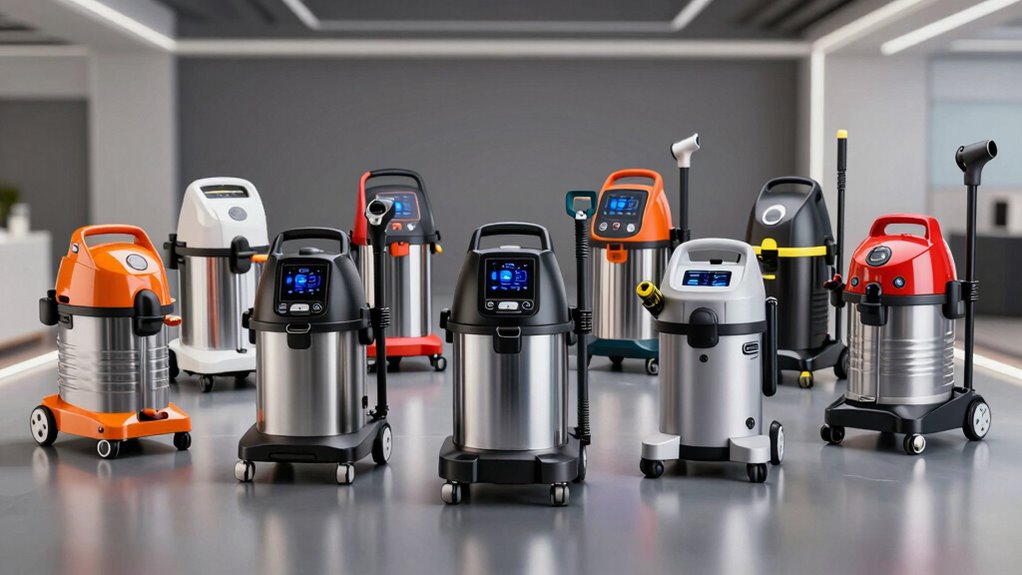

For a commercial steam cleaner machine that balances pressure, reach, and included tools, I name the McCulloch MC1385 Deluxe Canister Steam Cleaner my best overall pick, with its 23 accessories making it a versatile choice for varied jobs. The TVD 5 Bar 320°F Steam Cleaner stands out for buyers prioritizing stated steam pressure and temperature, while the Hapyvergo 1700W Handheld Steamer suits targeted grout, tile, and car cleaning. The main tradeoffs are portability versus working reach, accessory breadth versus setup and storage, and advertised steam performance versus the machine’s intended duty cycle. These six options vary in format and specification, so a commercial label alone does not establish that a machine is built for continuous professional use. Read on for the full comparison and a practical guide to choosing by workload.

Get cleaning gear delivered free with Prime
- Fast, free delivery on millions of items
- Prime Video, Amazon Music and more included
- Member-only deals all year
Complete the kit


Key Takeaways
- The McCulloch MC1385 ranks first for versatility: its canister format and 23 accessories suit varied tasks better than a handheld unit, though it takes more storage space.
- The TVD’s stated 5-bar pressure and 320°F temperature set it apart on listed steam specs; check that those figures match the cleaning work you plan to do.
- The Hapyvergo 1700W handheld is the focused choice for smaller grout, tile, and car jobs, not a substitute for a canister machine on large, varied routes.
- Accessory counts vary from 22 to 26 across several options, but tool fit and usefulness matter more than the count when choosing equipment for repeated jobs.
- The lineup includes several 1500W–1700W options, so wattage alone does not settle the choice; format, steam specifications, tool selection, and upkeep also shape day-to-day suitability.
| Hapyvergo High Pressure Steam Cleaner 1700W Handheld Steamer for Grout, Tile and Car (110V) |  | Best for Quick Spot Cleaning | Wattage: 1700 watts | Form factor: Handheld | Heat-up time: 20 seconds | VIEW ON AMAZON | See Our Full Breakdown |
| TaskStar High-Pressure Steam Cleaner |  | Best Accessory Kit for Mixed Tasks | Wattage: 1500 watts | Steam pressure: 4.5–5.0 bar | Maximum temperature: 230°F | VIEW ON AMAZON | See Our Full Breakdown |
| McCulloch MC1385 Deluxe Canister Steam Cleaner with 23 Accessories |  | Best for Long Cleaning Sessions | Model: MC1385 | Type: Canister steam cleaner | Wattage: 1500 watts | VIEW ON AMAZON | See Our Full Breakdown |
| Heavy-Duty 1500W Steam Cleaner with 22 Accessories |  | Best for High-Temperature Cleaning | Power: 1500 watts | Steam pressure: 65 PSI | Maximum temperature: 275°F | VIEW ON AMAZON | See Our Full Breakdown |
| Hapyvergo LU-3A High-Pressure Steam Cleaner, 1700W |  | Best for Bucket-Fed Handheld Cleaning | Model: LU-3A | Wattage: 1700 watts | Voltage: 110 volts | VIEW ON AMAZON | See Our Full Breakdown |
| TVD 5 Bar 320°F Steam Cleaner with 26 Accessories |  | Best for Long Cleaning Sessions | Pressure: 5 bar | Maximum temperature: 320°F (160°C) | Tank capacity: 52 oz (1.65 L) | VIEW ON AMAZON | See Our Full Breakdown |
| commercial steam cleaner machine | Maximum temperature | Wattage | Heat-up time | Weight |
|---|---|---|---|---|
| Hapyvergo High Pressure Steam | 221°F | 1700 watts | 20 seconds | 2.5 kg |
| TaskStar High-Pressure Steam C | 230°F | 1500 watts | 8 minutes | 9 pounds |
| McCulloch MC1385 Deluxe Canist | 200°F | 1500 watts | — | 13 pounds |
| Heavy-Duty 1500W Steam Cleaner | 275°F | — | 8–12 minutes | — |
| Hapyvergo LU-3A High-Pressure | 230°F | 1700 watts | 20 seconds | — |
| TVD 5 Bar 320°F Steam Cleaner | 320°F (160°C) | 1800 watts | 8 minutes | 13 pounds |
More Details on Our Top Picks
Hapyvergo High Pressure Steam Cleaner 1700W Handheld Steamer for Grout, Tile and Car (110V)
The Hapyvergo 1700W suits targeted jobs where waiting for a canister to heat feels like more effort than the cleanup itself. It reaches up to 221°F in 20 seconds, and its tankless setup draws water through a 3.3-foot inlet hose, avoiding a built-in tank and supporting continuous steam. Compared with the McCulloch MC1385, it is much faster to start and lighter to handle, but the McCulloch’s 64-ounce tank and long runtime make it better for larger, uninterrupted cleaning sessions. The short hose also limits working distance, so this is not a whole-room reach solution. It is a focused pick for grout, tile, and car-interior touch-ups; buyers should also note that it accepts tap water only, not detergent.
Pros:- Heats in 20 seconds, reducing downtime for short cleaning tasks.
- Tankless water feed supports continuous steam without carrying a full onboard tank.
- Stainless-steel evaporator and pump are designed for durability.
- Includes a carrying case, gloves, scraper, and towel.
Cons:- The 3.3-foot inlet hose restricts reach around larger work areas.
- Detergents cannot be used; the unit is limited to tap water.
- Its 221°F maximum is lower than the stated temperatures of several canister alternatives.
Best for: Car detailers and property-care staff who need fast steam for localized grout, tile, or interior touch-ups.
Not ideal for: Teams cleaning large floor areas or working far from a water source, since the 3.3-foot inlet hose limits reach and the handheld format is less suited to broad coverage.
- Wattage:1700 watts
- Form factor:Handheld
- Heat-up time:20 seconds
- Maximum temperature:221°F
- Voltage:110 volts
- Water inlet hose:3.3 feet
- Weight:2.5 kg
- Warranty:1 year
Our verdict“Choose this Hapyvergo for quick, close-range detail work, but pick the McCulloch MC1385 for longer sessions and broader coverage.”
TaskStar High-Pressure Steam Cleaner
The TaskStar is a versatile canister option for buyers who want one machine and a broad tool set for floors, grout, upholstery, kitchens, and vehicle interiors. Its 22 accessories give it more task-specific reach than the compact Hapyvergo handhelds, while the 1.6-liter tank supplies up to 50 minutes of steam before a refill. A 16.4-foot cord and rolling wheels help it move between rooms, though its nine-pound body is still a piece of equipment to pull along. The tradeoff is the 8-minute heat-up: unlike the Hapyvergo units, it is not ready for an immediate spot clean. Compared with the McCulloch MC1385, TaskStar has a shorter stated runtime, but it heats faster and includes child and steam-lock safety features.
Pros:- A 1.6-liter tank supports up to 50 minutes of continuous runtime.
- The 22-piece accessory kit covers a range of surfaces and tasks.
- A 16.4-foot power cord and rolling wheels aid movement between work areas.
- Child lock, mechanical steam lock, and safety valve provide multiple safety features.
Cons:- Eight-minute heat-up delays short, spontaneous cleaning tasks.
- Its runtime is shorter than the McCulloch MC1385’s stated maximum of 120 minutes.
- The main unit must not be submerged in water.
Best for: Small cleaning businesses and vehicle detailers who need a multi-surface kit with enough runtime for moderate cleaning rounds.
Not ideal for: Workers who need near-instant steam for brief jobs or who require the longest available cleaning interval between refills.
- Wattage:1500 watts
- Steam pressure:4.5–5.0 bar
- Maximum temperature:230°F
- Heat-up time:8 minutes
- Tank volume:1.6 liters
- Continuous runtime:Up to 50 minutes
- Accessory kit:22 pieces
- Power cord length:16.4 feet
- Weight:9 pounds
Our verdict“Pick TaskStar for a capable, accessory-rich canister setup, and choose the McCulloch if longer steam sessions matter more than faster warm-up.”
McCulloch MC1385 Deluxe Canister Steam Cleaner with 23 Accessories
For jobs that run across multiple rooms or a full vehicle interior, the McCulloch MC1385 stands out for its 64-ounce tank and up to 120 minutes of steam. That capacity reduces refill interruptions compared with the TaskStar’s stated 50-minute runtime and the heavy-duty 1500W cleaner’s 40 minutes. Variable steam control lets the operator adjust output for different sealed surfaces, while 23 accessories support home cleaning and car detailing. The cost of that endurance is a slower start: it takes under 12 minutes to heat, far longer than either Hapyvergo handheld’s 20-second warm-up. At 13 pounds, it is also less nimble than a handheld. Its U.S.-voltage design makes it a poor match for buyers outside compatible electrical systems.
Pros:- The 64-ounce tank provides up to 120 minutes of steam.
- Variable steam control allows output adjustment for different cleaning tasks.
- A 23-piece accessory set supports a range of home and vehicle work.
- The 18-foot power cord and 7-foot steam hose provide useful working reach.
Cons:- Heating takes under 12 minutes, making it slower to deploy than the Hapyvergo handhelds.
- At 13 pounds, it is heavier to move than the smaller handheld options.
- Designed for U.S. voltage requirements and use.
Best for: Detailing teams and facility staff who need extended steam sessions across sealed floors, multiple rooms, or vehicle interiors.
Not ideal for: Buyers who need rapid startup, a lightweight spot cleaner, or equipment compatible with voltage systems outside its 120V design.
- Model:MC1385
- Type:Canister steam cleaner
- Wattage:1500 watts
- Tank capacity:64 fluid ounces
- Steam duration:Up to 120 minutes
- Maximum temperature:200°F
- Steam pressure:Up to 58 PSI (4 bar)
- Power cord length:18 feet
- Weight:13 pounds
Our verdict“Choose the MC1385 when minimizing refills matters most; choose the TaskStar for a quicker warm-up in a lighter canister package.”
Heavy-Duty 1500W Steam Cleaner with 22 Accessories
This canister cleaner’s defining case is its stated 275°F steam temperature and 65 PSI pressure, the highest temperature and pressure figures among the listed canister options. That makes it the spec-led choice for buyers prioritizing hot, pressurized steam across floors, grout, upholstery, and kitchen surfaces. Its 50-ounce tank runs for up to 40 minutes, less than the TaskStar’s 50 minutes and well short of the McCulloch MC1385’s 120-minute claim. A 22-piece kit, 16-foot cord, and 6-foot hose add task flexibility, but the 8–12-minute heat-up means this is not a quick-start spot cleaner like the Hapyvergo LU-3A. It also produces steam rather than extracting liquid from carpet, so it should not be chosen as a carpet-washing machine.
Pros:- The stated 275°F maximum temperature and 65 PSI pressure are the highest listed among these canister options.
- A 50-ounce tank provides up to 40 minutes of runtime per fill.
- The 22-piece kit supports cleaning across floors, grout, upholstery, kitchens, and vehicles.
- A 16-foot cord and 6-foot hose offer 22 feet of combined cord-and-hose reach.
Cons:- The 8–12-minute heat-up is slower than the 20-second Hapyvergo handhelds.
- Its stated runtime is shorter than the TaskStar and McCulloch MC1385.
- It is not a vacuum extractor for carpets.
Best for: Cleaning crews who prioritize the listed temperature and pressure figures for varied sealed-surface jobs and can work in shorter sessions.
Not ideal for: Buyers who need long uninterrupted runtime, instant startup, or a machine that extracts dirt and moisture from carpet.
- Power:1500 watts
- Steam pressure:65 PSI
- Maximum temperature:275°F
- Tank capacity:50 fluid ounces (1.5 L)
- Runtime:Up to 40 minutes per fill
- Heat-up time:8–12 minutes
- Power cord:16 feet
- Steam hose:6 feet
- Warranty:2 years
Our verdict“Choose this model for its stated high-temperature, high-pressure output, but favor the McCulloch MC1385 for longer sessions.”
Hapyvergo LU-3A High-Pressure Steam Cleaner, 1700W
The Hapyvergo LU-3A pairs a quick 20-second warm-up with a tankless feed from an external bucket, giving it a different setup from the Hapyvergo 1700W model’s shorter 3.3-foot inlet hose. Its 4-foot hose offers a little more placement flexibility, while the stated 230°F output and 3.5 bar pressure make it suited to focused tile and shower work. Like the other handheld, it avoids the bulk of a canister, but neither Hapyvergo matches the broad accessory coverage or long tank-based sessions of the McCulloch MC1385. This model also calls for a cold-water pumping step before switching on steam, and the nozzle should be checked after 30 minutes of operation. The separately downloaded Spanish manual may add friction for English-speaking crews.
Pros:- Heats up in 20 seconds for short, targeted tasks.
- Tankless design draws water from an external bucket rather than relying on an onboard tank.
- The 4-foot inlet hose allows more placement flexibility than the other Hapyvergo model’s 3.3-foot hose.
- Stainless-steel evaporator and pump are designed for durability.
Cons:- The nozzle needs checking after 30 minutes of operation.
- A cold-water pumping step is required before switching on steam.
- The Spanish manual must be downloaded separately.
Best for: Tile and shower cleaners who want a compact, fast-start unit and can keep an external bucket close to the work area.
Not ideal for: Crews needing long, uninterrupted operation, a complete English-language paper manual, or broad canister-style accessory coverage.
- Model:LU-3A
- Wattage:1700 watts
- Voltage:110 volts
- Form factor:Handheld
- Heat-up time:20 seconds
- Maximum temperature:230°F
- Steam pressure:3.5 bar
- Water inlet hose:4 feet
- Recommended runtime:Check the nozzle after 30 minutes
Our verdict“Choose the LU-3A for fast, bucket-fed tile and shower work, but pick a canister such as the McCulloch MC1385 for longer, broader cleaning rounds.”
TVD 5 Bar 320°F Steam Cleaner with 26 Accessories
I’d rank the TVD as a strong fit for household cleaning sessions that cover several surfaces rather than a quick spot-clean. Its 52 oz tank supports up to 50 minutes of steam, giving it a longer-session focus than a compact handheld approach like the Hapyvergo High Pressure Steam Cleaner 1700W Handheld Steamer. The 26 accessories also make it more adaptable for floors, grout, upholstery, and windows, while the 197-inch cord and 57-inch hose help extend its reach.
The tradeoff is that this is not a ready-in-seconds cleaner: allow 8 minutes to heat up, and restarting may send condensed water through the hose. Its 13-pound weight also makes it less appealing for frequent stair carries than a lighter handheld. I’d choose it for capacity and accessory range, not for fast, portable jobs.
Pros:- 52 oz tank supports up to 50 minutes of steam for longer cleaning sessions
- 26 accessories cover a broad range of household surfaces
- Long power cord and steam hose extend cleaning reach
- Steam cleaning uses water rather than cleaning chemicals
Cons:- Eight-minute heat-up time delays quick cleaning jobs
- Condensed water may come out of the hose when steam is restarted
- At 13 pounds, it is less convenient to carry than a compact handheld cleaner
Best for: Homeowners who clean multiple hard-surface areas, grout, and upholstery in one session and want a large tank with broad accessory coverage
Not ideal for: People who need quick, portable spot cleaning or regularly carry a cleaner up and down stairs; the heat-up wait and 13-pound weight work against that use
- Pressure:5 bar
- Maximum temperature:320°F (160°C)
- Tank capacity:52 oz (1.65 L)
- Heat-up time:8 minutes
- Steam duration:Up to 50 minutes
- Wattage:1800 watts
- Power cord and hose length:197-inch power cord; 57-inch steam hose
- Weight:13 pounds
- Accessories and boiler:26 accessories; stainless steel boiler
Our verdict“Choose the TVD if longer sessions and broad surface coverage matter more than immediate startup or lightweight portability.”

How We Picked
I compared the six machines on buyer-relevant details: listed steam performance, machine format, included accessories, likely reach across different cleaning tasks, and the practical demands of setup, storage, and maintenance. I also separated compact spot-cleaning options from canister-style machines, since portability can matter more than accessory variety for vehicle interiors or isolated grout lines.
The ranking favors versatility and clarity of fit over a high accessory count by itself. The McCulloch takes the overall lead for its canister design and broad tool set; the TVD follows for its stated pressure and temperature figures. The handheld Hapyvergo ranks as a more specialized choice, while the remaining models are best compared by their intended task, listed tools, and suitability for the buyer’s workload. Product names and wattage do not establish commercial duty-cycle capacity, so buyers should verify manufacturer guidance before relying on any option for continuous daily service.
Factors to Consider When Choosing Commercial Steam Cleaner Machine
Before choosing a commercial steam cleaner machine, I would match the machine to the work pattern rather than start with accessory count or wattage. The factors below help distinguish a useful fit from a machine that may be awkward, underspecified, or costly to maintain in routine service.
Match the Machine Format to Your Route
A handheld unit is easy to carry between a vehicle, bathroom, or isolated grout line, but its compact format can mean more frequent pauses and less convenient coverage across a large floor area. A canister model typically gives you a separate body and a hose, which can make it easier to work across multiple surfaces without holding the main machine. That added reach and tool capacity come with more equipment to move, store, and prepare. Think through how far you travel between jobs and whether there is a safe place to park the machine while cleaning. A common misstep is buying the most portable option for a route that involves long, uninterrupted cleaning sessions. For mixed sites, I would favor a format that makes repeated repositioning manageable without sacrificing the reach your work needs.
Read Steam Specifications in Context
Pressure, temperature, and wattage describe different aspects of a steam cleaner, and one number cannot stand in for all the others. A stated pressure or temperature can help compare listings, but performance also depends on how the machine sustains steam during use and how its tools deliver it to a surface. Wattage is a power figure, not a direct measure of cleaning speed or commercial endurance. Check which conditions apply to published specifications, including whether a figure refers to a peak reading or a working setting. Match the machine to the soils and surfaces you actually encounter; delicate finishes may need gentler handling than tile grout or hard-wearing equipment. I would avoid treating a larger specification as proof that a unit can run through a full shift.
Choose Attachments by Task, Not Count
Accessory bundles can cover brushes, nozzles, and surface tools, but the number of pieces alone says little about whether they suit your jobs. List the surfaces and tasks you handle, then check whether the included tools address those jobs without requiring extra purchases. A narrow nozzle may help direct steam into a seam, while a broader tool may make sense for larger hard surfaces; neither replaces the other. Also check how attachments connect and whether replacement parts are available from the manufacturer. Too many seldom-used pieces can add sorting and storage work instead of saving time. The better bundle is the one that supports your regular tasks and can be replenished when a frequently used tool wears out.
Verify Duty-Cycle Fit Before Professional Use
The word commercial in a product listing does not, by itself, confirm that a machine is designed for continuous daily operation. Before using a home-oriented or lightly specified model for paid work, check the manufacturer’s guidance on run time, cooldown periods, refill procedure, and warranty coverage for business use. These details affect scheduling as much as the headline steam figures do. A machine that needs frequent pauses may be suitable for occasional detail work but frustrating on a large recurring contract. Ask about service support and replacement components if downtime would affect your work. Paying more for a clearly documented service profile can make sense when the cleaner will see frequent use; for occasional jobs, a simpler unit may be enough.
Plan for Water, Maintenance, and Storage
Water quality and routine care can affect how reliably a steam cleaner operates over time. Follow the specific manual’s instructions for water type, descaling, rinsing, and storage rather than assuming all machines share the same maintenance routine. If you work in a hard-water area, ask the manufacturer how often scale control is needed and whether any treatment method is permitted. A larger tool bundle can increase storage demands, while a canister body and hose need space of their own. Check whether the machine can be moved and stored safely at your work sites, especially if you carry equipment up stairs or load it into a vehicle. I would factor maintenance time and transport into the purchase decision, not treat them as afterthoughts.
Frequently Asked Questions
Can I use any of these machines for a full commercial shift?
Do not assume so from a product title or wattage figure. Check each manufacturer’s documentation for permitted run time, cooldown intervals, refill instructions, and whether business use is covered by the warranty. Those limits can determine whether a machine fits a route with long sessions or only occasional detail work. The lineup’s listed features help compare task fit, but they do not establish continuous-duty certification. If a full shift is your requirement, ask the manufacturer for explicit guidance before buying.
Should I choose the TVD’s stated pressure and temperature or the McCulloch’s larger tool set?
Choose based on the bottleneck in your work. The TVD’s listed 5-bar pressure and 320°F temperature make it the more specification-led option in this comparison, while the McCulloch’s 23 accessories and canister format point toward varied tasks and broader tool coverage. Neither advantage guarantees faster cleaning on every surface, and the figures may be measured under particular conditions. Compare the manuals for working settings, tool compatibility, and care requirements. If your jobs span many surfaces, versatility may matter more than a single headline specification; if steam output is your main concern, verify how the TVD figures apply during normal operation.
Is a handheld steam cleaner practical for paid cleaning work?
It can be practical when the work is focused and access matters more than broad coverage, such as spot work on grout, tile, or vehicle interiors. The Hapyvergo handheld is the lineup’s clearest fit for those targeted tasks. For larger areas or varied jobs, holding a compact machine and repeatedly changing position may slow the work compared with a canister setup. Check run time, refill process, and included tools before putting it on a regular route. I would choose handheld for a defined niche, not as a default replacement for a full-size machine.
Does a bundle with more accessories mean less work overall?
Not automatically. A broad set helps only when its tools fit the surfaces you clean and are easy to change, store, and replace. A bundle can still leave a gap for a recurring task, while unused attachments add clutter without improving the job. Before choosing, compare the included tools with your work checklist and confirm that replacements are available. For a team, also consider whether staff can identify the right tool quickly and follow surface-specific instructions.
What should I check before using steam on a customer’s surface?
Confirm that the surface and its finish are rated for steam, and check the machine manual for any material restrictions. Heat and moisture can damage some coatings, adhesives, sealed surfaces, and sensitive materials even when the cleaner is suitable for hard tile. Test an inconspicuous area first when the material is unfamiliar, and use the least aggressive suitable tool and setting. Do not rely on accessory descriptions as proof of compatibility. For client work, documenting the surface check and following the manufacturer’s instructions can reduce the risk of avoidable damage.
Conclusion
Best overall: I recommend the McCulloch MC1385 for buyers who need a canister format and broad accessory coverage across varied jobs. Best value: the Heavy-Duty 1500W Steam Cleaner with 22 Accessories is the bundle-focused option to compare when broad tool coverage is a priority, though I would verify duty-cycle guidance before relying on it for frequent commercial use. Best premium-style pick: the TVD 5 Bar 320°F Steam Cleaner is the choice for buyers who prioritize clearly stated pressure and temperature figures alongside a 26-piece tool set. Best for beginners: the Heavy-Duty 1500W model offers a straightforward way to start comparing a multi-tool setup, provided its operating instructions and workload limits fit the job. Best for specific needs: choose the Hapyvergo 1700W handheld for targeted grout, tile, and car cleaning; consider the TaskStar or Hapyvergo LU-3A when their specifications, format, and manufacturer guidance better match your route. My final advice is to confirm service limits, surface compatibility, and replacement-part support before treating any of these machines as daily commercial equipment.
Fall Picks

eufy Security Essential 7-Piece Alarm System
As an affiliate, we earn on qualifying purchases.