
For an aqueous parts washer for shop cleaning, I’d start with the Eastwood 40-Gallon Parts Washer with 120V Pump as the best overall choice for a dedicated shop that needs room for larger parts and regular cleaning. The JEGS 20-Gallon Parts Washer is a more manageable middle-ground option, while the CRC SmartWasher SW-423 stands out for shops that prioritize a water-based, non-flammable, pH-neutral system. The main tradeoffs are tank capacity and shop footprint versus portability, pump-driven circulation, and the cleaning system’s operating needs. A small 5-gallon washer can suit occasional jobs, but may feel cramped for frequent or bulky work. Read on for how the six options compare and which type of shop each one fits best.

Get cleaning gear delivered free with Prime
- Fast, free delivery on millions of items
- Prime Video, Amazon Music and more included
- Member-only deals all year
Complete the kit


Key Takeaways
- Eastwood’s 40-gallon capacity gives it the strongest fit for a fixed shop cleaning larger parts regularly, but it takes more space than the 20-gallon JEGS models.
- The JEGS 20-gallon washer and cart offer a capacity step up from the 5-gallon tubs without the same tank size as the Eastwood; the cart version is the more mobile of the pair.
- The CRC SmartWasher SW-423 is the standout for buyers who specifically want a water-based, non-flammable, pH-neutral cleaning approach rather than a conventional washer setup.
- The two 5-gallon options trade capacity for a smaller footprint; the VEVOR model includes an electric pump, while the other portable model suits buyers whose priority is a basic compact tub.
- Tank volume alone does not determine fit: part dimensions, how often the washer will be moved, pump setup, and the cleaning system’s upkeep all affect day-to-day usefulness.
| Portable Parts Washer 5-Gallon Tank |  | Best for Simple, Space-Saving Cleanup | Capacity: 5 gallons | Design: Compact | Tray: Removable | VIEW ON AMAZON | See Our Full Breakdown |
| Eastwood 40-Gallon Parts Washer with 120V Pump |  | Best for High-Volume Shop Cleaning | Capacity: 40 gallons | Tub depth: 10 inches | Pump voltage: 120V | VIEW ON AMAZON | See Our Full Breakdown |
| VEVOR 5-Gallon Portable Parts Washer with Electric Pump |  | Best Portable Pumped Option | Tank capacity: 5 gallons | Solvent capacity: 3.5 gallons | Pump output: 0.4 gallons per minute | VIEW ON AMAZON | See Our Full Breakdown |
| CRC SmartWasher SW-423 Mobile Parts Washer Kit – Water-Based, Non-Flammable, pH-Neutral |  | Best Water-Based Cleaning System | Model: SW-423 | Solution type: Water-based, non-flammable, pH-neutral | Included washer: 1 mobile parts and brake washer | VIEW ON AMAZON | See Our Full Breakdown |
| JEGS 20-Gallon Parts Washer |  | Best Mid-Size Garage Pick | Tank volume: 20 gallons | Solvent capacity: 12 gallons | Power source: 110V/60Hz | VIEW ON AMAZON | See Our Full Breakdown |
| JEGS Portable Parts Washer Cart, 20-Gallon Tank |  | Best for Mobile Shop Cleanup | Brand: JEGS | Tank capacity: 20 gallons | Solvent capacity: 12 gallons | VIEW ON AMAZON | See Our Full Breakdown |
| aqueous parts washer for shop cleaning | Weight | Dimensions | Material | Warranty |
|---|---|---|---|---|
| Portable Parts Washer 5-Gallon | — | — | — | — |
| Eastwood 40-Gallon Parts Washe | 92.4 pounds | 35 x 21.5 x 43 inches | Steel | 1-year limited warranty |
| VEVOR 5-Gallon Portable Parts | 15 pounds | 18.11 x 13.39 x 9.06 inches | Powder-coated steel | — |
| CRC SmartWasher SW-423 Mobile | — | — | — | — |
| JEGS 20-Gallon Parts Washer | 57.5 pounds | 30 x 21 x 34.5 inches | — | 30 days |
| JEGS Portable Parts Washer Car | 80 lb | 21.5 x 21.5 x 37 in | 20-gauge steel and polyurethane | 30 days |
More Details on Our Top Picks
Portable Parts Washer 5-Gallon Tank
The 5-gallon tank makes this JEGS washer a straightforward choice for a small bench or occasional cleanup of compact components. Its removable tray can make post-wash cleanup easier, while the portable format suits shops that need to move the washer between work areas. Compared with the VEVOR 5-Gallon Portable Parts Washer, this model has fewer listed features: the VEVOR includes an electric filtration pump and adjustable nozzle, while those details are not provided here. That simpler setup may suit buyers who value a compact footprint over specified circulation features. The tradeoff is capacity: it is a poor match for repeated cleaning of larger assemblies or a steady stream of parts. I’d choose it for light-duty shop tasks, not as a substitute for the larger Eastwood 40-Gallon unit.
Pros:- Compact design takes up less bench space
- Portable format suits moving between work areas
- Removable tray supports easier cleanup
- Powder-coated finish is designed for durable shop use
Cons:- Five-gallon capacity limits the size and volume of parts it can handle
- Pump, flow rate, and cleaning-solution details are not specified
- Less suited to sustained shop workloads than larger units
Best for: Home mechanics and small shops that clean compact parts occasionally and need a portable washer with a removable tray.
Not ideal for: Shops handling large components or frequent batches that need a deeper, higher-capacity wash basin.
- Capacity:5 gallons
- Design:Compact
- Tray:Removable
- Finish:Powder-coated black
- Portability:Portable
- Brand:JEGS
Our verdict“Choose this JEGS washer for occasional small-part cleaning where portability and a removable tray matter more than capacity or specified pump features.”
Eastwood 40-Gallon Parts Washer with 120V Pump
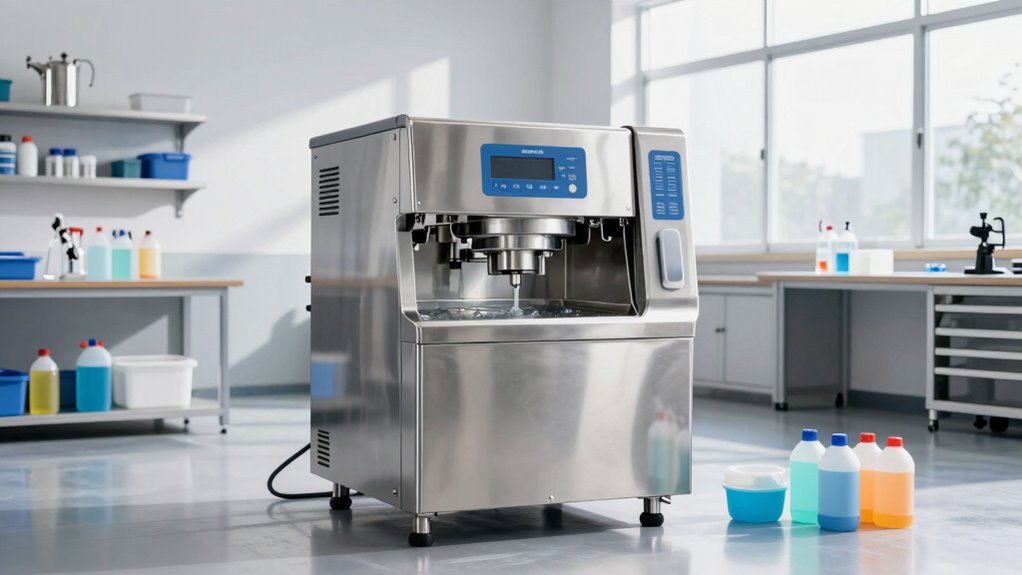
Among these options, the 40-gallon steel tub is the clearest fit for a shop that regularly cleans larger parts or works through batches. Its 120V pump moves 5.3 gallons per minute, and the reusable filter helps keep debris from shortening the useful life of the cleaning fluid. Compared with the JEGS 20-Gallon Parts Washer, Eastwood offers twice the tank capacity and a deeper 10-inch tub, but it also takes up more floor space and weighs 92.4 pounds. That makes it a more dedicated shop installation than the portable VEVOR unit. The washer does not include a cleaning brush, and the supplied information calls for a suitable cleaning solution and manual rinsing, so it is not a complete hands-off cleaning process. I’d rank it for throughput and capacity, not compactness.
Pros:- 40-gallon capacity and 10-inch tub accommodate larger parts
- 120V pump circulates solution at 5.3 gallons per minute
- Reusable filter helps extend cleaning-fluid life
- Steel construction and powder-coated finish suit regular shop use
Cons:- At 92.4 pounds and 35 x 21.5 x 43 inches, it needs substantial space
- Cleaning brush is not included
- Requires a suitable cleaning solution and manual rinsing
Best for: Automotive and repair shops that clean larger components or repeated batches and have room for a heavy stationary washer.
Not ideal for: Mobile technicians, cramped home garages, or buyers seeking a lightweight unit that can be moved easily.
- Capacity:40 gallons
- Tub depth:10 inches
- Pump voltage:120V
- Pump flow rate:5.3 gallons per minute
- Material:Steel
- Filter:Reusable
- Weight:92.4 pounds
- Dimensions:35 x 21.5 x 43 inches
- Warranty:1-year limited warranty
Our verdict“Pick the Eastwood when shop throughput and room for larger parts matter more than portability or a small footprint.”
VEVOR 5-Gallon Portable Parts Washer with Electric Pump
The VEVOR pairs a 15-pound portable steel body with an electric pump and filtration, giving it a more feature-led setup than the basic JEGS Portable Parts Washer 5-Gallon Tank. Its adjustable gooseneck nozzle directs solution at small automotive parts, while cyclic cleaning can help reuse the fluid. The distinction is useful for a mechanic moving between work areas who still wants powered circulation. Capacity remains modest: the tank holds 5 gallons, but solvent capacity is 3.5 gallons, and the 0.4-gallon-per-minute output is much slower than the Eastwood 40-Gallon washer’s stated flow. That limits its appeal for stubborn, heavily soiled parts or continuous batch work. I’d favor it over the simpler 5-gallon JEGS when pump control and mobility matter, but not for high-volume cleaning.
Pros:- Lightweight at 15 pounds for easy transport
- Electric filtration pump supports cyclic fluid cleaning
- Adjustable gooseneck nozzle directs solution where needed
- Powder-coated steel construction resists rust and corrosion
Cons:- Usable solvent capacity is 3.5 gallons despite the 5-gallon tank
- 0.4-gallon-per-minute pump output can be slow for demanding cleaning
- Small capacity limits larger parts and repeated batches
Best for: Mobile mechanics and home-garage users who need a lightweight washer with powered fluid circulation for small components.
Not ideal for: Busy repair shops cleaning heavy grease from large parts or processing frequent batches that benefit from higher flow and greater capacity.
- Tank capacity:5 gallons
- Solvent capacity:3.5 gallons
- Pump output:0.4 gallons per minute
- Weight:15 pounds
- Dimensions:18.11 x 13.39 x 9.06 inches
- Material:Powder-coated steel
- Power source:AC electric
- Model number:XH-PW3-1/2G
Our verdict“Choose the VEVOR for portable, powered cleaning of small parts, but step up to the Eastwood for faster circulation and heavier shop workloads.”
CRC SmartWasher SW-423 Mobile Parts Washer Kit – Water-Based, Non-Flammable, pH-Neutral
The CRC SmartWasher is the lineup’s most complete water-based cleaning system, supplied with three 5-gallon jugs of SW-4 degreaser and an OzzyMat activation mat. Its non-flammable, pH-neutral solution sets it apart from the other listed washers, which focus on tank size, portability, or pump performance without specifying an included aqueous-fluid kit. The mobile unit is built for moving around an automotive or industrial work area, while the included consumables let a shop start with a matched cleaning system rather than sourcing fluid separately. This comes with a different tradeoff: the information specifies heating time before use, and the full kit is bulkier than a small bench washer such as the JEGS 5-Gallon model. Claims about waste handling should be checked against local disposal rules and operating instructions; the product details alone do not establish every shop’s disposal requirements.
Pros:- Water-based, non-flammable, pH-neutral solution
- Includes three 5-gallon jugs of SW-4 degreaser
- Includes an OzzyMat multi-layer fluid activation mat
- Mobile unit can be moved around the work area
Cons:- Requires heating time before use
- Bulkier than compact bench-top washers
- The supplied details do not specify tank capacity, pump flow, or dimensions
Best for: Automotive and industrial shops seeking a mobile, water-based washer supplied with matching degreaser and an activation mat.
Not ideal for: Small garages that need a compact unit for occasional jobs or buyers who want a ready-to-use washer without a warm-up period.
- Model:SW-423
- Solution type:Water-based, non-flammable, pH-neutral
- Included washer:1 mobile parts and brake washer
- Included degreaser:3 x 5-gallon jugs of OzzyJuice SW-4 Heavy Duty Degreasing Solution
- Included mat:1 FL-4 OzzyMat Multi-Layer Fluid Activation Mat
- Mobility:Mobile unit
Our verdict“Choose the CRC kit when a mobile aqueous system with included cleaning solution is the priority and you can accommodate its warm-up and footprint.”
JEGS 20-Gallon Parts Washer
The JEGS 20-Gallon washer lands between the small portable units and Eastwood’s large shop tub: its 20-gallon tank offers more room for small-part work without the 40-gallon Eastwood’s larger footprint. The stated 12-gallon solvent capacity and 317-gallon-per-hour pump output give buyers useful capacity and circulation figures, while the removable tray helps with cleanup. At 57.5 pounds, it is not as easy to carry from job to job as the 15-pound VEVOR, and its listed 30-day warranty is notably short compared with Eastwood’s one-year limited warranty. The 3500 psi maximum-pressure figure is also listed, but it should not be mistaken for a direct measure of parts-washing performance. This is a practical middle ground for a garage with regular small-part jobs, provided its warranty and fixed setup suit the buyer.
Pros:- 20-gallon tank with 12-gallon solvent capacity
- 317-gallon-per-hour pump output is specified
- Removable tray simplifies cleanup
- Smaller capacity than the Eastwood 40-Gallon model can suit limited shop space
Cons:- 30-day manufacturer warranty is short
- 57.5-pound weight makes frequent relocation inconvenient
- Tank size is less suited to large assemblies than the Eastwood washer
Best for: Home garages and smaller professional shops that clean small parts regularly and want more capacity than a portable 5-gallon washer.
Not ideal for: Buyers who need a long warranty, easy job-site portability, or a tub suited to large components.
- Tank volume:20 gallons
- Solvent capacity:12 gallons
- Power source:110V/60Hz
- Pump output:317 gallons per hour
- Maximum pressure:3500 psi
- Weight:57.5 pounds
- Dimensions:30 x 21 x 34.5 inches
- Warranty:30 days
Our verdict“Choose this JEGS model for regular small-part cleaning when a mid-size tank fits your garage better than either a portable 5-gallon unit or a 40-gallon washer.”
JEGS Portable Parts Washer Cart, 20-Gallon Tank
The JEGS Portable Parts Washer Cart suits a shop that needs to move cleaning work between benches rather than dedicate one spot to a washer. Its four swivel casters and cart layout make repositioning easier, while the drying shelf, drain, and removable pan give cleaned parts a place to drip without adding a separate tray. Compared with the fixed-format JEGS 20-Gallon Parts Washer, this model prioritizes mobility and work-area organization over a stationary setup. The 317 gph pump supports recirculating cleaning, but the 12-gallon solvent capacity is less than the 20-gallon tank capacity, so tank size should not be mistaken for usable fluid volume. At 80 lb, it is also a substantial cart, and its 30-day warranty offers limited coverage.
Pros:- Four swivel casters support movement around the shop.
- Drying shelf includes a drain and removable pan for catching runoff.
- Separate storage shelf keeps supplies close to the washer.
- 317 gph pump provides recirculating flow.
Cons:- Usable solvent capacity is 12 gallons despite the 20-gallon tank designation.
- The 30-day manufacturer warranty provides limited coverage.
- At 80 lb, it is not a lightweight cart to lift or transport over obstacles.
Best for: Small repair shops and mechanics who need to roll a washer between work areas and want an integrated place to drain parts.
Not ideal for: Shops seeking a long warranty, maximum fluid capacity, or a permanent high-volume cleaning station.
- Brand:JEGS
- Tank capacity:20 gallons
- Solvent capacity:12 gallons
- Pump output:317 gph
- Voltage:110/120V
- Dimensions:21.5 x 21.5 x 37 in
- Weight:80 lb
- Material:20-gauge steel and polyurethane
- Warranty:30 days
Our verdict“Choose this JEGS cart if you need a movable washer with built-in drying and storage space, but skip it if fluid capacity or warranty length matters most.”

How We Picked
I ranked these washers around the work a shop needs them to handle: usable capacity, ability to circulate cleaning solution, mobility, and fit for a regular cleaning routine. I also weighed the practical difference between a conventional tank-and-pump washer and the CRC SmartWasher’s stated water-based, non-flammable, pH-neutral approach. Product claims identify features, but buyers should confirm exact dimensions, included accessories, and operating requirements before purchase.
The Eastwood 40-Gallon washer leads for a dedicated shop because its larger tank suits a wider range of recurring jobs. The JEGS 20-gallon options follow as more compact capacity choices, with the cart version favored when moving the washer matters. The CRC earns a distinct role for its cleaning-system priorities, while the two 5-gallon portable washers rank lower for capacity but remain sensible for smaller parts and limited space. This order reflects breadth of shop use, not a claim that one machine fits every cleaning task.
Factors to Consider When Choosing Aqueous Parts Washer For Shop Cleaning
Choosing a parts washer is less about buying the biggest tank and more about matching the equipment to your work area, parts, cleaning frequency, and solution-handling routine. I’d check the constraints below before settling on capacity or portability.
Match the Tank to Your Largest Regular Part
Measure the parts you clean most often, including their height and the room needed to position them safely. Tank volume does not tell you the usable basket dimensions, so check the interior measurements rather than relying on a gallon figure alone. A 5-gallon unit can handle smaller components but may require splitting up assemblies or making repeated batches. Moving to a 20- or 40-gallon tank can reduce that inconvenience, though it claims more floor space. Avoid sizing only for an occasional oversized part if it will leave a large washer awkwardly placed the rest of the year. If your jobs vary widely, prioritize access and basket layout as much as capacity.
Choose Mobility Based on Your Shop Layout
A portable washer is useful when cleaning happens at different benches or when floor space must be reclaimed between jobs. But portability matters only if the unit can be moved safely when configured for use; verify wheel or cart details and the maker’s guidance for moving a filled tank. A stationary setup can be a better fit for a dedicated cleaning corner where stable placement and regular access matter more than relocation. Carts can add convenience, but they also take up space and may have different handling limits than a fixed tank. Map the route through doors and around equipment before buying. Buyers often focus on where a washer will sit and forget to check how it will get there.
Check the Cleaning System and Solution Requirements
“Aqueous” does not mean every washer uses the same process or maintenance routine. Confirm which cleaning solutions are compatible, whether the unit circulates solution, and what the manufacturer requires for replenishment or service. The CRC SmartWasher’s stated non-flammable, pH-neutral, water-based system may appeal to shops seeking those characteristics, but buyers should review its operating instructions and consumables before choosing it. Do not assume a solution suitable for one washer is appropriate for another. Match the system to the soils you remove and the materials on the parts, since cleaning needs can vary between grease, oil, and other residues. The right fit depends on the full cleaning routine, not just the tank.
Treat Pump Setup as a Workflow Decision
A pump can make it easier to direct circulating solution over parts, particularly when cleaning is a repeated task rather than an occasional one. Check whether a pump is included, how it is powered, and whether the washer’s setup suits the available outlet and workspace. The VEVOR 5-gallon model specifies an electric pump, while the Eastwood model specifies a 120V pump; those details help distinguish them from a basic compact tank. A powered system also adds components that may need attention over time. If you mostly clean small parts intermittently, a pump may matter less than easy storage and access. Compare the complete setup rather than treating “pump included” as an automatic upgrade.
Plan for Maintenance and Shop Safety
Before buying, identify how used solution will be monitored, replaced, or handled under the manufacturer’s instructions and your local rules. Leave enough room around the washer for loading parts, cleaning the work area, and carrying out routine service. A larger tank may reduce how often you need to manage small batches, but it also means more solution to account for. Review electrical requirements and keep the washer’s placement suitable for its power setup. Do not assume a water-based product is harmless to handle or dispose of; follow its stated safety guidance. A washer that fits the cleaning corner but blocks access for upkeep can turn routine care into a nuisance.
Pay for Capacity or Features You Will Use
Spending more makes sense when additional capacity, a cart, or a specialized cleaning system addresses a recurring shop need. It is harder to justify a large tank if most jobs involve small components and the washer must share limited floor space. On the other hand, repeatedly breaking down larger parts to fit a small tub costs time and interrupts workflow. Compare the ongoing operating requirements alongside the purchase setup, especially when a system depends on specific solution or service routines. For a first washer, a simpler compact unit can be a sensible way to establish how often the shop cleans parts. Choose based on normal weekly work, not a rare job or a feature list alone.
Frequently Asked Questions
Is a 5-gallon parts washer enough for a small repair shop?
It can be enough if the shop mainly cleans small components and uses the washer occasionally. The two compact options in this roundup are easier to fit into a limited workspace than the 20- and 40-gallon models, but their capacity can constrain part size and batch volume. Check interior dimensions before deciding, since the stated tank capacity does not show how much room a part has inside. If larger assemblies come through regularly, a 20-gallon model may save repeated handling. A small tub is most convincing when limited space and modest jobs are the normal case.
Should I choose the 20-gallon JEGS washer or the portable cart version?
Start with whether the washer needs to move during normal shop work. The cart version is the more relevant pick when mobility is part of the routine, while a standard 20-gallon washer makes more sense when you have a dedicated cleaning location. Check the product details for dimensions, included components, and any movement guidance before comparing them. A cart does not remove the need to plan where the unit will park or how it will be handled when in use. If the washer will stay in one place, prioritize the setup that best fits that space rather than paying attention to mobility alone.
What makes the CRC SmartWasher different from a tank-and-pump washer?
The CRC SW-423 is identified as a water-based, non-flammable, pH-neutral parts washer kit, giving it a distinct role among the conventional tank options here. That makes it worth investigating for shops that put those solution characteristics high on their checklist. It is not automatically the right choice for every job: review its operating method, service routine, and required supplies before committing. Compare those requirements with the simpler capacity-and-pump considerations of the Eastwood and JEGS units. The best choice depends on both the parts being cleaned and the process the shop is prepared to maintain.
Do I need an electric pump for routine shop cleaning?
An electric pump is more useful when solution circulation is part of frequent, repeatable cleaning work. The Eastwood model specifies a 120V pump, and the VEVOR compact washer specifies an electric pump, so check the power setup and workspace before choosing either. For occasional cleaning of small parts, pump-driven flow may be less important than tank access and storage. Also account for the pump as a component that may need care, rather than treating it as a feature with no upkeep. Let the work frequency and cleaning method guide the decision.
How much larger should a washer be than the parts I clean?
There is no useful gallon-based rule without knowing the washer’s interior dimensions and the shape of your parts. Check that the largest routine item fits through the opening and can sit in the working area with enough room for the intended cleaning process. A tight fit can make loading awkward even when the nominal tank capacity seems adequate. Think about batches too: several smaller components may need more usable space than one large part. If your work changes from job to job, favor a layout that accommodates typical parts comfortably instead of buying around a single unusual item.
Conclusion
For most shops with room for a dedicated cleaning station, I’d choose the Eastwood 40-Gallon Parts Washer with 120V Pump as the best overall pick for its larger capacity and powered setup. The best value in practical capacity is the standard JEGS 20-Gallon Parts Washer for buyers who want more room than a 5-gallon tub without stepping up to the largest unit. For a premium, process-focused choice, the CRC SmartWasher SW-423 is the best fit for shops seeking its stated water-based, non-flammable, pH-neutral approach. Beginners with limited space can start with the Portable Parts Washer 5-Gallon Tank; choose the VEVOR instead if an electric pump is a priority. For shops that need a mid-size washer they can relocate, the JEGS Portable Parts Washer Cart is the specific-use pick. Match the final choice to your regular part size, available floor space, and willingness to maintain its cleaning system.