For a daycare classroom, I’d prioritize an air purifier with room coverage that fits the actual space, a clear filter replacement plan, and a noise level that works during naps and activities. The DREO DR-HAP009 is my best overall pick for its large-room focus, while the VEWIOR 2-Pack stands out for placing units in more than one area and the MOOKA PR1 for its air quality display and sensor. The main tradeoffs are broad coverage versus quiet operation, washable components versus filter upkeep, and one powerful unit versus multiple smaller units. A purifier can support cleaner indoor air, but it does not replace ventilation or other infection-control practices. Continue reading for the full comparison and guidance on matching a unit to your classroom.

Get cleaning gear delivered free with Prime
- Fast, free delivery on millions of items
- Prime Video, Amazon Music and more included
- Member-only deals all year
Complete the kit


Key Takeaways
- DREO DR-HAP009 leads this lineup for buyers who want a large-room-oriented unit; check its published coverage against your classroom layout rather than relying on the model’s “large room” label alone.
- VEWIOR’s 2-pack offers placement flexibility across separate rooms or zones, while its washable-filter design makes maintenance details and the exact filtration stages especially important to verify.
- MOOKA PR1 is the standout for visible air-quality feedback, but a sensor display does not show that every part of a classroom receives equal airflow.
- GermGuardian AC4825E and Levoit Core 300-P are more compact choices than the large-room models, which can suit a small nap room or office but may require multiple units in a larger classroom.
- FULMINARE, Honeyuan, AromaRoom, VOOPNU, Purivortex PX500, and MOOKA B-D02L broaden the choices, but buyers should compare their stated room coverage, replacement-filter availability, and operating noise before choosing on headline features alone.
| DREO Air Purifier for Large Rooms, DR-HAP009 |  | Best for Air Quality Monitoring | Model: DR-HAP009 | CADR: 158 CFM | Coverage at 4.8 ACH: 245 sq. ft. | VIEW ON AMAZON | See Our Full Breakdown |
| VEWIOR Air Purifiers with Washable Filters, 2-Pack, for Rooms up to 1,200 sq. ft. |  | Best for Two-Room Coverage | Pack size: 2 air purifiers | Stated room coverage: Up to 1,200 sq. ft. | Air intake: 360° | VIEW ON AMAZON | See Our Full Breakdown |
| GermGuardian AC4825E 22-Inch HEPA Tower Air Purifier, Gray |  | Best for Smaller Classrooms | Model: AC4825E | Type and height: Tower air purifier; 22 inches | Frequent circulation: 153 sq. ft. every 12.5 minutes | VIEW ON AMAZON | See Our Full Breakdown |
| Levoit Core 300-P Air Purifier for Home, Pets, and Allergens |  | Best for Verified Classroom Sizing | Model: Core 300-P | CADR: Smoke 143 CFM; dust 153 CFM; pollen 167 CFM | Coverage at 4.8 ACH: 222 sq. ft. | VIEW ON AMAZON | See Our Full Breakdown |
| FULMINARE H13 True HEPA Air Purifier for Bedroom |  | Best Compact Nap-Room Pick | Filter: H13 True HEPA | Coverage: 215 sq. ft. / 20 m² | Air refresh rate: Up to 5 times per hour | VIEW ON AMAZON | See Our Full Breakdown |
| MOOKA B-D02L Air Purifier for Large Rooms |  | Best for Quiet, Defined Classroom Zones | Model: B-D02L | Maximum stated coverage: Up to 1,076 sq. ft. | Air changes: 6 per hour in 215 sq. ft.; 1 per hour in 1,076 sq. ft. | VIEW ON AMAZON | See Our Full Breakdown |
| MOOKA PR1 Air Purifier for Home Large Room up to 2200 sq.ft, HEPA Air Cleaner with Washable Filter, PM 2.5 Display, Air Quality Sensor, Pet Mode (White) |  | Best for Large Classrooms with Sensor Feedback | Model: PR1 | Maximum stated coverage: Up to 2,200 sq. ft. | Filtration: 4-stage HEPA with washable pre-filter | VIEW ON AMAZON | See Our Full Breakdown |
| Honeyuan Air Purifier with H13 HEPA Filter, White |  | Best for Simple Timer-Based Scheduling | Filter: Three-stage H13 True HEPA | Air intake: 360-degree | Maximum stated coverage: Up to 1,095 sq. ft. | VIEW ON AMAZON | See Our Full Breakdown |
| VOOPNU Air Purifier for Home, 360° Filtration, Covers up to 1076 Ft², White |  | Best Compact Pick for a Small Room | Maximum stated coverage: Up to 1,076 sq. ft. | Dimensions: 6.69 x 6.69 x 9.84 inches | Noise level: 22 dB | VIEW ON AMAZON | See Our Full Breakdown |
| Purivortex PX500 Air Purifier for Rooms up to 880 Sq Ft, Black |  | Best for Quick Cleaning in a Defined Room | Maximum stated coverage: Up to 880 sq. ft. in one hour | Cleaning time: About 15 minutes in 215 sq. ft. | Filtration: Three-layer pre-filter, HEPA, and activated carbon | VIEW ON AMAZON | See Our Full Breakdown |
| AromaRoom True HEPA Air Purifier for Bedroom and Baby Room |  | Best for Quiet Nap Rooms | Coverage area: 323 ft² (30 m²) | Air circulation rate: 2 times per hour | Filtration: True HEPA; captures particles 0.1–0.3 microns | VIEW ON AMAZON | See Our Full Breakdown |
| air purifier for daycare classroom | Filtration |
|---|---|
| DREO Air Purifier for Large Ro | — |
| VEWIOR Air Purifiers with Wash | Three-stage washable pre-filter, H13 filter, and activated carbon |
| GermGuardian AC4825E 22-Inch H | True HEPA and activated carbon |
| Levoit Core 300-P Air Purifier | — |
| FULMINARE H13 True HEPA Air Pu | — |
| MOOKA B-D02L Air Purifier for | Pre-filter, True HEPA filter, activated carbon filter |
| MOOKA PR1 Air Purifier for Hom | 4-stage HEPA with washable pre-filter |
| Honeyuan Air Purifier with H13 | — |
| VOOPNU Air Purifier for Home | — |
| Purivortex PX500 Air Purifier | Three-layer pre-filter, HEPA, and activated carbon |
| AromaRoom True HEPA Air Purifi | True HEPA; captures particles 0.1–0.3 microns |
More Details on Our Top Picks
DREO Air Purifier for Large Rooms, DR-HAP009
For a daycare team that wants to see changing particle levels and let the purifier adjust its airflow, the DREO DR-HAP009 has a useful combination of a PM2.5 display and Auto mode. Its 158 CFM CADR is AHAM Verified, and its listed refresh rate is more informative for classroom planning than the headline coverage figure: it reaches 4.8 air changes per hour in a 245-square-foot room. The stated 1,176-square-foot maximum is only at one air change per hour, so I would not use that figure to size a busy classroom. Compared with the Levoit Core 300-P, DREO lists a slightly lower smoke CADR but offers a larger stated room size at 4.8 air changes per hour. Its tradeoff is that neither unit’s airflow alone resolves ventilation needs across a larger or crowded room.
Pros:- AHAM Verified CADR of 158 CFM gives a comparable performance measure
- PM2.5 display and Auto mode can respond to detected particle changes
- Lists 4.8 air changes per hour for rooms up to 245 square feet
- ENERGY STAR certification and Sleep mode with display lights off
Cons:- The 1,176-square-foot coverage figure represents only one air change per hour
- At 4.8 air changes per hour, listed coverage is limited to 245 square feet
- A PM2.5 sensor does not measure every classroom air quality concern
Best for: Daycare directors who want visible PM2.5 readings and automatic fan changes in a classroom around 245 square feet
Not ideal for: Centers expecting one purifier to provide frequent air changes across a very large classroom based on the 1,176-square-foot claim
- Model:DR-HAP009
- CADR:158 CFM
- Coverage at 4.8 ACH:245 sq. ft.
- Coverage at 1 ACH:Up to 1,176 sq. ft.
- Filter:3-in-1 pre-filter, high-efficiency filter, and activated carbon
- Air quality monitor:PM2.5 sensor with AQI display from 1–999
- Modes:Auto, Turbo, Sleep, Normal
- Certifications:AHAM Verified; ENERGY STAR certified
Our verdict“Choose the DREO when visible particle readings and automatic adjustments matter for a classroom sized near its 245-square-foot frequent-refresh rating.”
VEWIOR Air Purifiers with Washable Filters, 2-Pack, for Rooms up to 1,200 sq. ft.
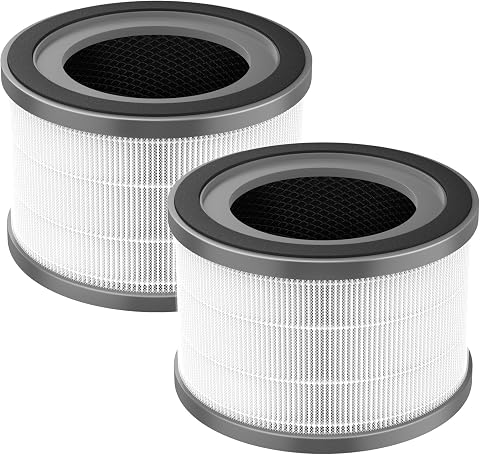
The VEWIOR two-pack is the lineup’s clearest choice when a daycare needs units in separate rooms, such as a classroom and a nap room. Each purifier has 360-degree intake, a washable pre-filter, and a PM2.5 display with Auto mode. That setup offers flexible placement and lets staff clean larger debris from the pre-filter, though the main filters still need replacement every three to six months. The combined listing says coverage up to 1,200 square feet, but it does not provide CADR or an air-change rate for that figure; I would not treat it as evidence that one unit suits a large, occupied classroom. The DREO DR-HAP009 provides AHAM-verified CADR data for more direct sizing, while VEWIOR gives you two placements in the box. Its performance claims are harder to compare independently.
Pros:- Two units allow placement in separate rooms
- Washable pre-filters can be vacuumed or washed
- PM2.5 display and Auto mode adjust airflow based on detected air quality
- Child lock, sleep mode, and timer settings support supervised classroom routines
Cons:- The stated coverage lacks CADR and air-change details
- Main filters are recommended for replacement every three to six months
- The claimed noise level and coverage lack independent performance data
Best for: Daycare operators who need a purifier in two smaller rooms and value washable pre-filters and child-lock controls
Not ideal for: Buyers who need independently comparable CADR or clearly stated air changes per hour for classroom sizing
- Pack size:2 air purifiers
- Stated room coverage:Up to 1,200 sq. ft.
- Air intake:360°
- Filtration:Three-stage washable pre-filter, H13 filter, and activated carbon
- Filter care:Pre-filter can be vacuumed or washed; main filter replacement every 3–6 months recommended
- Air quality monitoring:Real-time PM2.5 display and indicator lights
- Noise claim:As low as 15 dB
- Additional features:Child lock, sleep mode, 2-, 4-, and 8-hour timers, aromatherapy pad
Our verdict“Pick VEWIOR for two-room placement and washable pre-filters if you can size each unit without published CADR data.”
GermGuardian AC4825E 22-Inch HEPA Tower Air Purifier, Gray
The GermGuardian AC4825E fits a smaller classroom or activity room where its stated frequent-circulation area is a better match than a large-room headline. It circulates air in 153 square feet every 12.5 minutes, and its True HEPA and activated carbon filters target particles and odors. Three fan speeds include a sleep mode, while optional UV-C is an added feature rather than a reason to choose it for daycare use. The listed 743-square-foot figure describes hourly circulation, so it does not imply frequent cleaning across that whole area. By comparison, the Levoit Core 300-P gives an AHAM-verified CADR and a 222-square-foot rating at 4.8 air changes per hour, making its sizing easier to compare. GermGuardian’s tower format and stated filtration make sense for a smaller room, but ongoing filter and bulb maintenance adds work.
Pros:- True HEPA and activated carbon filtration addresses particles and odors
- States circulation for 153 square feet every 12.5 minutes
- Three fan speeds include a quiet sleep mode
- CARB, ETL, and Zero Ozone Verified certifications are listed
Cons:- The 743-square-foot figure is based on hourly circulation
- Replacement filters and UV-C bulbs add maintenance
- UV-C light is optional
Best for: Daycare staff seeking a tower purifier for a smaller classroom or activity room with a clearly stated frequent-circulation area
Not ideal for: Centers that need frequent air changes in a large classroom or want to avoid replacement filter and UV-C bulb upkeep
- Model:AC4825E
- Type and height:Tower air purifier; 22 inches
- Frequent circulation:153 sq. ft. every 12.5 minutes
- Hourly coverage:Up to 743 sq. ft.
- Filtration:True HEPA and activated carbon
- Particle capture claim:99.97% of particles as small as 0.1 microns
- Fan speeds:3
- Certifications:CARB Certified, ETL Certified, Zero Ozone Verified
Our verdict“Choose the GermGuardian for a smaller room where tower placement and its stated 153-square-foot refresh rate fit the space.”
Levoit Core 300-P Air Purifier for Home, Pets, and Allergens
For buyers comparing purifiers by documented airflow, the Levoit Core 300-P offers AHAM VERIFIDE certification and separate CADR figures for smoke, dust, and pollen. Its listed 222-square-foot coverage at 4.8 air changes per hour gives a practical reference for a smaller classroom or a defined zone within a larger room. Sleep mode runs at 24 dB, and the timer and filter indicator can simplify routine operation. Compared with the DREO DR-HAP009, Levoit has the higher listed pollen CADR but a smaller stated area at 4.8 air changes per hour. That makes the choice depend on room shape, occupancy, and the particle type of greatest concern, not a single coverage headline. Levoit’s 120V specification limits it to compatible power systems, and it calls for official replacement filters for best performance.
Pros:- AHAM VERIFIDE certification and separate smoke, dust, and pollen CADR figures
- Lists 222 square feet at 4.8 air changes per hour
- 24 dB Sleep mode suits quieter periods
- Timer and filter indicator support routine operation
Cons:- Official Levoit replacement filters are recommended for best performance
- 120V specification limits use to compatible power systems
- Frequent-refresh coverage is limited compared with the large-area headline
Best for: Daycare buyers who want AHAM-verified CADR data to size a purifier for a room or classroom zone up to about 222 square feet
Not ideal for: Centers with larger rooms that need one purifier to cover the full space at frequent air changes, or facilities without 120V power
- Model:Core 300-P
- CADR:Smoke 143 CFM; dust 153 CFM; pollen 167 CFM
- Coverage at 4.8 ACH:222 sq. ft.
- Coverage at 1 ACH:1,073 sq. ft.
- Filtration efficiency:99.97% for 0.1–0.3 μm particles
- Noise:24 dB in Sleep mode
- Power:56 W; 120 V
- Certifications:AHAM VERIFIDE, FCC, ETL Listed, CARB Compliant
Our verdict“Choose the Core 300-P when you want verified CADR figures and the classroom zone falls within its 222-square-foot frequent-refresh rating.”
FULMINARE H13 True HEPA Air Purifier for Bedroom
The FULMINARE H13 is the most bedroom-oriented option here, which makes it a plausible fit for a daycare nap room or other compact space rather than a main classroom. Its stated coverage is 215 square feet, with dual-channel technology described as refreshing air up to five times per hour. The 24 dB low or sleep setting and built-in night light may suit rest periods, though a light may be unwelcome in rooms kept dark for naps. Compared with the GermGuardian AC4825E, FULMINARE is more compact and adds several timer settings, while GermGuardian provides a stated 153-square-foot refresh interval and additional certification details. FULMINARE requires a plug-in connection and filter replacement every three months; its filter packaging must also be removed before use. I would reserve it for a smaller, supervised room rather than rely on it for a busy classroom.
Pros:- Compact format is suited to smaller rooms
- Lists up to five air refreshes per hour in rooms up to 215 square feet
- 24 dB low or sleep mode supports quieter periods
- Night light and five timer settings provide nap-room controls
Cons:- Must remain plugged in and has no battery
- Replacement filter is recommended every three months
- Filter packaging must be removed manually before use
Best for: Daycare teams setting up a compact nap room who want quiet operation, a timer, and a night light
Not ideal for: Centers needing a purifier for a large, busy classroom or a unit that can operate away from an outlet
- Filter:H13 True HEPA
- Coverage:215 sq. ft. / 20 m²
- Air refresh rate:Up to 5 times per hour
- Noise:24 dB in Low/Sleep mode
- Power:Plug-in; no battery
- Timer settings:2, 4, 8, 10, and 12 hours
- Replacement filter model:FULMINARE PU-P05
- Filter replacement interval:Every 3 months recommended
Our verdict“Choose FULMINARE for a compact nap room within its stated 215-square-foot coverage if the night light and plug-in design suit your setup.”
MOOKA B-D02L Air Purifier for Large Rooms
The MOOKA B-D02L fits a daycare that needs quiet filtration in a room where its actual cleaning rate matches the space. It delivers six air changes per hour in 215 sq. ft., a more useful classroom planning figure than its headline maximum of 1,076 sq. ft., where it manages just one change per hour. Compared with the sensor-equipped MOOKA PR1, this model skips automatic air-quality adjustments but keeps controls straightforward with four fan modes, timers, and a child lock. Its 20 dB noise level may suit nap periods, while the HEPA and carbon stages address particles and some odors. The tradeoff is ongoing filter replacement every three to six months, and larger classrooms may need a more powerful unit or multiple purifiers.
Pros:- Six air changes per hour in a 215 sq. ft. area
- Quiet 20 dB operation and four fan modes
- Child lock helps prevent curious children from changing settings
- Pre-filter, True HEPA, and activated carbon stages address particles and odors
Cons:- At the maximum 1,076 sq. ft. coverage, it provides only one air change per hour
- Filter replacement is recommended every three to six months
- Lacks the PM 2.5 display and auto mode found on the MOOKA PR1
Best for: Daycare operators furnishing a small classroom or nap room who want quiet operation, a child lock, and simple manual controls.
Not ideal for: Staff relying on one purifier for a large classroom, since its stated rate at maximum coverage is only one air change per hour.
- Model:B-D02L
- Maximum stated coverage:Up to 1,076 sq. ft.
- Air changes:6 per hour in 215 sq. ft.; 1 per hour in 1,076 sq. ft.
- Filtration:Pre-filter, True HEPA filter, activated carbon filter
- Particle filtration:As small as 0.3 microns
- Noise level:20 dB
- Fan modes:Sleep, Low, Medium, High
- Filter replacement interval:Every 3–6 months
Our verdict“Choose the B-D02L for a smaller daycare room where quiet running and simple child-resistant controls matter more than sensor automation.”
MOOKA PR1 Air Purifier for Home Large Room up to 2200 sq.ft, HEPA Air Cleaner with Washable Filter, PM 2.5 Display, Air Quality Sensor, Pet Mode (White)
For a larger daycare classroom, the MOOKA PR1 offers the strongest stated coverage in this batch, along with a PM 2.5 display and Auto mode that can adjust fan speed as readings change. That gives staff more feedback than the manual controls on the MOOKA B-D02L, though the supplied data does not state an air-change rate for the PR1’s full 2,200 sq. ft. area. Its washable pre-filter can catch larger debris such as hair before it reaches the main filter, but staff still need to clean the sensor to keep readings accurate and replace filters every three to six months. The sensor also takes about a minute to preheat after startup. Six fan modes and a 26 dB sleep setting add flexibility, while the aroma function may be less useful in a shared childcare space.
Pros:- Largest stated coverage in this batch, up to 2,200 sq. ft.
- PM 2.5 sensor, display, and Auto mode provide air-quality feedback
- Washable pre-filter can catch larger debris before it reaches the main filter
- Six fan modes, child lock, and sleep mode as low as 26 dB
Cons:- Sensor needs regular cleaning and briefly preheats after startup
- Main filter replacement is recommended every three to six months
- No air-change rate is provided for the maximum coverage claim
Best for: Daycare directors with a larger classroom who want visible PM 2.5 readings, automatic fan adjustment, and a washable pre-filter.
Not ideal for: Small centers that need a basic, low-maintenance control setup or staff cannot regularly clean the sensor and replace filters.
- Model:PR1
- Maximum stated coverage:Up to 2,200 sq. ft.
- Filtration:4-stage HEPA with washable pre-filter
- Fan modes:Sleep, I, II, III, Auto, Pet
- Sleep noise level:As low as 26 dB
- Sensor:PM 2.5 air-quality sensor and display
- Filter replacement interval:Every 3–6 months
- Ozone release:None
Our verdict“Pick the PR1 for a large room where staff will use its sensor feedback and keep up with sensor and filter maintenance.”
Honeyuan Air Purifier with H13 HEPA Filter, White
The Honeyuan suits a daycare room where staff want a simple schedule and quiet setting without the sensor-driven controls of the MOOKA PR1. Its three fan speeds keep operation uncomplicated, while nine hourly timer settings let staff match run time to a room’s routine. The 360-degree intake draws air from around the unit, which gives placement flexibility, and the product listing states coverage up to 1,095 sq. ft. However, the supplied air-delivery figure is 90–120 m³/h, and no air-change rate is given for that maximum area; I would avoid treating the coverage claim as proof of fast cleaning in a busy classroom. Sleep operation is listed as low as 24 dB. Replacement filters are sold separately, so ongoing upkeep needs to be part of the purchasing plan.
Pros:- Three-stage H13 True HEPA filtration with 360-degree air intake
- Nine timer settings support scheduled operation
- Sleep mode is listed as low as 24 dB
- Includes a one-year warranty
Cons:- Replacement filters must be purchased separately
- No air-change rate is provided for the stated 1,095 sq. ft. coverage
- Three fan speeds offer less adjustment than the MOOKA PR1’s six modes
Best for: Daycare staff who want a quiet purifier with a straightforward fan setup and timers that can follow a daily schedule.
Not ideal for: Centers seeking demonstrated high air-change performance in a large, occupied classroom or wanting to avoid sourcing replacement filters separately.
- Filter:Three-stage H13 True HEPA
- Air intake:360-degree
- Maximum stated coverage:Up to 1,095 sq. ft.
- Air delivery:90–120 m³/h
- Fan speeds:3
- Timer:9 settings, 1–9 hours
- Noise level:As low as 24 dB
- Warranty:1 year
Our verdict“Choose the Honeyuan for a smaller or schedule-driven room where quiet operation and simple timed controls matter more than air-quality sensing.”
VOOPNU Air Purifier for Home, 360° Filtration, Covers up to 1076 Ft², White
The VOOPNU’s clearest advantage for daycare use is its compact 6.69-by-6.69-inch footprint, which may be easier to place in a small room than the larger MOOKA PR1. Its 360-degree intake supports flexible placement, and the listed 22 dB operation is quiet on paper. The controls are also unusually simple: one-tap operation avoids a maze of settings, but gives staff less control than the Honeyuan’s three speeds and nine timers. Although the listing claims coverage up to 1,076 sq. ft. and 99.97% filtration efficiency, it does not provide an air-change rate or filter type in the supplied data. That makes its classroom capacity harder to judge. The essential-oil tray is an extra, but fragrance may not suit a shared space with young children.
Pros:- Compact dimensions of 6.69 x 6.69 x 9.84 inches
- 360-degree airflow allows flexible placement
- Listed noise level is 22 dB
- One-tap operation keeps controls simple
Cons:- No air-change rate or specific filter type is provided in the supplied product data
- Listing says continuous use is needed for optimal performance
- Official replacement filters are required to maintain efficiency
Best for: A daycare operator needing a small-footprint purifier for a compact room and who values basic one-tap operation.
Not ideal for: Centers choosing equipment for a large or busy classroom that need a specified air-change rate, detailed controls, or clear filter-type information.
- Maximum stated coverage:Up to 1,076 sq. ft.
- Dimensions:6.69 x 6.69 x 9.84 inches
- Noise level:22 dB
- Filtration efficiency:99.97%
- Airflow:360-degree intake
- Certifications:DOE, ETL, FCC, CARB, CE, ROHS
Our verdict“Consider the VOOPNU for a compact daycare room where size and simple controls lead, but choose a better-documented model for a large classroom.”
Purivortex PX500 Air Purifier for Rooms up to 880 Sq Ft, Black
The Purivortex PX500 is the more convincing choice when a daycare needs a stated cleaning time for a particular room: it is listed to purify 215 sq. ft. in about 15 minutes. That gives buyers a more concrete basis for matching it to a classroom than the VOOPNU’s coverage claim, which has no air-change rate in the supplied data. Its three-layer pre-filter, HEPA, and activated carbon system targets particles and light household odors, with capture claims down to 0.1 microns. The 880 sq. ft. figure is a one-hour coverage claim, so this is better matched to a defined smaller zone than a large classroom. Four fan modes and a two-year warranty are useful advantages, but night lights may add little in a childcare setting and the carbon stage is described as handling only light odors.
Pros:- Listed to purify a 215 sq. ft. room in about 15 minutes
- Three-layer filtration includes pre-filter, HEPA, and activated carbon
- Four fan modes and three timer settings
- Two-year warranty
Cons:- The 880 sq. ft. coverage figure is based on one hour
- Activated carbon is described as reducing light household odors
- Night light modes may add little value in a daycare classroom
Best for: Daycare operators who can match the purifier to a room around 215 sq. ft. and value a stated cleaning time and longer warranty.
Not ideal for: Centers expecting rapid cleaning across a large classroom or looking for stronger odor control than the listed light household odor reduction.
- Maximum stated coverage:Up to 880 sq. ft. in one hour
- Cleaning time:About 15 minutes in 215 sq. ft.
- Filtration:Three-layer pre-filter, HEPA, and activated carbon
- Particle capture:Up to 99.97%; particles as small as 0.1 microns
- Filter thickness:6 inches
- Fan modes:Sleep, Low, Medium, High
- Timer settings:4, 8, and 12 hours
- Warranty:2 years
Our verdict“Choose the PX500 for a smaller defined room where its stated cleaning time and two-year warranty outweigh its slower maximum-area coverage.”
AromaRoom True HEPA Air Purifier for Bedroom and Baby Room
For a daycare nap room where fan noise matters, the AromaRoom’s 22 dB sleep mode is its clearest advantage. Its stated coverage is 323 square feet, with air circulation twice per hour, making it a better fit for a smaller classroom or sleep area than larger spaces. Compared with the DREO Air Purifier for Large Rooms, AromaRoom puts less emphasis on broad room coverage and more on quiet operation and a fragrance pad. The True HEPA system is described as capturing particles from 0.1 to 0.3 microns, including dust, pollen, and smoke. The tradeoffs matter in a childcare setting: the filter needs replacement every three to six months, and scented oils may be unsuitable for children sensitive to fragrances. I’d choose it for a quiet, modest-size room, not as the sole purifier for a large classroom.
Pros:- 22 dB sleep mode is suited to quiet nap periods
- True HEPA filtration is specified for particles from 0.1 to 0.3 microns
- Stated coverage of 323 square feet fits smaller rooms
- Two-, four-, and eight-hour timer settings support scheduled operation
Cons:- Air circulation is listed at only twice per hour
- Filter replacement is needed every three to six months
- Fragrance pad may not suit scent-sensitive children, and essential oils are not included
Best for: Daycare operators seeking a quiet purifier for a smaller nap room where its stated 323-square-foot coverage is sufficient.
Not ideal for: Classrooms larger than its stated coverage, or childcare settings that avoid fragrance features and need higher air circulation than twice per hour.
- Coverage area:323 ft² (30 m²)
- Air circulation rate:2 times per hour
- Filtration:True HEPA; captures particles 0.1–0.3 microns
- Sleep mode noise:22 dB
- Timer settings:2, 4, and 8 hours
- Features:Smoke remover and fragrance pad
- Filter replacement interval:3–6 months
Our verdict“Choose AromaRoom for a smaller daycare nap room where quiet running takes priority over faster air circulation or wider coverage.”

How We Picked
I compared these 11 models through the needs of a daycare classroom: whether stated room coverage can match a real occupied space, how filtration and maintenance are described, and whether controls and operation appear practical around children. I also considered unit placement, filter replacement needs, available monitoring features, and the tradeoff between a single larger purifier and several smaller units. These factors matter because a classroom may have changing occupancy, nap periods, furniture that interrupts airflow, and a schedule that leaves limited time for maintenance.
The DREO DR-HAP009 ranks first as the broadest fit for buyers seeking a large-room-focused option. The VEWIOR 2-Pack and MOOKA PR1 follow for distinct needs: distributed placement and visible air-quality feedback. More compact models such as the Levoit Core 300-P and GermGuardian AC4825E make more sense for smaller rooms or supplemental use. Product names and manufacturer coverage claims do not establish classroom performance on their own, so I’d confirm clean air delivery, filter specifications, replacement availability, and sound data for the intended room before purchasing.
Factors to Consider When Choosing Air Purifier For Daycare Classrooms
Choosing a purifier for childcare means planning how it will work across a room, a daily schedule, and a maintenance routine. I’d start with the classroom itself, then check the unit’s performance information and operating requirements before weighing convenience features.
Match Clean-Air Output to the Classroom
Room coverage figures can be calculated at different air-change rates, so two units with similar advertised square footage may deliver different levels of filtration in practice. Look for a clean air delivery rate or a clearly stated air-change rate at the room size you need, and check what fan speed the figure assumes. A high coverage claim tied to maximum speed may be too loud for naps or group instruction. Measure the occupied area, including adjoining spaces only if air can move freely between them. Tall shelves, partitions, and closed doors can limit circulation, so one unit may not serve a divided classroom as expected. If documentation gives only a broad square-foot figure, treat that as a starting point rather than a performance guarantee.
Plan Placement Before Buying
Air purifiers need open space around their intake and outlet; placing one behind a shelf or tight against a wall can restrict airflow. Think about where children gather, where staff can keep the unit out of reach, and whether cords create a trip or tampering risk. One large purifier can be easier to maintain, but two smaller units may distribute clean air better across a long or irregular room. A multi-pack such as VEWIOR’s can support that approach, provided each unit is sized for its own zone. Keep units away from curtains, toys, and areas where spilled liquids or active play could damage them. Follow the manufacturer’s clearance and safety instructions for the chosen location.
Check Filter Type and Replacement Supply
Filter labels are not interchangeable: confirm the exact particle filtration standard, whether the filter is a combined prefilter and main filter, and whether replacement parts are sold for the specific model. Washable filters can reduce the number of disposable components, but they still need cleaning on schedule and may not replace a high-efficiency particle filter. Washing a filter that the manufacturer says should stay dry can damage it or reduce performance. Before settling on a model, check how often filters need replacement under typical use and whether the process is manageable for staff. Include recurring filters in the operating plan, since a purifier that cannot be maintained as directed may not deliver its stated performance.
Balance Noise With Continuous Operation
Daycare rooms need air cleaning during activities and rest periods, so consider sound at the speed you expect to use most often. Manufacturers may publish noise only for selected settings; compare the setting’s airflow as well as its decibel figure. A quiet low setting may move less air than the room needs, while a high setting may interfere with sleep or conversation. If possible, look for independent sound measurements or a return policy that allows a practical in-room assessment. Timer and sleep modes can help match operation to the schedule, but they do not resolve a mismatch between required airflow and tolerable noise. Plan around a steady setting that staff can leave running safely and consistently.
Treat Sensors as Guidance, Not Proof
A built-in particle sensor or PM2.5 display can help staff notice changes and understand whether a purifier is responding to particles in its immediate area. It does not measure every pollutant, confirm pathogen removal, or prove that the whole classroom has received enough filtered air. Sensor readings may also be affected by placement, dust, humidity, or nearby activity. Use monitoring as one input alongside maintenance records, ventilation practices, and the manufacturer’s performance data. If a unit includes automatic mode, check whether its sensor-driven speed changes could lower airflow during a busy period. A display can be useful for awareness, but it should not replace a defined operating and cleaning routine.
Frequently Asked Questions
Can one air purifier cover a whole daycare classroom?
It can if its clean-air output is suitable for the classroom’s size and layout at a speed staff can tolerate. Check coverage at a stated air-change rate rather than relying only on a maximum square-foot claim. Long rooms, partitions, and furniture can create areas that receive less airflow, even when the room’s total area fits the published figure. In those cases, two appropriately sized units may distribute airflow better. The DREO DR-HAP009 is the lineup’s large-room-focused pick, but its published performance still needs to match your specific room.
Should a daycare run an air purifier during naps?
Continuous operation can provide ongoing filtration, but the chosen speed needs to fit the room’s noise and safety needs. Compare sound measurements at the same speed used to determine the unit’s air-cleaning output. A sleep mode may be quieter while moving less air, so check whether it still provides enough clean air for the room. Place the unit where children cannot obstruct vents, tamper with controls, or reach a cord. Follow the manufacturer’s operating and placement instructions.
Are washable filters a good choice for a childcare center?
They can reduce disposable-filter handling, but “washable” does not tell you how much particle filtration the full system provides. Confirm which filter stages can be washed and which must be replaced, then check the cleaning schedule and drying instructions. Staff need time to perform that maintenance consistently, and a damp filter should not be reinstalled unless the manufacturer permits it. Compare ongoing filter availability as well as upkeep effort. In this roundup, the VEWIOR 2-Pack and MOOKA PR1 make washable components a point to investigate closely.
Is an air purifier a substitute for classroom ventilation?
No. A portable purifier filters air that passes through its unit, while ventilation brings in outdoor air or otherwise exchanges indoor air according to the building’s system. Both can play different roles in indoor air management. Keep using the childcare center’s established ventilation and health practices, and consult facilities staff about room-specific needs. A purifier’s coverage claim does not indicate that it supplies outdoor air. Treat it as a supplement selected for the room, not a replacement for building ventilation.
What should I check before buying purifiers for several classrooms?
Start with the area and layout of each room, since identical units may not suit a small nap room and a large activity room equally well. Confirm replacement-filter supply, maintenance intervals, noise at the intended operating speed, and whether controls can be secured from children. A two-pack such as VEWIOR’s may simplify distribution, but each unit still needs suitable output for its assigned space. Compare total upkeep and staff time across the fleet, not just the initial setup. Keep a room-by-room record of model, filter changes, and placement so routine checks are straightforward.
Conclusion
For the broadest classroom fit in this lineup, I’d start with the DREO DR-HAP009 as best overall, then verify its output and sound at the room’s actual size. The VEWIOR 2-Pack is my best value in flexibility for buyers who need units in separate zones and can keep up with filter care. For a more feature-focused choice, the MOOKA PR1 is the premium-style pick for buyers who want an air-quality display and sensor. Beginners who want a familiar, compact format can compare the Levoit Core 300-P with the GermGuardian AC4825E, sizing either to a smaller classroom or support area. Choose the MOOKA B-D02L or other compact models for smaller spaces only after confirming their coverage, while centers with divided or extended rooms should consider multiple appropriately sized units.
Halloween Picks
halloween
As an affiliate, we earn on qualifying purchases.