
TL;DR

Get cleaning gear delivered free with Prime
- Fast, free delivery on millions of items
- Prime Video, Amazon Music and more included
- Member-only deals all year
Livingetc has outlined five Japanese kitchen storage principles: declutter before adding organizers, choose containers for their job, keep frequently used items easy to reach, use cookware for serving as well as cooking, and limit counter displays. The advice is design guidance from interior designer Yoko Kloeden and Nakagawa executive vice president Tasuku Ogino, not a formal study or a claim that every Japanese kitchen follows the same rules.
Livingetc has published five kitchen-storage lessons drawn from Japanese design practices, including clearing out unwanted items before buying organizers and keeping only purposeful objects on counters. The report quotes London-based interior designer Yoko Kloeden and Tasuku Ogino, an executive vice president at Japanese home-goods company Nakagawa, offering readers a set of practical ideas rather than a documented survey of Japanese households.
The first principle is to declutter before adding storage. Kloeden advises taking one shelf at a time and asking what each item is for before buying containers or organizers. The approach can reveal unused objects and free space without adding more products to the kitchen.
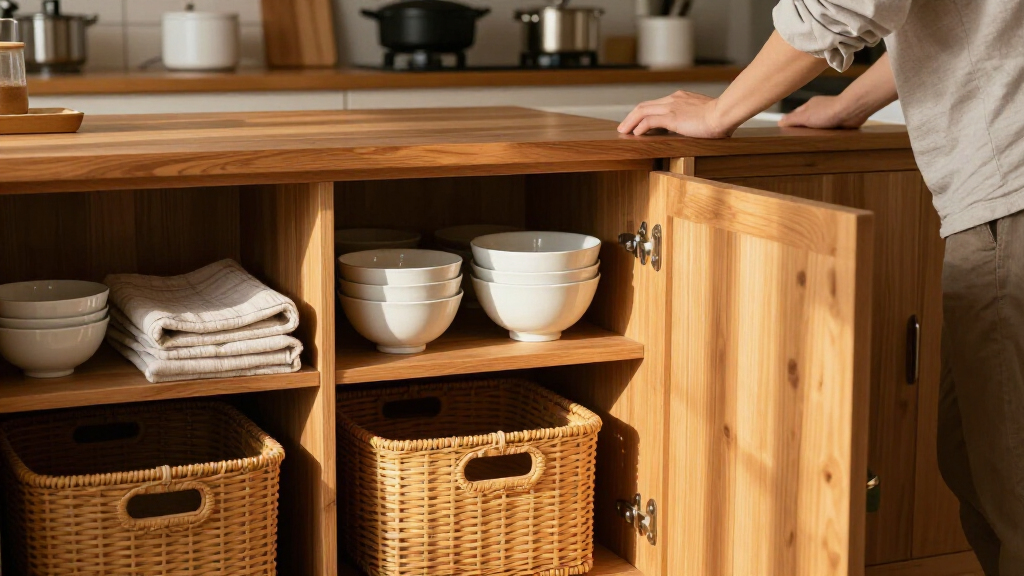
The report’s second and third lessons focus on choosing containers according to how they work and what they hold. Kloeden says dried goods and tea can be stored in paulownia wood boxes, while clear containers are useful when visibility is the priority. She also recommends giving frequently used cooking ingredients accessible vessels: salt and sugar, which can clump, can go in ceramic jars, while a container with an easy-to-lift lid can make repeated use simpler.
The final lessons are to choose cookware that can also serve food and to keep counters selective. Kloeden describes vessels that can store leftovers, reheat food or move from cooking to the table, reducing transfers and dishes. For counter space, she relays a test attributed to Nakagawa: an item should be used daily and contribute visually. The report says branded packaging can be put away rather than left on display.
Fewer Organizers, More Usable Space
The advice matters because kitchen storage problems are often treated as a shortage of shelves or containers. The Livingetc report instead frames editing possessions and matching storage to use as the starting point. For readers with limited cupboard or counter space, that can offer a low-cost first step before purchasing organizers.
Several suggestions also link storage to daily routines: putting often-used ingredients within reach, selecting lids that are easy to handle, and moving food from cooking vessel to table. These are practical design recommendations, not measured claims about time saved or a guarantee that a particular arrangement will suit every household.
The emphasis on restraint also addresses how a kitchen looks as well as how it functions. Keeping only frequently used or visually pleasing items out can make work surfaces feel less crowded, while cookware that serves more than one role may reduce the need for separate serving pieces.
Japanese style kitchen storage containers
As an affiliate, we earn on qualifying purchases.
As an affiliate, we earn on qualifying purchases.
The Report’s Five Design Principles
The source is a Livingetc advice report titled “5 Lessons from Japanese Kitchen Storage That Will Help You Organize Your Space.” It presents the lessons through comments from Kloeden, whose London architecture and interior design studio works with Japanese aesthetics, and Ogino, identified as Nakagawa’s executive vice president. The supplied material does not give the article’s publication date.
The five recommendations are to declutter before adding storage; assign containers according to their function; make frequently reached ingredients and tools easy to access; select cookware that can move from cooking to serving; and leave out only items that are both regularly used and visually considered. The article also refers to ichibutsu tayō, described as one object serving many uses, and to merihari, which Ogino translates as deliberate contrast.
These examples are presented as lessons to borrow, not as universal rules followed in every Japanese home. The source offers design commentary and examples, rather than household data or a comparison of storage practices across countries.
“Before you add storage, take one shelf and ask what each thing on it is for.”
— Yoko Kloeden, interior designer, as quoted by Livingetc
What the Advice Does Not Establish
The supplied report does not provide a publication date, research data, or an estimate of how much space or time these methods save. Its recommendations are attributed design opinions and examples, not tested outcomes. It also does not establish that all Japanese kitchens use these storage methods or that specific materials are suitable for every food, climate or household routine. Readers should check product guidance and food-storage requirements for the items they store.
How Readers Can Apply the Ideas
The report’s suggestions can be applied one area at a time: review a shelf before buying storage, group containers by their job, move regular cooking essentials within comfortable reach, and assess which cookware can also serve food. For counters, readers can use the report’s two-part test—daily use and visual contribution—to decide what stays out. Livingetc also points readers toward the Japanese 5S method for further decluttering advice, but the supplied material gives no date or details for a follow-up report.
Key Questions
What are the five Japanese kitchen storage lessons in the report?
They are to declutter before adding organizers, choose containers for their function, keep frequently used cooking items accessible, use cookware that can also serve food, and leave only purposeful items on counters.
Should I buy organizers before sorting my kitchen?
The report recommends sorting first. Kloeden suggests reviewing one shelf and considering what each item is for before deciding whether additional storage is needed.
What should stay on the kitchen counter?
According to the approach Kloeden attributes to Nakagawa, an item should be used daily and have visual presence to earn a place on the counter. The report gives utensil holders and condiment jars as examples.
Does the report prove these methods work in every home?
No. It presents design advice and examples from named professionals, but supplies no study or household data demonstrating that the methods work for everyone.
Source: rss
Fall Picks
fall essentials
As an affiliate, we earn on qualifying purchases.